Lake Lanao
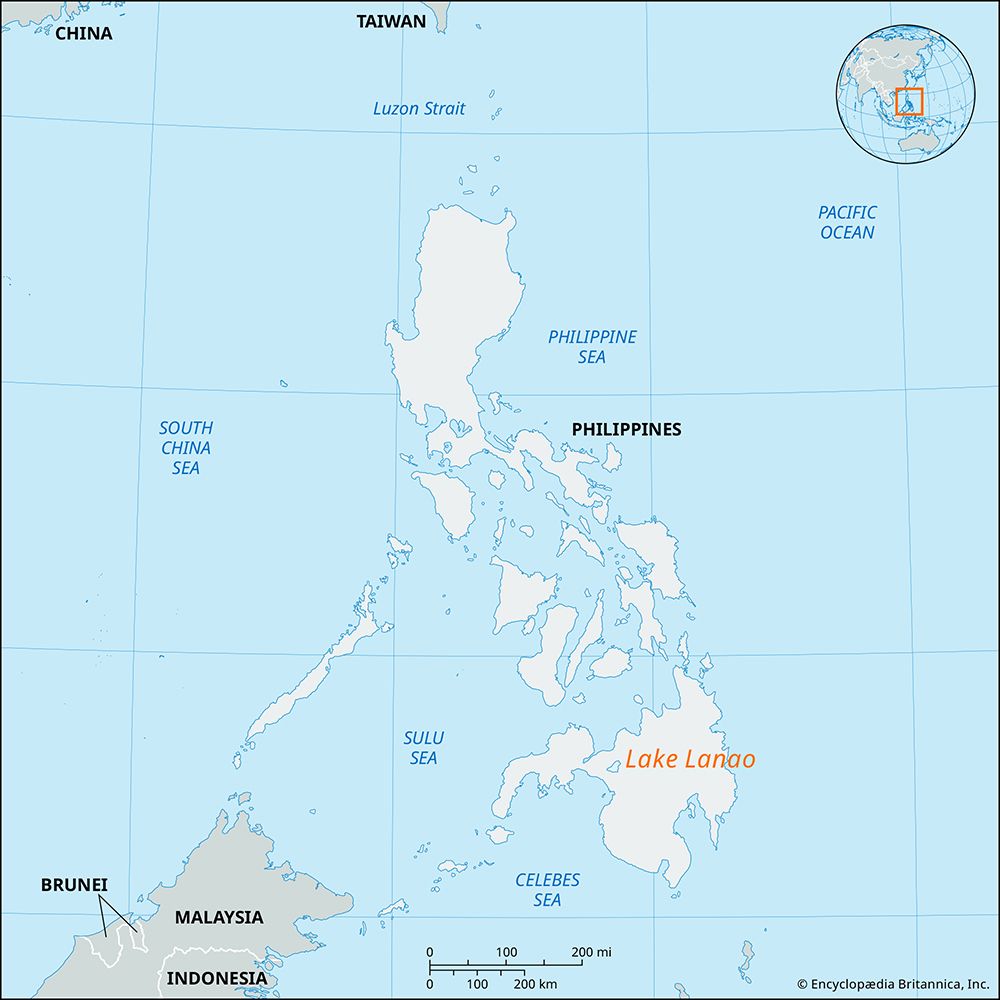
Lake Lanao is the second-largest lake in the Philippines, covering an area of 131 square miles (340 square km) in west-central Mindanao. Located just south…
What is Lake Lanao?
Lake Lanao is the second-largest lake in the Philippines, covering an area of 131 square miles (340 square km) in west-central Mindanao. Located just south of Marawi, the lake serves as the source of the Agus River, which flows north toward Iligan Bay and powers a hydroelectric power plant at Maria Cristina Falls.1
The region surrounding the lake is home to the Maranao, the largest Muslim cultural-linguistic group in the Philippines. The Maranao people maintain distinct cultural and Islamic traditions, with their livelihoods centered on rice farming, metalworking, and woodworking. Their social structure is characterized by clan-based land ownership overseen by local leaders known as datus.2
How was Lake Lanao formed geologically?
Sorry, the Britannica knowledge base does not contain information regarding the specific geological formation of Lake Lanao.
What makes the Agus River important for energy?
The Agus River is a critical source of hydroelectric power in the Philippines because it serves as the primary outlet for Lake Lanao. As the river flows northward from the lake, it descends over the Maria Cristina Falls, where a hydroelectric plant is situated to harness the energy generated by the water’s flow toward Iligan Bay.4
Please note that the Agusan River, which is the longest river in Mindanao, is distinct from the Agus River and is primarily noted for its role in the region’s forestry and agricultural industries rather than hydroelectric energy production.1
What are some unique traditions of the Maranao people?
The Maranao people, the largest Muslim cultural-linguistic group in the Philippines, maintain a distinct cultural identity centered around Lake Lanao on the island of Mindanao. Their traditions are characterized by several unique elements:
- Social Structure: The Maranao operate under a clan-based land ownership system controlled by local leaders known as datus.2
- Oral Traditions: Cultural identity is deeply preserved through storytelling, most notably the Darangen. This epic poem serves as a vital repository of local history and lore, addressing foundational questions about the world and human origins.5
- Craftsmanship: The community is well-regarded for its specialized skills in metalworking and woodworking, which remain central to their livelihood alongside rice farming.2
- Attire: The malong, a traditional garment, is a significant cultural symbol within the Maranao community, reflecting their history and identity.5
- Musical Heritage: As part of the southern Philippine tradition, the Maranao utilize the kulintang ensemble. This sophisticated musical form features a row of seven or eight gongs that provide melodic phrases, often accompanied by a cylindrical drum.6
Sources
- Lake Lanao — Encyclopædia Britannica
- Maranao — Encyclopædia Britannica
- Lake Mainit — Encyclopædia Britannica
- Agusan River — Encyclopædia Britannica
- Southeast Asian arts - The Philippines — Encyclopædia Britannica
- Philippines - Cultural life — Encyclopædia Britannica
Published on · 2 min read