McMurdo Station
McMurdo Station is the largest research and logistics installation in Antarctica. Located on the Hut Point Peninsula of Ross Island, it serves as the primary…
What is McMurdo Station?
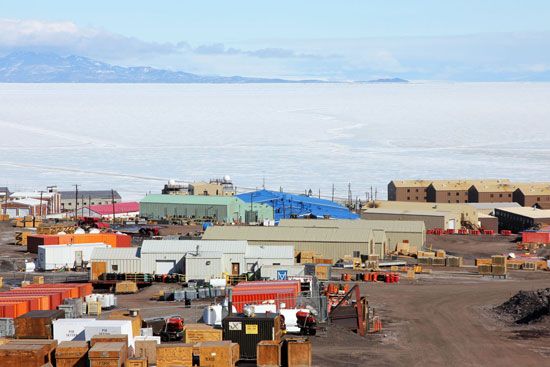
McMurdo Station is the largest research and logistics installation in Antarctica. Located on the Hut Point Peninsula of Ross Island, it serves as the primary hub for U.S. scientific expeditions and provides essential resupply support for other stations on the continent.1
Operated by the National Science Foundation, the station functions as a small town, hosting between 1,200 and 1,400 people during the peak summer season and a smaller, isolated crew during the winter. It features extensive infrastructure, including desalination plants, wastewater treatment facilities, and recreational amenities like a bowling alley.1
Established in 1955 as part of Operation Deep Freeze, the facility was named after British naval officer Archibald McMurdo. While it once utilized nuclear power, the station now relies primarily on diesel generators to maintain its operations in one of the world’s most inhospitable environments.21
Where is McMurdo Station located?
McMurdo Station is located on the Hut Point Peninsula at the southern tip of Ross Island, Antarcticaica.com/place/Ross-Island), Antarctica.1
Situated near the foot of Mount Erebus, the station occupies the southernmost point of solid ground on the continent. It is positioned just north of Cape Armitage and is approximately 1,360 km (845 miles) from the Amundsen-Scott South Pole station. The site was chosen for its proximity to a harbor capable of accommodating deep-keel ships, making it a vital logistics hub for the region.13
Why was McMurdo Station built in Antarctica?
McMurdo Station was established in 1955 to serve as a critical staging ground and logistics hub for scientific research in Antarctica. Its location on the Hut Point Peninsula of Ross Island was strategically chosen because it sits alongside a harbor capable of accommodating deep-keel ships, providing a reliable access point to the continent.2
The site has a long history as a gateway for exploration, dating back to its discovery in 1841. Following the success of various projects during the International Geophysical Year (1957–1958), the decision was made to maintain the station permanently as an operational and scientific research facility. Originally operated by the U.S. military as part of Operation Deep Freeze, the station now functions under the National Science Foundation to facilitate the movement of supplies and personnel to other research stations across the continent.2
What types of research do scientists conduct at McMurdo Station?
Researchers at McMurdo Station conduct a wide variety of projects focused primarily on Earth sciences, atmospheric sciences, and environmental sciences.2
Beyond these specific fields, the station serves as a vital hub for broader scientific inquiry. Because it functions as the primary logistics center for the continent, it supports researchers traveling to and from various other Antarctic stations and remote field missions. While a significant portion of the population is dedicated to the essential support roles—such as mechanics, firefighters, and culinary staff—required to sustain life in such an inhospitable environment, the station itself remains a central site for ongoing observation and data collection.2
Sources
- McMurdo Station — Merriam-Webster
- McMurdo Station — Encyclopædia Britannica
- McMurdo Sound — Encyclopædia Britannica
- Ross Island — Encyclopædia Britannica
- Antarctica - Early geographic discoveries — Encyclopædia Britannica
Published on · 2 min read