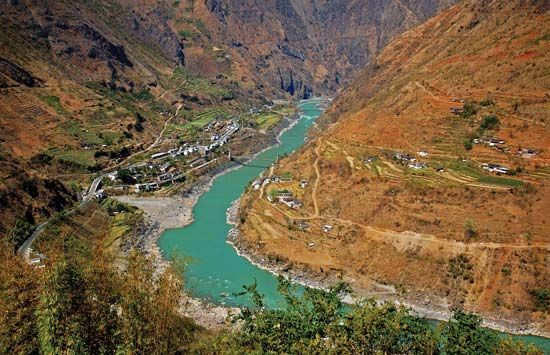
Min River
It is important to clarify that there are two distinct rivers in China referred to as the Min River. The information below details the tributaries for both:
What are the main tributaries of the Min River?
It is important to clarify that there are two distinct rivers in China referred to as the Min River. The information below details the tributaries for both:
Min River (Fujian Province)
The Min River in southeastern China features a trellislike drainage pattern. Its primary headwaters and tributaries include:
- Futun River and Jin River: These serve as the headwaters flowing from the western mountain ranges.1
- Sha River: Drains the major interior valley basin from the southwest.1
- Jian River: Drains the northern mountains along the border of Jiangxi and Zhejiang1.
Min River (Sichuan Province)
The Min River located in the Min Mountains of southwestern China is a tributary of the Yangtze River. While the Britannica records note that this river is fed by various tributaries within the mountain range, specific names for these individual tributaries are not detailed in the provided search results.2
How has the Min River influenced the culture and history of the Fujian region?
The Min River has been a foundational element of the Fujian region’s development, serving as a vital artery for transportation, commerce, and cultural exchange for centuries.1
Economic and Historical Significance
- Transportation and Trade: Historically, the river provided the primary means of transport through Fujian’s rugged interior. It connected inland production centers—such as those producing timber, bamboo, and paper—to the coastal port of Fuzhou—to the coastal port of Fuzhou. During the 19th century, Fuzhou’s status as a treaty port made it a chief hub for the tea trade, as the river offered a more efficient route than overland transport to Guangzhou.143
- Urban Development: The river’s confluence at Nanping created a strategic node for regional communications, while Fuzhou, situated near the river’s estuary, grew into a major political and cultural center.34
- Modernization: In the 1860s, the Fuzhou Navy Yard was established on the river as a pioneering center for Western-style technical education and shipbuilding. Today, the river continues to support the region through the Shuikou hydroelectric station, which provides essential power for Fuzhou’s industrial growth.3
How does the Min River contribute to the economy and agriculture of Fujian province?
The Min River is vital to the economy and agriculture of Fujian province, covering approximately half of the province’s total area.16
Agricultural Importance
The river system provides essential water supplies for domestic use and is critical for the irrigation of the extensive rice fields located in the alluvial plains along its course. Furthermore, the river’s tributaries, particularly those within the Jian River subsystem, drain the renowned Wuyi Mountains tea-growing districts, supporting a major regional industry.6
Economic and Transport Role
Historically, the river served as the primary transportation network for the province. While its upper reaches traditionally supported junk traffic, the lower course near Fuzhou was improved in the 1950s to accommodate small ships. Today, cities like Nanping and Sanming function as key transshipment hubs, where goods are transferred between river vessels and the railroad network that links the interior to coastal ports1.61
What is the length of the Min River and how does it compare to other major rivers in China?
The Min River of Fujian province has a total length of approximately 360 miles (580 km) and a drainage basin covering about 21,600 square miles (56,000 square km).1
When compared to China’s major river systems, the Min River is a regional waterway rather than a national-scale artery. China’s three principal rivers—the Huang He, the Yangtze, and the Xi River—are significantly larger, traversing vast portions of the country and serving as major national transport and agricultural hubs. For instance, the Yangtze, which is the longest river in China and Asia, spans 3,915 miles (6,300 km) and drains an area of nearly 700,000 square miles.78
It is also important to distinguish the Min River of Fujian from the Min River located in Sichuan province; the latter is a major tributary of the Yangtze River. While the Fujian-based Min River is essential to the local economy and geography of southeastern China, its scale and reach are localized compared to these primary national rivers.8617
Sources
- Min River — Encyclopædia Britannica
- Min Mountains — Encyclopædia Britannica
- Fuzhou — Encyclopædia Britannica
- Nanping — Encyclopædia Britannica
- Fujian - History of Fujian — Encyclopædia Britannica
- Fujian - Drainage — Encyclopædia Britannica
- China - Drainage — Encyclopædia Britannica
- Yangtze River — Encyclopædia Britannica
Published on · 3 min read