Mountain Zebra National Park
Mountain Zebra National Park is a protected area located in the Eastern Cape province of South Africa. Situated within the semiarid Great Karoo region, the…
What is Mountain Zebra National Park?
Mountain Zebra National Park is a protected area located in the Eastern Cape province of South Africa. Situated within the semiarid Great Karoo region, the park covers approximately 25 square miles (65 square km).1
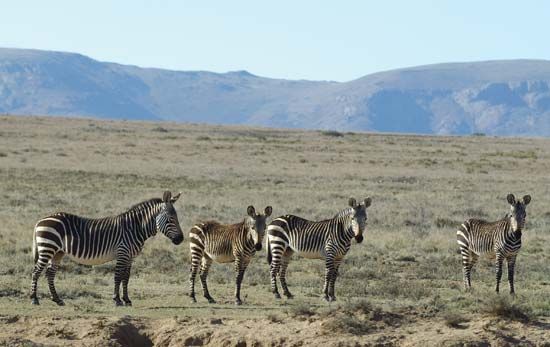
Established in 1937, the park was created primarily to conserve the mountain zebra, a species characterized by a stocky build and a unique stripe pattern on its rump. This conservation effort is critical, as the subspecies E. zebra zebra was once common in the Cape region but faced severe population decline, leaving only a small remnant population today. In addition to zebras, the park serves as a habitat for various wildlife, including black wildebeests, elands, and other antelope species, set against a landscape of shrubs, grasses, and acacia trees.12
How do mountain zebras differ from plains zebras?
Mountain zebras and plains zebras are distinct species within the genus Equus that differ primarily in their physical appearance, habitat, and geographic range.3
Physical Differences
The most notable differences between the two species are their stripe patterns:
- Plains Zebra: Features wide, widely spaced stripes. Some subspecies exhibit lighter “shadow stripes” between the main black stripes. In southern populations, the striping on the lower legs often fades into white.3
- Mountain Zebra: Possesses smaller, more closely spaced stripes on the head and shoulders, which become widely spaced on the haunches. A defining characteristic is a unique, gridlike pattern of stripes on the rump.3
Habitat and Range
- Plains Zebra: Inhabits rich grasslands across much of eastern and southern Africa.3
- Mountain Zebra: Prefers dry, upland plains and is found in Namibia and scattered areas of western South Africa. Unlike the plains zebra, mountain zebras are known to excavate pits in dry streambeds to access subsurface water during the dry season.3
Both species live in small family groups consisting of a stallion and several mares, and they share similar dietary adaptations for processing high-fiber grasses.3
What is the Great Karoo region like?
The Great Karoo is an arid to semiarid plateau basin located in South Africa’s Western Cape province, situated between the Great Escarpment to the north and the Swartberg mountains to the south.4
Geography and Climate
The region is characterized by its dry environment, with annual rainfall ranging from as little as 4 inches (100 mm) in the west to 16 inches (400 mm) in the east. The landscape is typical of semidesert regions, featuring vegetation composed of succulents and low scrub bushes spaced apart. The area is largely devoid of surface water, a trait reflected in the name “Karoo,” which is derived from a Khoisan word meaning “land of thirst.”45
Economy and Land Use
Despite its aridity, the Great Karoo is a significant grazing area, particularly for sheep and goats. Agriculture is highly dependent on irrigation along stream courses, where farmers cultivate grains and fruit. Key towns in the region include Graaff-Reinet, Beaufort West, and Aberdeen.45
Why are some zebra species endangered?
All three zebra species have experienced declines in abundance due to human activities, though their conservation statuses vary based on population trends and specific threats.3
- Grevy’s Zebra: Currently listed as an endangered species by the International Union for Conservation of Nature (IUCN).3
- Mountain Zebra: This species was previously listed as endangered during the 1990s and early 2000s. Due to population increases, it was reclassified as vulnerable in 2008. Historically, the Cape Mountain zebra (E. zebra zebra) faced severe decline, surviving only as a small remnant population, while Hartmann’s mountain zebra (E. zebra hartmannae) has faced pressure from conflicts with farm livestock over limited pasture in semidesert regions.32
- Plains Zebra: While still relatively abundant, the species has seen its range shrink considerably, and its populations have been reduced in many areas. Conservationists are particularly focused on protecting their large-scale migration corridors in East Africa, as these behaviors are considered endangered.32
Sources
- Mountain Zebra National Park — Encyclopædia Britannica
- perissodactyl - Zebras — Encyclopædia Britannica
- zebra — Encyclopædia Britannica
- Great Karoo — Encyclopædia Britannica
- Karoo — Encyclopædia Britannica
- Little Karoo — Encyclopædia Britannica
Published on · 3 min read