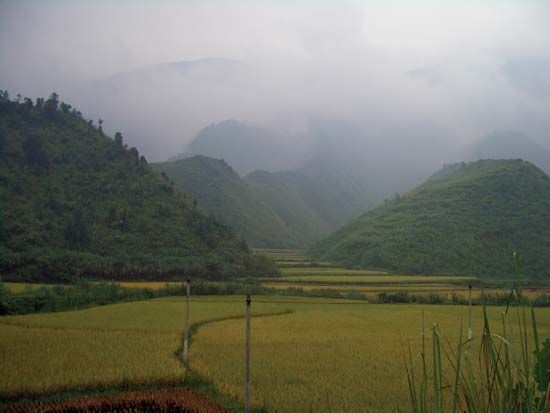
Mufu Mountains
The Mufu Mountains are a mountain range located in east-central China, situated along the borders of Hunan, Hubei, and Jiangxi provinces.
Where are the Mufu Mountains located in China?
The Mufu Mountains are a mountain range located in east-central China, situated along the borders of Hunan, Hubei, and Jiangxi provinces.1
The range extends over 125 miles (200 km) in a northeastward direction, stretching from the vicinity of Pingjiang in Hunan to the Yangtze River valley located west of Jiujiang. These rugged, forested mountains serve as a geographic divide between the Yangtze valley and the valley of the Xiu River.1
Are there any significant historical or cultural sites associated with the Mufu Mountains?
While the Mufu Mountains themselves are primarily recognized for their rugged terrain and forest products, they are geographically and culturally linked to significant sites, most notably the Lu Mountains.
The Lu Mountains form the eastern extremity of the Mufu range and are of immense historical and cultural importance:
- Religious and Intellectual History: From ancient times, the Lu Mountains were venerated as a holy area. Between the 6th and 8th centuries, they served as a major center for Buddhism and Daoism.
- Literary Significance: The area has deep associations with numerous famous poets and literary figures who referred to the mountains as Kuanglu.
- World Heritage Status: Due to their unique combination of natural beauty and cultural history, the Lu Mountains were designated a UNESCO World Heritage site in 1996.
- Resort History: Before World War II, the mountains hosted hundreds of temples and shrines and became a popular summer retreat for Western residents of coastal cities, a role the area continues to fulfill today.
How do the Mufu Mountains compare to other mountain ranges in China in terms of size and importance?
In the context of China’s vast and complex topography, the Mufu Mountains are a regional range rather than a major national landmark. While China is home to world-renowned, massive mountain systems—such as the Kunlun Mountains or the Qin Mountains, which serve as critical climatic and topographic divides—the Mufu range is more localized in its influence.156
Size and Elevation
The Mufu Mountains extend over 125 miles (200 km) with an average elevation of approximately 3,300 feet (1,000 meters). Their highest peaks, such as Mount Mufu (5,236 feet/1,596 meters) and Mount Jiugong (5,062 feet/1,543 meters), are modest compared to the towering ranges of western China, where peaks can reach heights of over 29,000 feet.15
Regional Importance
The importance of the Mufu Mountains is primarily economic and geographic:
- Economic: They serve as a vital source of timber, wood oil, and tea production.1
- Geographic: They act as a physical divide between the Yangtze River valley and the valley of the Xiu River.1
- Cultural: Their significance is amplified by the Lu Mountains, which form the range’s eastern extremity. Unlike the Mufu range as a whole, the Lu Mountains are a UNESCO World Heritage site of global cultural and historical renown.3
What is the highest peak in the Mufu Mountains and its elevation?
The highest peak in the Mufu Mountains is Mount Mufu, which reaches an elevation of 5,236 feet (1,596 meters).1
Sources
- Mufu Mountains — Encyclopædia Britannica
- Hunan - Cultural life — Encyclopædia Britannica
- Lu Mountains — Encyclopædia Britannica
- Jiangxi - Cultural life — Encyclopædia Britannica
- China - Relief of China — Encyclopædia Britannica
- Lüliang Mountains — Encyclopædia Britannica
- Qin Mountains — Encyclopædia Britannica
- Jiuling Mountains — Encyclopædia Britannica
Published on · 2 min read