Nevado De Toluca National Park
Nevado de Toluca National Park is a protected area located in the state of México, central Mexico. Established in 1936, the park spans 259 square miles (671…
What is Nevado de Toluca National Park?
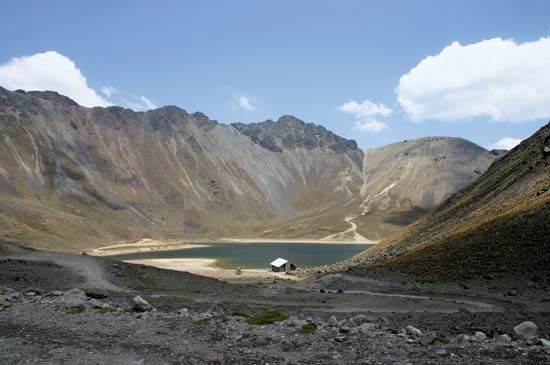
Nevado de Toluca National Park is a protected area located in the state of México, central Mexico. Established in 1936, the park spans 259 square miles (671 square km) and is situated west of Mexico City in the municipality of Zinacantepec.1
The park’s primary landmark is the Nevado de Toluca volcano. While often described as a dormant, snowcapped peak reaching 14,977 feet (4,565 meters), some sources identify it as an extinct volcano reaching 15,016 feet (4,577 meters). The volcano’s crater contains two picturesque lakes, and its rim is accessible via a road considered the highest in the country. The lower slopes of the mountain are characterized by dense forests of pine and fir trees.12
How do volcanic craters form lakes?
Volcanic craters and calderas form lake basins through several geological processes. When volcanic activity ceases, these depressions can accumulate water from precipitation, eventually creating a lake.34
The formation of these basins generally occurs in the following ways:
- Crater Collapse: Large depressions called calderas often form when the roof of an underground magma chamber collapses following a massive eruption. These deep, circular basins are prime sites for lake formation, as seen at Crater Lake in Oregon.3
- Explosive Craters: Some basins are created by violent volcanic explosions. A specific type known as a maar forms when an explosion creates a depression in nonvolcanic material, which then fills with water.3
- Lava Flow Obstruction: Lake basins can also arise when lava flows from fissures or craters interrupt existing drainage patterns, effectively damming water in a depression.3
- Secondary Features: Within larger caldera basins, renewed volcanic activity may create secondary cinder cones, such as Wizard Island, which rise above the water level.34
What are the differences between dormant and extinct volcanoes?
The provided search results do not contain specific definitions or distinctions between dormant and extinct volcanoes. While the results discuss the mechanisms of volcanic eruptions and categorize various volcanic landforms, they do not explicitly define the terms “dormant” or “extinct” in the context of volcanic activity levels.
Sorry, the Britannica knowledge base does not contain this information.
What types of wildlife live in high-altitude Mexican forests?
High-altitude forests in Mexico, particularly those found in the Sierra Madre Occidental, support a variety of wildlife adapted to these mountainous environments. While human activity and deforestation have impacted these regions, they remain critical habitats for several species.
Notable wildlife and migratory patterns in these high-elevation areas include:
- Migratory Species: The northern regions of the Sierra Madre Occidental serve as a destination for countless ducks and geese that migrate annually. Additionally, millions of endangered monarch butterflies travel to forested peaks in the western Mesa Central—specifically in eastern Michoacán—to overwinter in the Monarch Butterfly Biosphere Reserve.8
- Mountain Fauna: In mountainous areas where human disturbance is lower, larger animals such as deer, pumas, and coyotes are frequently found.8
- General Mountain Biodiversity: High-altitude ecosystems often act as “islands” of cool climates, harboring distinct biota adapted to colder temperatures. These areas can serve as refuges for species that have been displaced from lower elevations by environmental changes or human activity.9
Sources
- Nevado de Toluca National Park — Encyclopædia Britannica
- Toluca, Nevado de — Merriam-Webster
- lake - Basins formed by tectonism , volcanism, and landslides — Encyclopædia Britannica
- Crater Lake — Encyclopædia Britannica
- Crater — Encyclopædia Britannica
- What Causes a Volcano to Erupt? — Encyclopædia Britannica
- volcano - Major types — Encyclopædia Britannica
- Mexico - Plant and animal life — Encyclopædia Britannica
- New Mexico - Plant and animal life — Encyclopædia Britannica
- Mountain ecosystem - Origin — Encyclopædia Britannica
Published on · 2 min read