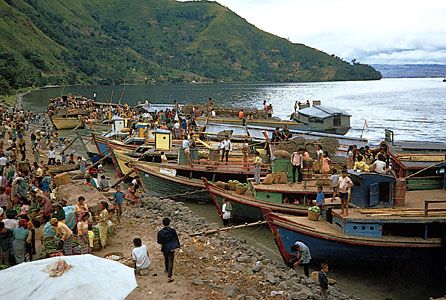
Nias
Nias is an island located in the Sumatera Utara province of Indonesia, situated in the Indian Ocean off the western coast of Sumatra.
Where is Nias Island located, and what is its geographical significance in Indonesia?
Nias is an island located in the Sumatera Utara province of Indonesia, situated in the Indian Ocean off the western coast of Sumatra1.1
Geographically, it is the largest island in a chain that parallels the Sumatran coast. Its topography is similar to western Sumatra, though notably, it lacks volcanoes, with its highest elevation reaching 2,907 feet (886 metres). The island’s coastline is characterized by rocky or sandy terrain that lacks natural ports, requiring ships to anchor offshore at locations such as Guningsitoli and Telukdalem.2
Beyond its physical features, Nias is culturally significant for its megalithic monuments and traditional architecture, including houses built on piles. The island is also recognized as a popular destination for surfers, though it remains vulnerable to seismic activity, having been devastated by a tsunami following an undersea earthquake in 2004.2
How did the 2004 Indian Ocean tsunami and 2005 earthquake affect Nias Island?
In 2004, the coastal areas of Nias Island were devastated by a tsunami generated by a massive undersea earthquake that occurred nearby. While the 2004 Indian Ocean tsunami caused widespread destruction across the region, the provided search results do not contain specific details regarding a separate 2005 earthquake event on Nias Island.1
The 2004 disaster resulted in immense loss of life and severe environmental damage across the Indian Ocean rim, with coastal regions experiencing demolished infrastructure, inundated farmland, and the destruction of livelihoods. The event underscored the critical need for improved disaster management, leading to the establishment of the Indian Ocean Tsunami Warning and Mitigation System to enhance regional preparedness and community resilience.3
How has tourism developed on Nias Island, and what are its main attractions?
Tourism has emerged as a significant contributor to the economy of Nias, primarily driven by the island’s natural coastal beauty and unique cultural heritage.
The island’s main attractions include:
- Surfing: The coasts of Nias are widely recognized as premier destinations for surfers, drawing enthusiasts to its challenging waves and scenic shoreline.1
- Megalithic Culture: Visitors are often drawn to the island’s distinct megalithic monuments and traditional wooden sculptures, which serve as cultural landmarks honoring the dead or representing fertility.1
- Traditional Architecture: The island features unique, historically significant architecture. In southern Nias, villages are notable for their large, pile-built houses, particularly the elaborate homes of village chiefs, which are characterized by high roofs and massive, intricately carved pillars and beams.1
- Village Layouts: The distinct spatial organization of Nias villages—ranging from hilltop settlements in the north with stone-paved rectangles to larger southern villages that may include communal bathing pools—offers a glimpse into the island’s traditional social structure.1
How does the traditional architecture of Nias differ from other Indonesian islands?
The traditional architecture of Nias is distinct from the architectural traditions found on other Indonesian islands, such as Java or Sumatra, which were heavily influenced by the evolution of mosques and court complexes (kratons).14
Key characteristics that differentiate Nias architecture include:
- Pile Construction: Houses in Nias are built on piles, a design that contrasts with the walled courtyard and pavilion (pendopo) layouts common in Javanese and Balinese complexes.14
- Chief’s Houses: The homes of village chiefs in Nias are uniquely massive, featuring high roofs and supported by large, intricately carved pillars and beams, serving as a focal point of the village.1
- Village Organization: Unlike the mosque-centered layouts of many Indonesian communities, Nias villages are organized based on their geography. Northern villages are typically small and situated on hilltops, enclosing a stone-paved rectangle, while southern villages are larger and may incorporate communal bathing pools.1
- Lack of Islamic Influence: While much of Indonesian architecture from the 15th century onward reflects the integration of Islamic design—such as multitiered roofs (meru) and ceremonial gateways—Nias architecture remains rooted in its own distinct Austronesian traditions, often associated with megalithic cultural practices.14
Sources
- Nias — Encyclopædia Britannica
- Nias — Merriam-Webster
- Indian Ocean tsunami of 2004 — Encyclopædia Britannica
- Southeast Asian arts - 16th century to the present — Encyclopædia Britannica
Published on · 3 min read