Oregon Caves National Monument
Oregon Caves National Monument is a protected cave complex located in the Siskiyou Mountains of southwestern Oregon, near the border of California.
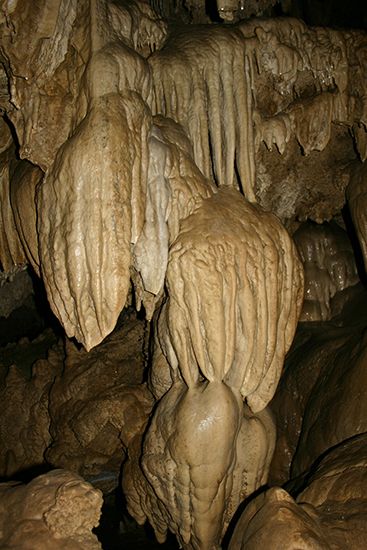
What is the Oregon Caves National Monument and where is it located?
Oregon Caves National Monument is a protected cave complex located in the Siskiyou Mountains of southwestern Oregon, near the border of California1.
Established in 1909, the monument covers 0.8 square miles and features a complex system of chambers and corridors spanning four levels. The cave was formed through the dissolution of marble by groundwater, resulting in approximately 3.5 miles of passages filled with diverse formations such as stalactites, stalagmites, and flowstones. The surface area above the caves is characterized by old-growth forests, including Douglas fir, cedar, oak, and pine, which provide a habitat for wildlife like the Pacific giant salamander.1
How does the Oregon Caves National Monument compare to other cave systems in the United States?
The Oregon Caves National Monument is distinct from many other U.S. cave systems due to its geological composition and formation. While many famous American caverns, such as those found in the Appalachian Mountains, are formed by the dissolution of limestone, the Oregon Caves were created through the dissolution of marble by groundwater.
Furthermore, the monument differs from the volcanic lava tubes commonly found elsewhere in the Pacific Northwest, such as those in the Bend region of Oregon or Ape Cave in Washington. Lava tubes are formed by volcanic processes, whereas the Oregon Caves are a solutional cave system featuring a series of chambers and corridors spanning four levels, decorated with stalactites, stalagmites, and flowstones. While the Appalachian caverns also feature dramatic underground passages and formations, the Oregon site is unique for its specific marble-based geology and its location within the Siskiyou Mountains.
How has the Oregon Caves National Monument contributed to scientific research and understanding?
The Oregon Caves National Monument serves as a valuable site for scientific inquiry, particularly within the fields of geology and paleoclimatology.6
While the monument is primarily recognized for its complex system of chambers and corridors formed by the dissolution of marble, it functions as a natural archive that helps researchers reconstruct Earth’s history. Scientists utilize stalagmites found within such cave systems as proxy evidence to study past climatic conditions. By analyzing the geochemical signatures preserved in these formations, researchers can gain insights into historical climate patterns that predate modern instrumental records.15
Furthermore, the study of cave environments—including the analysis of sedimentary deposits and solutional features like scallops—allows geologists to interpret ancient water flow directions and velocities. These investigations contribute to a broader understanding of karst landscapes and the complex geological processes that shape the Earth’s subsurface over millions of years.65
Are there any endangered species found within the Oregon Caves National Monument?
The provided information does not identify any endangered species within the Oregon Caves National Monument. While the monument is home to diverse wildlife, including flying squirrels and the Pacific giant salamander, the current data does not specify their conservation status or mention any endangered species residing in the area.1
Sources
- Oregon Caves National Monument — Encyclopædia Britannica
- Oregon Caves — Merriam-Webster
- Appalachian Mountains - Physiography — Encyclopædia Britannica
- cave - Other types of lava caves — Encyclopædia Britannica
- cave - Solutional sculpturings — Encyclopædia Britannica
- Climate change - Evidence for climate change — Encyclopædia Britannica
Published on · 2 min read