Overpopulation
Overpopulation is a condition in which the number of individuals of a given species exceeds the carrying capacity of its environment. When a population…
What is Overpopulation?
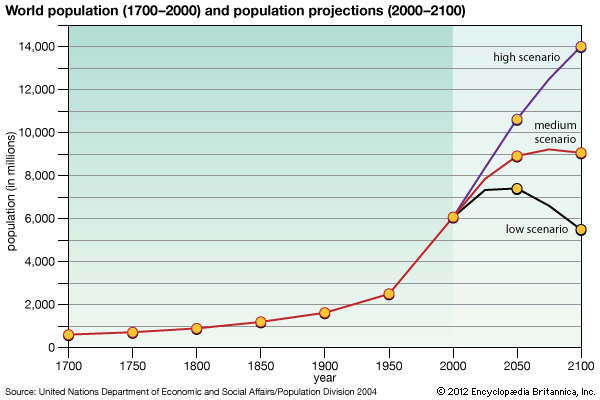
Overpopulation is a condition in which the number of individuals of a given species exceeds the carrying capacity of its environment. When a population surpasses the resources available to sustain it, the potential consequences include environmental deterioration, a decline in the quality of life, and a population crash—a sudden, sharp reduction in numbers resulting from high mortality and a failure to produce viable offspring.1
Historically, concerns regarding human population growth were famously shaped by Thomas Robert Malthus, who theorized about the natural limits imposed on population size. While the mid-20th century saw a significant “population explosion” that prompted debates over the economic and social pressures of rapid growth, global trends have since shifted. Today, many nations face the opposite challenge of declining fertility rates, which can lead to aging populations and labor shortages.2345
What is the demographic transition model?
The demographic transition theory is a historical generalization that describes the shift in population patterns as societies move from pre-industrial to industrialized states. It explains how fertility and mortality rates change in response to socioeconomic developments like industrialization, urbanization, and improved public health6.67
The transition is typically categorized into stages, often visualized through population pyramids:
- Stage 1: High birth rates and high death rates result in slow population growth and a small total population. The population pyramid is broad-based and sharply tapering.68
- Stage 2: Improvements in medical knowledge and food supply drastically reduce the death rate, while birth rates remain high. This leads to a population explosion and a rapidly growing, youthful population.68
- Stage 3: As societies urbanize, birth rates decline due to changing economic values and increased access to education. Population growth flattens, and the population structure stabilizes with a larger proportion of older individuals.68
While originally based on the European experience, the model has been refined to account for cultural factors, such as the spread of nuclear family ideals and the social acceptance of fertility control.7
How does the total fertility rate affect a country’s economy?
The total fertility rate (TFR) significantly influences a country’s economic growth and stability by shaping the size and age structure of its workforce.92
Impacts of Low Fertility
When a country’s TFR falls below the replacement rate of 2.1, the population eventually shrinks and ages. This creates several economic challenges:
- Labor Shortages: A declining number of young workers entering the labor market can stunt innovation and overall productivity.2
- Fiscal Burden: An aging population increases the demand for pensions, healthcare, and social security. These costs must be supported by a shrinking base of working-age taxpayers, potentially straining national budgets.92
Potential Benefits and Opportunities
Conversely, some scholars note that lower fertility can offer economic advantages:
- Resource Efficiency: Smaller populations may reduce pressure on finite environmental resources, such as land and food, and allow for more efficient investment in human capital.2
- Demographic Dividend: Countries with a large proportion of working-age adults relative to dependents can experience a “demographic dividend,” where increased labor force participation—particularly among women—can drive a significant rise in gross domestic product per person.2
What is the Malthusian theory of population growth?
Malthusianism is an economic theory developed by Thomas Malthus that posits population growth will inevitably outpace the food supply. Malthus argued that while population increases in a geometric progression, the means of subsistence only increase in an arithmetic progression, meaning society will always expand to the limit of its resources.10
To manage this, Malthus identified two types of checks:
- Preventive checks: These include “moral restraint,” such as delayed marriage and celibacy, which he advocated to limit population growth.10
- Positive checks: If moral restraint is ignored, Malthus warned that society would face “positive checks”—such as war, famine, and epidemic—which increase mortality.10
The theory has been criticized for failing to anticipate the agricultural revolution, which allowed food production to keep pace with population growth, and the widespread adoption of birth control, which lowered fertility rates.10
Sources
- Overpopulation — Encyclopædia Britannica
- Are Declining Birth Rates a Problem? — Encyclopædia Britannica
- population - Population theories — Encyclopædia Britannica
- population - Utopian views — Encyclopædia Britannica
- birth control - The population explosion — Encyclopædia Britannica
- modernization - Population change — Encyclopædia Britannica
- population pyramid — Encyclopædia Britannica
- population - Theory of the demographic transition — Encyclopædia Britannica
- fertility rate — Encyclopædia Britannica
- Malthusianism — Encyclopædia Britannica
- population - The Darwinian tradition — Encyclopædia Britannica
Published on · 3 min read