Population
Environmental factors influencing population size and distribution are generally categorized into density-dependent and density-independent forces.
What are some environmental factors that influence population size and distribution?
Environmental factors influencing population size and distribution are generally categorized into density-dependent and density-independent forces.12
Density-Dependent Factors
These factors influence population size in response to the number of individuals per unit area. They are often biological in nature and include:1
- Resource Competition: As density increases, competition for food, water, and nesting sites intensifies, which can limit growth.134
- Disease: Pathogens often spread more rapidly in crowded populations.14
- Predation: Predator-prey relationships, such as the cyclical fluctuations seen between the snowshoe hare and lynx, significantly impact population dynamics.34
Density-Independent Factors
These forces affect populations regardless of their density and typically stem from physical or chemical phenomena. Key examples include:12
- Climate and Weather: Seasonal variations and long-term climatic conditions dictate where species can survive.542
- Natural Disasters: Events such as flooding, wildfires, and landslides can cause sudden mortality.2
- Environmental Stress: Factors like pollution or changes in oxygen availability can limit population growth.42
These variables, alongside historical factors and species adaptability, determine the geographic distribution and size of populations.5
How do factors like birth rates, death rates, and migration affect population dynamics?
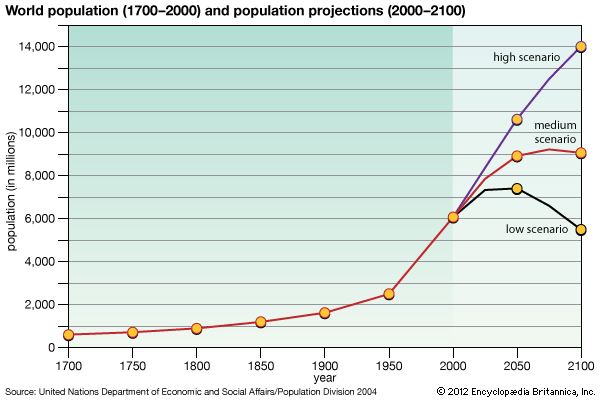
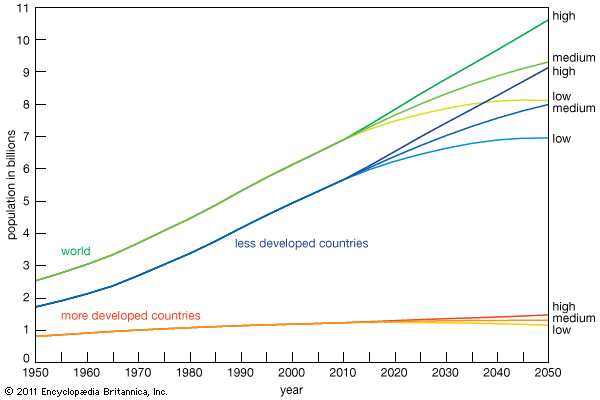
Population dynamics are fundamentally driven by three primary components: fertility (births), mortality (deaths), and migration. These factors determine not only the total size of a population but also its growth rate and demographic composition, such as age, sex, and geographic distribution.6
Natural Increase
The rate of natural increase is the difference between the birthrate and the death rate. In a closed population—one without migration—these two variables are the sole drivers of change. While birth and death rates are influenced by biological factors, they are also deeply shaped by socioeconomic conditions, such as industrialization, urbanization, and access to health care. For instance, declining infant mortality often leads to lower birth rates as families require fewer births to achieve a desired size.7689
The Role of Migration
Migration acts as an additional mechanism for population change in open systems. It involves the movement of individuals into (in-migration) or out of (out-migration) a region. While migration can significantly alter local population counts, its overall impact on global growth rates is generally smaller than that of fertility and mortality. Historically, migration has been a powerful force for cultural and technological exchange, though it has also been associated with periods of significant social disorder and mortality.6101112
What is the concept of carrying capacity in population ecology?
In population ecology, carrying capacity refers to the average population density or size of a species that an environment can sustainably support. Below this threshold, population numbers tend to increase, while above it, they tend to decrease due to shortages of essential resources like food, shelter, and water.1415
This concept is central to the logistic function, a mathematical model that describes how populations grow over time. The growth is represented by an S-shaped curve that levels off as the population reaches its maximum sustainable value, denoted as L in the equation:
P(t)=L(1+e−r(t−t0))P(t) = \frac{L}{(1 + e^{-r(t - t_0)})}
In this model, the growth rate is constrained by available resources, reflecting real-world conditions where populations stabilize rather than growing indefinitely. If a population exceeds its carrying capacity, it is considered to be in a state of overpopulation, which can lead to environmental degradation and potential population crashes.161
How do anthropologists study human populations and their cultural variations?
Anthropologists study human populations and cultural variations through a multidisciplinary approach that bridges the natural sciences and the humanities. The discipline is organized into several specialized branches, each employing distinct methodologies to understand the human experience.17
Core Research Methods
- Ethnography: The hallmark of cultural anthropology, this method involves long-term fieldwork where researchers immerse themselves in the daily lives of a community. Through participant-observation, anthropologists attempt to understand a society’s system of meaning while maintaining objective detachment.1819
- Archaeology: Researchers use excavation and surveys to analyze physical remnants, providing insights into how past populations lived and how cultures have evolved over time.1817
- Physical Anthropology: This branch examines human remains and biological data to study human evolution and variability. Modern studies also utilize genetics and DNA analysis to model historical population movements.181720
- Comparative Analysis: By comparing different societies, anthropologists identify patterns in social organization, religious beliefs, and cultural adaptations to local environments. This comparative approach helps challenge biases and fosters a more pluralistic understanding of human diversity.212219
Sources
- density-dependent factor — Encyclopædia Britannica
- population ecology - Logistic population growth — Encyclopædia Britannica
- biogeography — Encyclopædia Britannica
- Population growth — Encyclopædia Britannica
- density-independent factor — Encyclopædia Britannica
- population - Population growth — Encyclopædia Britannica
- population - Theory of the demographic transition — Encyclopædia Britannica
- population - Natural increase and population growth — Encyclopædia Britannica
- population - Early human migrations — Encyclopædia Britannica
- population - Infant mortality — Encyclopædia Britannica
- population - The basic components of population change — Encyclopædia Britannica
- population - Modern mass migrations — Encyclopædia Britannica
- population - Internal migrations — Encyclopædia Britannica
- carrying capacity — Encyclopædia Britannica
- logistic function — Encyclopædia Britannica
- Overpopulation — Encyclopædia Britannica
- Anthropology: Top Questions — Encyclopædia Britannica
- Anthropology - Genetics — Encyclopædia Britannica
- Anthropology - American cultural anthropology — Encyclopædia Britannica
- Ethnography — Encyclopædia Britannica
- comparative method — Merriam-Webster
- study of religion - Specialized studies — Encyclopædia Britannica
- Anthropology - Overview — Encyclopædia Britannica
Published on · 4 min read