P’eng-hu Islands
The provided search results do not contain specific historical population data or a year-by-year analysis of demographic trends for the P'eng-hu Islands over…
How has the population of the P’eng-hu Islands changed over the past century?
The provided search results do not contain specific historical population data or a year-by-year analysis of demographic trends for the P’eng-hu Islands over the past century. While the records note a population of approximately 6,000 inhabitants in 1683 and a recorded population of 81,738 in 2020, there is no information detailing the fluctuations or specific growth patterns during the intervening 100-year period.1
How does the climate and ecology of the P’eng-hu Islands differ from mainland Taiwan?
The P’eng-hu Islands and mainland Taiwan exhibit significant differences in climate and ecology, primarily due to the islands’ low elevation, exposure to harsh winds, and limited water resources.
Climate and Geography
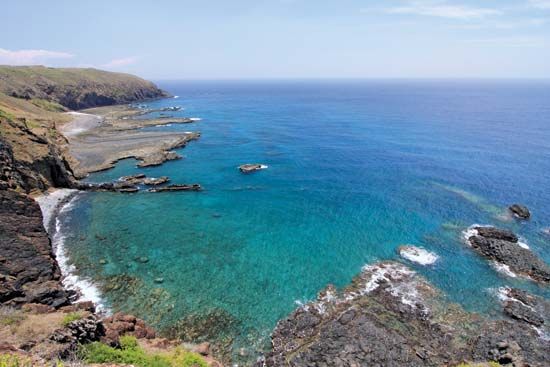
While Taiwan experiences abundant rainfall and warm temperatures that support extensive vegetation, the P’eng-hu Islands are characterized by a harsher environment. The islands are low-lying, with most rising only 100–130 feet above sea level, and they lack rivers entirely. Rainfall is significantly restricted, averaging about 35 inches annually, with nearly all precipitation occurring between June and September. For the remainder of the year, the islands face severe water shortages and are swept by intense winter winds.1
Ecological Impact
These conditions create a stark contrast in vegetation:
- Forestry: Unlike mainland Taiwan, which supports a vast variety of forests, the P’eng-hu Islands have very few trees. Persistent, strong winds inhibit forest growth, making the landscape much more barren.2
- Agriculture: The islands’ poor soils and harsh climate limit agricultural output to crops typically associated with poor hill country, such as sweet potatoes, peanuts, and millet.1
- Biodiversity: The smaller islands governed by Taiwan, including P’eng-hu, host a much lower variety of plant and animal life compared to the mainland.2
Where are the P’eng-hu Islands located, and how many islands make up this archipelago?
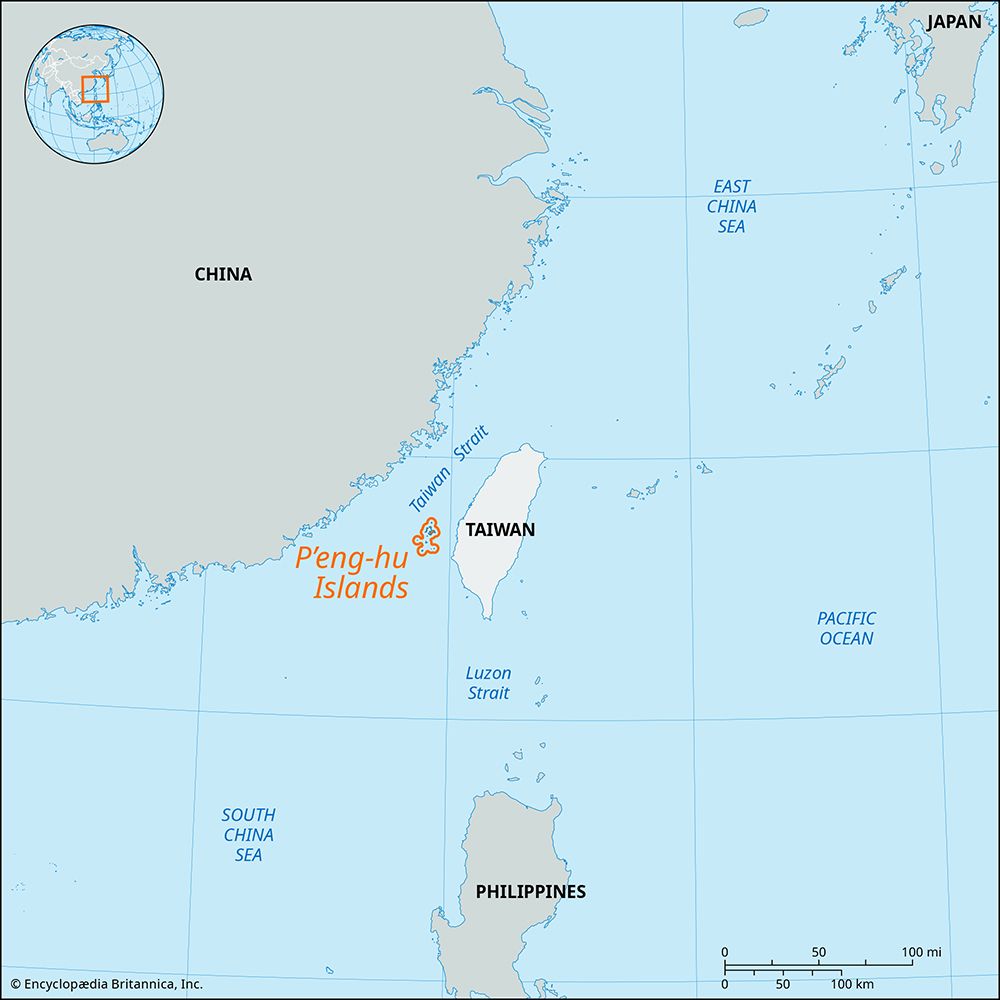
The P’eng-hu Islands are an archipelago and county (hsien) of Taiwan. They are located approximately 30 miles (50 km) west of the coast of mainland Taiwan, separated from it by the P’eng-hu Channel.
The archipelago consists of about 64 small islands, many of which are of volcanic origin and composed of weathered basalt surrounded by coral reefs.1
What are the main economic activities on the P’eng-hu Islands?
The economy of the P’eng-hu Islands is primarily supported by the following activities:
- Fishing: A large portion of the population is engaged in the fishing industry. Historically, the islands were so renowned for this activity that the Portuguese named them the Pescadores, meaning “Fishermen,” in the 16th century.1
- Agriculture: Although the islands have poor soil and a harsh climate, about half of the land is cultivated. The main crops include sweet potatoes, peanuts (groundnuts), corn (maize), and millet, which are typical of poor hill country.1
- Mining: The extraction and working of the islands’ phosphate deposits have historically provided a source of income for the region.1
Sources
- P’eng-hu Islands — Encyclopædia Britannica
- Taiwan - Plant and animal life — Encyclopædia Britannica
- Micronesia - Economy — Encyclopædia Britannica
Published on · 2 min read