Rockall
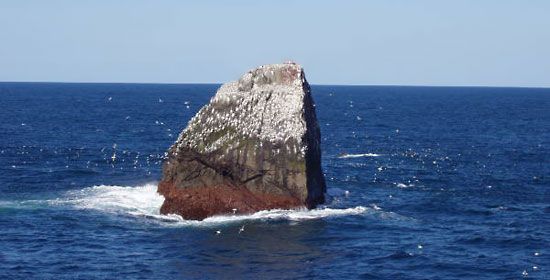
Rockall is an isolated granite islet situated in the North Atlantic Ocean, approximately 220 miles (354 km) west of the Outer Hebrides in Scotland.
What is Rockall?
Rockall is an isolated granite islet situated in the North Atlantic Ocean, approximately 220 miles (354 km) west of the Outer Hebrides in Scotland.1
The islet is quite small, measuring about 100 yards (91 metres) in circumference and rising roughly 70 feet (21 metres) above sea level. Although it is uninhabited, Rockall holds significant strategic and economic value; it was formally annexed by the United Kingdom in 1955 and incorporated into Scotland in 1972. This status serves as a foundation for claiming territorial waters and associated rights regarding fishing and oil exploration in the surrounding region.1
How does the United Nations Convention on the Law of the Sea define an island versus a rock?
The provided search results do not contain the specific definitions for an “island” versus a “rock” as outlined in the United Nations Convention on the Law of the Sea. While the results discuss the general legal framework regarding the continental shelf and the status of Rockall, they do not provide the criteria used to distinguish between these two maritime features.
Sorry, the Britannica knowledge base does not contain this information.
What kind of marine life is found in the waters surrounding Rockall?
The provided search results do not contain information regarding the specific types of marine life found in the waters surrounding Rockall. While the area is recognized for its economic importance regarding fishing rights, the available data does not detail the biological diversity or species present in that region.1
Why is granite significant in understanding the geology of the ocean floor?
Granite is significant in geology primarily because it serves as the defining material of the continental crust, distinguishing it from the oceanic crust. Understanding the presence and formation of granite helps geologists differentiate between these two primary types of Earth’s crust based on composition, density, and buoyancy.3
Key aspects of granite’s significance include:
- Compositional Contrast: While oceanic crust is primarily basaltic—rich in iron and magnesium—continental crust is broadly granitic, meaning it is richer in silica and lighter in density. This density difference (approximately 2.7 g/cm³ for granite versus 2.9–3.0 g/cm³ for basalt) causes continental crust to float higher in the mantle, creating the planet’s distinct landmasses.3
- Crustal Growth: Granite and related rocks, such as granodiorite, are central to the growth of continents. They form in batholiths at convergent plate boundaries, where subduction processes lead to the melting of oceanic slabs and overlying mantle, eventually adding new material to the continental margins.45
- Geological History: By studying granitic rocks, scientists can trace the history of subduction zones and the evolution of mountain belts, as these rocks provide evidence of past tectonic interactions and the recycling of crustal material.45
Sources
- Rockall — Encyclopædia Britannica
- continental shelf - The Law of the Sea — Encyclopædia Britannica
- oceanic crust — Encyclopædia Britannica
- continental crust — Encyclopædia Britannica
- geology - Igneous petrology — Encyclopædia Britannica
- granite — Encyclopædia Britannica
- igneous rock - Convergent plate boundaries — Encyclopædia Britannica
Published on · 2 min read