Robert D. Bullard
Robert D. Bullard (born 1946) is a prominent American sociologist and activist widely recognized as the father of environmental justice.
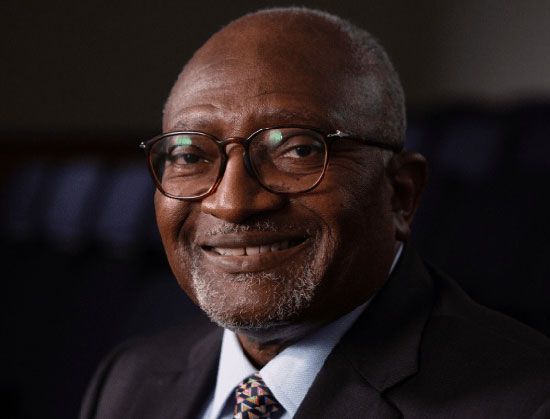
Who is Robert D. Bullard?
Robert D. Bullard (born 1946) is a prominent American sociologist and activist widely recognized as the father of environmental justice.1
After earning his Ph.D. in sociology, Bullard began his groundbreaking research in the late 1970s while teaching at Texas Southern University. His work revealed that communities of color were disproportionately burdened by environmental hazards, such as landfills and incinerators, regardless of their economic status. He documented these findings in his seminal 1990 book, Dumping in Dixie: Race, Class, and Environmental Quality, often called the “environmental justice bible”.1
Bullard’s activism helped shape national policy, including advising the Bill Clinton administration on Executive Order 12898, which mandated that federal agencies address environmental inequities. Throughout his career, he has cofounded the HBCU Climate Change Consortium and served on the White House Environmental Justice Advisory Council under President Joe Biden. In 2020, he received the United Nations Environment Programme’s Champions of the Earth award for his lifetime commitment to fighting environmental racism.1
What is Robert D. Bullard known for?
Robert D. Bullard is widely recognized as the father of environmental justice. An American sociologist and activist, he is best known for his pioneering research demonstrating that communities of color are disproportionately burdened by environmental hazards, such as landfills and chemical plants, regardless of their economic status.1
His career in this field began in the late 1970s at Texas Southern University, where he mapped the location of waste facilities in Houston. His findings, which revealed a clear pattern of environmental racism, were detailed in his seminal 1990 book, Dumping in Dixie: Race, Class, and Environmental Quality, often referred to as the environmental justice bible.1
Bullard’s advocacy has significantly influenced national policy:
- He advised the Bill Clinton administration on Executive Order 12898, which requires federal agencies to address environmental inequities.1
- He cofounded the HBCU Climate Change Consortium and helped relaunch the National Black Environmental Justice Network.1
- He was appointed by President Joe Biden to the White House Environmental Justice Advisory Council.1
In 2020, he received the United Nations Environment Programme’s Champions of the Earth award for his lifetime commitment to fighting environmental racism.1
What does it mean to be an environmental activist?
Being an environmental activist involves participating in a diverse movement dedicated to protecting the natural world and promoting sustainable social values. While the movement encompasses various philosophies, it is generally unified by four pillars: environmental protection, grassroots democracy, social justice, and nonviolence.2
Activists employ a wide range of strategies to achieve their goals, including:
- Direct Action: Engaging in unconventional protests to draw attention to or obstruct environmentally harmful policies and projects.2
- Lobbying and Policy: Working to influence government officials, participating in electoral politics through green parties, and advocating for stronger environmental regulations.2
- Education and Awareness: Running public-education and media campaigns, as well as promoting “green” consumerism and sustainable lifestyle projects like recycling.2
- Grassroots Organizing: Building coalitions to address local and global issues, such as poverty, human rights, and environmental justice—the latter of which specifically seeks to ensure that minority and underprivileged populations are not disproportionately burdened by pollution and industrial waste.23
Ultimately, an environmental activist works to transform how society interacts with nature, advocating for a world where all people have the right to live in a clean and safe environment.23
How did Robert D. Bullard help start the environmental justice movement?
Robert D. Bullard helped launch the environmental justice movement by providing the empirical evidence needed to prove that environmental hazards were systematically concentrated in communities of color.
His involvement began in 1979 when his wife, attorney Linda McKeever Bullard, asked him to map Houston’s waste facilities for a class-action lawsuit, Bean v. Southwestern Waste Management, Inc. Bullard and his students discovered that despite Black residents making up only a quarter of the city’s population, the vast majority of city-owned and private landfills and incinerators were located in Black neighborhoods.1
During the 1980s, Bullard expanded this research across the American South, confirming that race—independent of economic status—was a primary predictor for the siting of hazardous facilities. He synthesized these findings in his 1990 book, Dumping in Dixie: Race, Class, and Environmental Quality, which became a foundational text for the movement. His work transitioned into advocacy, leading him to advise the Bill Clinton administration on Executive Order 12898, which mandated that federal agencies address environmental inequities.1
Sources
- Robert D. Bullard — Encyclopædia Britannica
- environmentalism - History of the environmental movement — Encyclopædia Britannica
- environmental justice — Encyclopædia Britannica
Published on · 3 min read