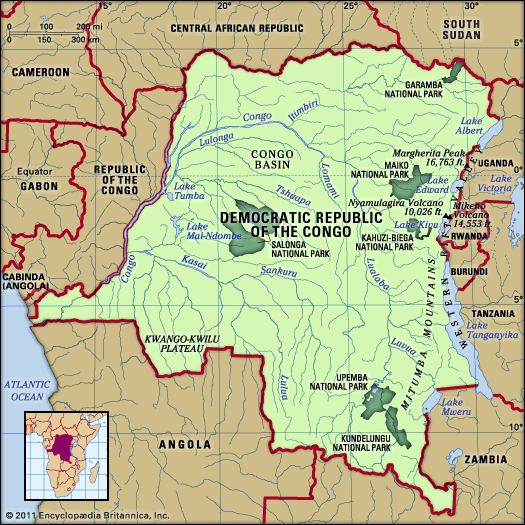
Salonga National Park
Salonga National Park is the largest nature reserve in the Democratic Republic of the Congo, covering more than 14,000 square miles (36,000 square km) within…
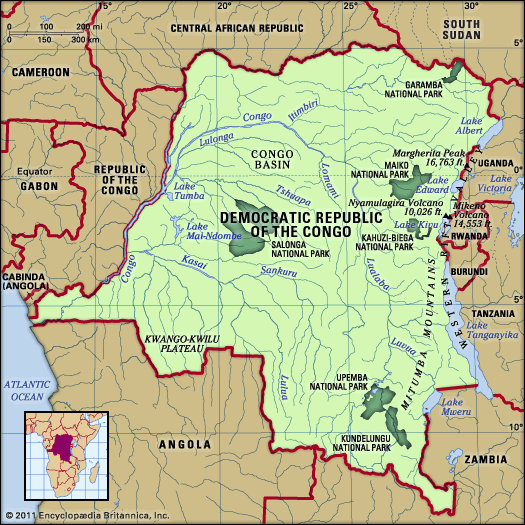
What is Salonga National Park?
Salonga National Park is the largest nature reserve in the Democratic Republic of the Congo, covering more than 14,000 square miles (36,000 square km) within the central Congo River basin. Established in 1970, the park consists of two separate sections located north and south of its administrative headquarters at Monkoto.12
The park is characterized by dense equatorial rainforest, which serves as a vital habitat for a diverse array of wildlife, including elephants, antelope, various monkeys, and parrots. It is particularly notable for being home to pygmy chimpanzees (bonobos), which are unique to this region. Because the park is accessible primarily by boat, visitors observe the local fauna from motorized river craft, and all hunting is strictly prohibited.12
Recognized for its ecological significance and its role in protecting endangered and endemic species, the park was designated a UNESCO World Heritage site in 1984.12
What are bonobos and why are they unique to this region?
The bonobo (Pan paniscus) is an ape closely related to the chimpanzee, though it was classified as a distinct species in 1933. Physically, bonobos are more slender than chimpanzees, possessing longer limbs, narrower chests, and rounder heads.4
Bonobos are unique to the Democratic Republic of the Congo, where they are found exclusively in the lowland rainforests situated along the south bank of the Congo River.4
Their social structure is notably different from that of chimpanzees. Bonobo society is egalitarian and peaceful; they do not exhibit the lethal aggression, infanticide, or cannibalism observed in chimpanzee communities. Instead, they utilize a variety of sexual behaviors to promote social bonding and maintain group cohesion. Furthermore, bonobo communities are often led by mature females, and individuals from separate groups frequently intermingle. Due to habitat loss and illegal hunting, the International Union for Conservation of Nature lists the bonobo as an endangered species, with populations estimated at just over 20,000 as of 2016.4
What does it mean for a species to be endemic to a specific area?
An endemic species is any taxon whose geographic range is strictly confined to a single, specific area. While these species may inhabit a small location like a single lake or an entire continent, they are defined by the fact that they are not found anywhere else in the world.5
It is important to distinguish endemic species from native or indigenous species. While native species evolved in a particular area, they may also exist in surrounding regions. Endemic species, however, are restricted to a specific habitat within their range.5
There are two primary categories of endemism:
- Paleoendemic species: Ancient, often relict species that were once widespread but have been reduced to a small area due to factors like habitat loss or climatic changes.5
- Neoendemic species: Newly evolved species that remain restricted to a specific area due to reproductive isolation.5
Because these species often possess specialized adaptations for unique habitats, they are highly susceptible to environmental disturbances and are frequently endangered.5
How do UNESCO World Heritage sites help protect endangered wildlife?
UNESCO World Heritage sites help protect endangered wildlife by providing a formal framework for international cooperation in the preservation and management of natural areas with “outstanding universal value.” Established under the 1972 Convention Concerning the Protection of the World Cultural and Natural Heritage, this program encourages nations to identify and safeguard critical habitats.67
These sites benefit from a structured approach to wildlife conservation, which includes:
- International Oversight: The designation serves as a global recognition of a site’s importance, often stimulating coordinated efforts to manage and protect its unique environment.67
- Financial Support: Funding for the conservation of these areas is supported by the World Heritage Fund, which utilizes contributions from member states and voluntary donations to assist in preservation goals.8
- Habitat Preservation: By designating specific regions—such as the Simien Mountains National Park, which protects several endangered species—UNESCO helps ensure that vital ecosystems remain intact against threats like habitat loss.9
Sources
- Salonga National Park — Encyclopædia Britannica
- Democratic Republic of the Congo - Plant and animal life — Encyclopædia Britannica
- list of World Heritage sites - Democratic Republic of the Congo — Encyclopædia Britannica
- bonobo — Encyclopædia Britannica
- endemic species — Encyclopædia Britannica
- World Heritage site — Encyclopædia Britannica
- Ethiopia - Plant and animal life — Encyclopædia Britannica
- UNESCO: Top Questions — Encyclopædia Britannica
- World Heritage site - The international conservation movement — Encyclopædia Britannica
Published on · 3 min read