Scypha
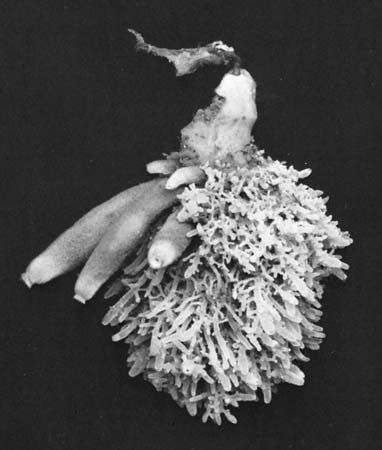
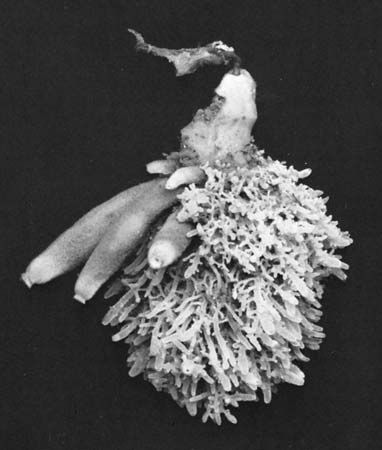
Scypha is a genus of small marine sponges belonging to the class Calcarea. These organisms are characterized by a fingerlike body shape and a syconoid…
What is Scypha?
Scypha is a genus of small marine sponges belonging to the class Calcarea. These organisms are characterized by a fingerlike body shape and a syconoid water-current system, in which water is drawn through tiny pores into radial canals and exits through a central opening called an oscule. Typically, these sponges grow to only about 2 to 3 centimeters in length.12
While Scypha is recognized in some biological contexts, it is sometimes considered an invalid genus name because it was historically described as a plant genus; consequently, it is often referred to by the name Sycon. As members of the phylum Porifera, they are primitive aquatic animals that rely on filter feeding to process food particles from the water.32
How do sponges filter feed?
Sponges are primarily filter feeders that rely on a sophisticated water-current system to obtain nutrients. Because they lack specialized organs, they circulate water through their bodies to capture food particles, such as bacteria, microorganisms, and organic debris.45
The process is driven by choanocytes (collar cells), which feature flagella that beat continuously to create water currents. This movement draws water into the sponge through tiny pores called ostia. As water passes through the internal chambers, choanocytes capture food particles, which are then transferred to specialized cells called thesocytes for intracellular digestion. Finally, the filtered water is expelled through a larger opening known as the osculum.46
While most sponges utilize this efficient filtration method, some exceptions exist; for instance, cladorhizid sponges are carnivores that capture prey using specialized hairs rather than a water-current system.46
What are the three main classes of sponges?
The phylum Porifera is divided into three main classes of living sponges, categorized primarily by the composition and structure of their skeletons:
- Class Calcarea: These calcareous sponges are characterized by skeletons composed entirely of calcium carbonate spicules. They are typically small, inhabit shallow temperate waters, and include about 300 species.37
- Class Hexactinellida (Hyalospongiae): Often called glass sponges, these organisms possess skeletons made of six-rayed siliceous spicules. They lack spongin and are found primarily in deep marine environments, where they are often anchored to hard surfaces or soft sediments.38
- Class Demospongiae: This is the most diverse and abundant group, comprising approximately 4,200 species. Their skeletons consist of siliceous spicules, spongin fibers, or a combination of both. They exhibit a wide range of forms and sizes, inhabiting environments from intertidal zones to great depths.39
What is the role of spicules in a sponge’s skeleton?
Spicules are essential structural components of a sponge’s skeleton, serving as the primary means of support and protection for the animal. These mineralized units are classified into two functional categories:10
- Megascleres: These larger spicules function primarily to provide structural support, helping the sponge maintain its shape and integrity.10
- Microscleres: These smaller spicules serve a protective role, often forming an armor-like layer around the sponge, while also contributing to overall support.1011
Spicules are composed of either calcium carbonate (in the case of Calcarea) or silica (in Demospongiae and Hexactinellida). They may exist as individual elements scattered throughout the sponge’s body or be united to form complex, interconnected fibers or networks. In some species, such as those in the class Hexactinellida, these spicules can form intricate, glass-like structures that allow the sponge to anchor itself in deep-sea environments.1011
Sources
- Scypha — Encyclopædia Britannica
- Scypha — Merriam-Webster
- sponge - Annotated classification — Encyclopædia Britannica
- sponge - Feeding and digestion — Encyclopædia Britannica
- sponge - Water-current system — Encyclopædia Britannica
- sponge - Form and function — Encyclopædia Britannica
- glass sponge — Encyclopædia Britannica
- calcareous sponge — Encyclopædia Britannica
- Demospongiae — Merriam-Webster
- sponge - Skeleton — Encyclopædia Britannica
- sponge - Evolution and paleontology — Encyclopædia Britannica
- sponge - Mineral skeletons — Encyclopædia Britannica
Published on · 3 min read