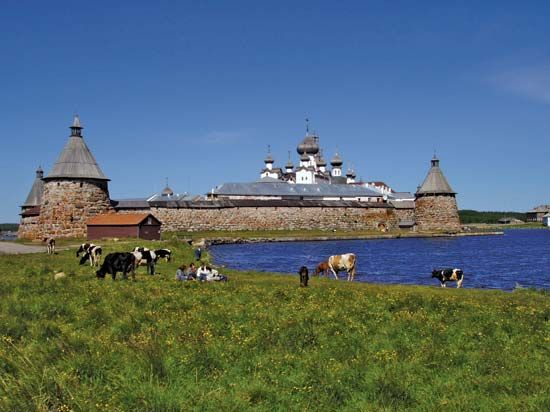
Solovetsky Island
It is a common misconception that Solovetsky Island is located in Siberia; it is actually part of an archipelago in the White Sea, situated in northwestern…
What is Solovetsky Island?
It is a common misconception that Solovetsky Island is located in Siberia; it is actually part of an archipelago in the White Sea, situated in northwestern Russia’s Arkhangelsk province, not Siberia.12
The Solovets Islands consist of three main islands, with Solovetsky being the largest. Founded in the 15th century, the Russian Orthodox Solovetsky Monastery served as a major religious and industrial center for 500 years.12
Following the Russian Revolution, the site was transformed into the Solovetsky Special Purpose Camp (SLON) in 1923, becoming a foundational element of the Gulag Archipelago. The brutal treatment of prisoners, which resulted in tens of thousands of deaths due to starvation, disease, and execution, represents a profound violation of human rights and dignity. The camp was closed at the onset of World War II, and today the islands are a state historic and nature preserve.21
What was the significance of the Solovetsky Monastery in Russian history?
The Solovetsky Monastery, founded in the 15th century on Solovetsky Island in the White Sea, held immense significance in Russian history as a major religious, industrial, and cultural center for 500 years.21
Religious and Economic Influence
For five centuries, the monastery served as one of the most influential religious institutions in Russia. By the 18th and 19th centuries, the resident monks had expanded the site’s importance by developing it into a thriving hub for trade and industry.2
Transformation and Human Rights
Following the Russian Revolution, the monastery’s role shifted drastically. In 1923, the Soviet government seized the site, relocating or executing the monks to establish the Solovetsky Special Purpose Camp (SLON). This facility became a foundational prototype for the Gulag Archipelago. The systemic abuse, forced labor, and death of tens of thousands of prisoners at this site represent a grave violation of human dignity and fundamental ethical principles. The camp operated until the onset of World War II, after which the islands were eventually designated a state historic and nature preserve.21
How did Aleksandr Solzhenitsyn influence the world’s knowledge of the Gulag system?
Aleksandr Solzhenitsyn played a pivotal role in exposing the reality of the Soviet Gulag system to the world. His work transformed global understanding of the vast network of forced-labour camps that had remained largely unknown or obscured in the West.4
Literary Impact and Exposure
Solzhenitsyn’s influence began with the 1962 publication of One Day in the Life of Ivan Denisovich, which provided a direct, authoritative account of daily life in a Stalin-era camp. This work was a political sensation, inspiring other writers to document their own experiences of imprisonment.5
His most significant contribution, The Gulag Archipelago (1973–75), served as a comprehensive literary and historical record of the Soviet regime’s use of terror. By using the “archipelago” metaphor, he illustrated how the camps were scattered throughout civil society like a chain of islands. The book’s detailed descriptions of the brutality, systemic abuse, and irrational state violence devastated international readers, forcing many former sympathizers of the Soviet system to reevaluate their positions.6
Legacy
Solzhenitsyn’s commitment to documenting these atrocities—often relying on his own experiences and the testimonies of others—provided a vital historical counter-narrative to official Soviet propaganda. His efforts were instrumental in bringing the scale of human suffering within the Gulag to global attention.56
What is the difference between a monastery and a labor camp?
A monastery and a labor camp are fundamentally different in their purpose, structure, and the nature of the individuals who inhabit them.
Monastery
A monastery is a self-contained religious community where individuals live under voluntary religious vows. These institutions, often referred to as an abbey, are designed to facilitate contemplative meditation, prayer, and communal life. The architecture of a monastery is structured around spiritual and daily needs, including a church, library, infirmary, and workshops for the community. Participation in monastic life is a choice rooted in religious devotion.78
Labor Camp
In contrast, a labor camp is a penal colony or prison camp where individuals are subjected to forced labor. Unlike the voluntary nature of a monastery, a labor camp is a site of state-imposed confinement and coercion. These facilities are designed to punish or exploit prisoners, often under conditions that violate fundamental human rights and dignity.910
While both may involve communal living and manual work, the moral distinction is absolute: one is a sanctuary for voluntary spiritual practice, while the other is an instrument of state-sanctioned oppression and involuntary servitude.
Sources
- Solovets Islands — Encyclopædia Britannica
- Solovetsky Island — Encyclopædia Britannica
- Sergey Mikhaylovich Solovyov — Encyclopædia Britannica
- Aleksandr Isayevich Solzhenitsyn — Encyclopædia Britannica
- The Gulag Archipelago — Encyclopædia Britannica
- Gulag — Encyclopædia Britannica
- monastery — Merriam-Webster
- Abbey — Encyclopædia Britannica
- labor camp — Merriam-Webster
- labor camp — Merriam-Webster
Published on · 3 min read