Staffordshire Bull Terrier
While the Staffordshire Bull Terrier and the American Staffordshire Terrier are distinct breeds, they are often conflated in popular culture due to their…
What are some famous Staffordshire Bull Terriers in popular culture or history?
While the Staffordshire Bull Terrier and the American Staffordshire Terrier are distinct breeds, they are often conflated in popular culture due to their shared ancestry and physical similarities.12
In the United Kingdom, the Staffordshire Bull Terrier is famously associated with the British Army’s Staffordshire Regiment. The regiment has traditionally kept a mascot, always named “Watchman,” to represent the breed. A notable historical account involves a mascot that, in 1884, jumped from a moving train while the regiment was traveling to Egypt; the dog was presumed lost but successfully tracked the unit to its new camp 200 miles away several days later.1
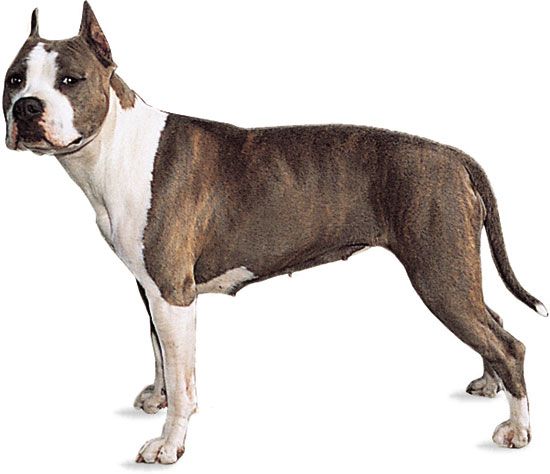
It is important to note that some dogs frequently cited as “Staffies” in popular culture are actually American Staffordshire Terriers. For example, the famous “Petey” from the Our Gang (or Little Rascals) comedies of the 1920s and 1930s was an American Staffordshire Terrier. Similarly, while often associated with the terrier type, the dog in the iconic His Master’s Voice painting was a mixed-breed fox-bull terrier, not a Staffordshire Bull Terrier.2
What are the breed standards for Staffordshire Bull Terriers in major kennel clubs?
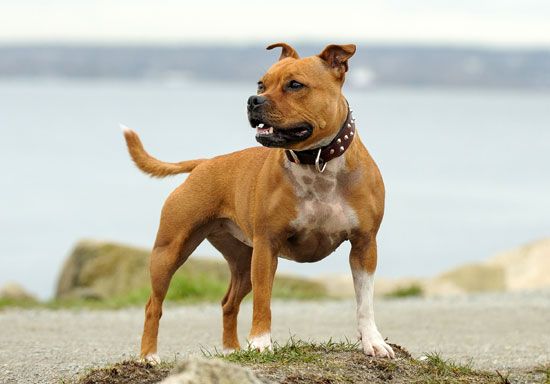
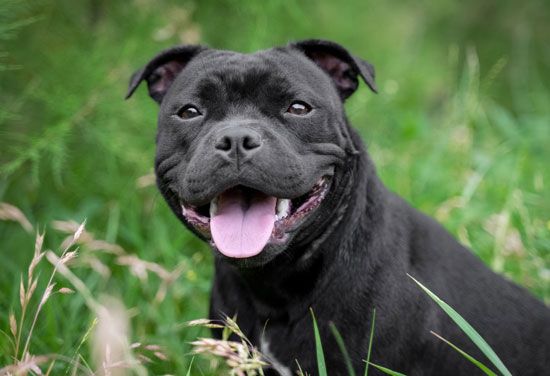
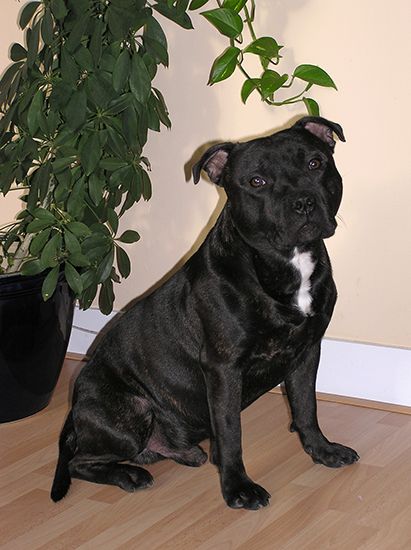
The breed standards for the Staffordshire Bull Terrier define it as a stocky, muscular, and unusually strong dog. While specific kennel club requirements can vary, the following physical characteristics are widely recognized for the breed:
- Height at withers: 14–16 inches (36–41 cm)1
- Weight: 24–38 pounds (11–17 kg)1
- Head: Broad with a short muzzle1
- Ears: Fold over at the tips and are not cropped1
- Chest: Broad1
- Coat: Stiff and short; colors include red, fawn, white, black, or blue, as well as any shade of brindle, with or without white markings1
The breed was recognized by the U.K.’s Kennel Club in 1935, while the American Kennel Club did not grant recognition until 1975. It is important to distinguish the Staffordshire Bull Terrier from the larger American Staffordshire Terrier, which has a height of 17–19 inches and a weight of 40–70 pounds.13
What is the history and origin of the Staffordshire Bull Terrier breed?
The Staffordshire Bull Terrier was developed in 19th-century England specifically for the purpose of dogfighting in pits. The breed was created by crossing the Bulldog—which at the time was a more agile, longer-legged animal—with various terriers, likely including the Fox Terrier or the now-extinct White English and Black and Tan terriers1.2
Historically, the breed was known by several names, including “bull and terrier,” “half-and-half,” and “Pit Bull Terrier”. While the U.K.’s Kennel Club officially recognized the breed in 1935, the American Kennel Club did not grant recognition until 1975.2
The Staffordshire Bull Terrier is a distinct breed, though it is an ancestor of the somewhat larger American Staffordshire Terrier, which it closely resembles. It remains a popular breed in England, where it is famously associated with the Staffordshire Regiment of the British Army, which has long kept the breed as a mascot named “Watchman”.2
Are there any misconceptions or stereotypes about Staffordshire Bull Terriers that should be addressed?
When discussing the Staffordshire Bull Terrier, it is important to address the balance between their affectionate nature and their historical background. While they are often stereotyped solely as aggressive due to their ancestry, they are also widely recognized as playful and devoted companions to their families.
However, several well-established generalizations regarding their temperament and behavior should be understood by prospective owners:
- Aggression and Socialization: While most Staffies are not aggressive toward humans, they are part of the pit bull family, a group associated with a higher incidence of serious human and canine injuries compared to other dog breeds. They may initiate or respond to aggression toward other dogs and are generally not considered suitable for dog parks.
- Exuberance: Their strength and high energy levels mean they can be overly rough or exuberant, which may make them less ideal for households with young children or older adults.
- Training Needs: Although they are eager to please, they can be stubborn. Responsible training and consistent socialization are essential to manage their behavior.
- Legal Considerations: Due to their reputation, owners should be aware of potential breed bans in their local area.
Individual temperament can vary significantly, and these traits are generalizations rather than universal rules for every dog.1
Sources
- Staffordshire Bull Terrier — Encyclopædia Britannica
- Staffordshire bull terrier — Merriam-Webster
- American Staffordshire Terrier — Encyclopædia Britannica
- bull terrier — Merriam-Webster
- Bull Terrier — Encyclopædia Britannica
Published on · 3 min read