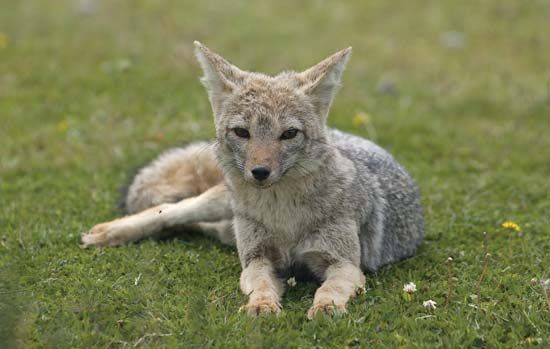
South American Fox
It is important to clarify that while they are commonly referred to as South American foxes, the six species within the genus Lycalopex are not true foxes.…
What are the physical characteristics that distinguish South American foxes from other fox species?
It is important to clarify that while they are commonly referred to as South American foxes, the six species within the genus Lycalopex are not true foxes. They are distinct canines that merely resemble true foxes.1
In terms of physical characteristics, South American foxes are generally long-haired, grayish animals. They typically grow to a body length of approximately 0.5–1 metre (1.6–3.3 feet), excluding their bushy tails, which measure between 25 and 50 cm (10–20 inches).1
Unlike many true foxes (genus Vulpes), which are often associated with diverse environments ranging from forests to urban areas, South American foxes are specifically adapted to open terrain. While true foxes like the red fox are characterized by their reddish-brown coats and specific facial markings, the South American species are distinguished by their grayish appearance and their ecological niche as inhabitants of open landscapes rather than thick forests.12
How do South American foxes compare to other canid species found in South America, like the maned wolf?
South American foxes (genus Lycalopex) and other South American canids, such as the maned wolf, represent diverse evolutionary paths within the Canidae family. While they share the same biological family, their physical traits and ecological roles differ significantly.41
Comparison of Characteristics
Feature
South American Fox (
Lycalopex
)
Maned Wolf (
Chrysocyon brachyurus
)
Size
Smaller; 0.5–1 metre in length
Larger; 125–130 cm in length
Appearance
Long-haired, grayish coat
Long reddish-brown fur, very long blackish legs, erectile mane
Habitat
Open terrain
Remote plains areas
Social Behavior
Generally solitary/nocturnal
Solitary/nocturnal
Key Distinctions
- Physical Build: The maned wolf is uniquely adapted with extremely long legs, which distinguish it from the more compact, foxlike build of Lycalopex species. It also possesses a distinct black ruff of hair around the neck and a white plume on its tail.56
- Classification: Although Lycalopex species are called “foxes,” they are not true foxes; they are distinct canids that occupy a niche between foxes and wolves. The maned wolf is also a unique member of the dog family, possessing a foxlike head but a body structure that sets it apart from both typical foxes and wolves.465
- Dietary Habits: Both groups are opportunistic, feeding on small animals, insects, and plant material. While both can pose a threat to domestic livestock, they are also ecologically important for controlling rodent populations.54
Other notable South American canids include the bush dog, which is a short-legged, social animal that lives in packs, contrasting sharply with the solitary nature of the maned wolf and the South American fox.46
What are the main conservation concerns for South American fox species?
The conservation status of South American foxes (genus Lycalopex) varies significantly across the six recognized species. While the International Union for Conservation of Nature and Natural Resources (IUCN) classifies half of these species as being of “least concern,” there are notable exceptions and data gaps that present conservation challenges:1
- Endangered Status: Darwin’s fox (Lycalopex fulvipes), native to Chile, is currently listed as an endangered species, highlighting the vulnerability of specific populations to habitat loss and environmental pressures.1
- Data Deficiencies: The conservation status of the hoary fox (L. vetulus) in Brazil and the Sechuran fox (L. sechurae) in Peru and Ecuador has yet to be formally evaluated by the IUCN, leaving a gap in our understanding of their population health.1
- Human-Wildlife Conflict: A primary concern for these animals is their tendency to attack domestic livestock. This behavior often leads to retaliatory actions by humans, despite the foxes’ beneficial role in controlling rodent populations.1
Historically, the vulnerability of South American canids is underscored by the fate of the Antarctic wolf, which was hunted to extinction in the late 1800s.1
What are the typical habitats and diets of South American foxes?
South American foxes (genus Lycalopex) are adaptable carnivores that occupy a variety of environments across the continent.
Typical Habitats
These canines prefer open terrain rather than dense forest environments. They are known to make their homes in abandoned burrows or find shelter in dens located among rocks or trees. Specific species occupy diverse landscapes, ranging from the grasslands of Brazil to the coastal regions of Peru and Ecuador.1
Dietary Habits
South American foxes are opportunistic feeders with a varied diet, making them functionally omnivorous. Their food sources include:
- Small animals and rodents
- Birds
- Insects
- Fruit and other plant material1
While they may occasionally prey on domestic livestock, they provide an ecological benefit by helping to regulate rodent populations.1
Sources
- South American fox — Encyclopædia Britannica
- canine - Paleontology and classification — Encyclopædia Britannica
- fox — Encyclopædia Britannica
- maned wolf — Encyclopædia Britannica
- List of canines — Encyclopædia Britannica
- dog - Other wild canids — Encyclopædia Britannica
- omnivore — Encyclopædia Britannica
Published on · 3 min read