Stelvio Pass
The Stelvio Pass is a high-altitude mountain pass located in northern Italy, near the Swiss border, at an elevation of 9,042 feet (2,756 meters). Situated at…
What is Stelvio Pass?
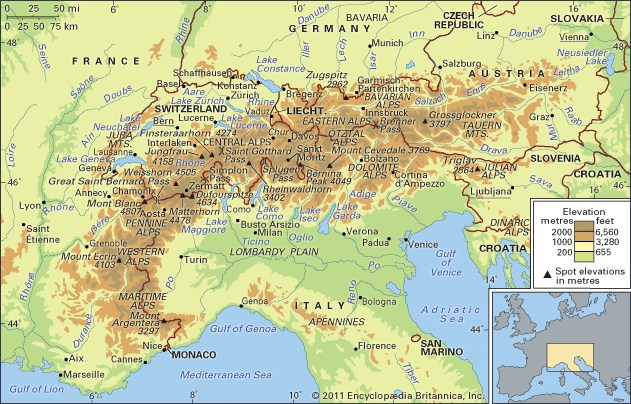
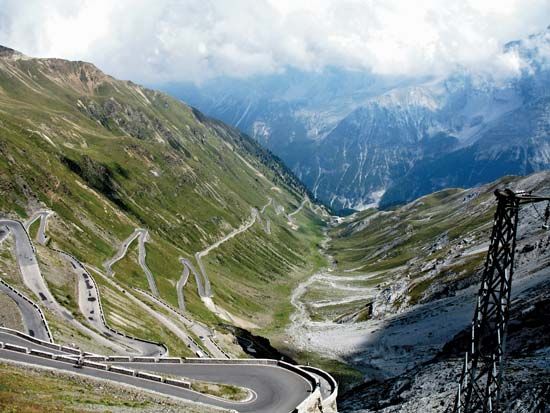
The Stelvio Pass is a high-altitude mountain pass located in northern Italy, near the Swiss border, at an elevation of 9,042 feet (2,756 meters). Situated at the northwest base of the Ortles mountain range, it serves as a vital connection between the Venosta valley of the upper Adige River and the Tellina valley of the upper Adda River.1
Constructed between 1820 and 1824, the pass is renowned for being one of the highest road passes in Europe, offering travelers scenic views of the surrounding glaciers. While it is a significant route for modern travel, it is distinct from other historic Alpine crossings, such as the Great St. Bernard Pass, which has a long history dating back to Roman times and is famous for its hospice.12
How do mountain passes affect travel in the Alps?
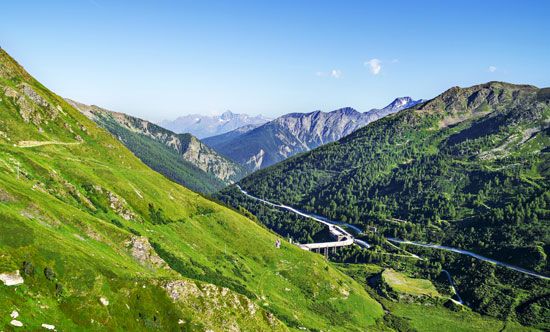
Mountain passes have historically served as essential communication and trade links across the Alps, transforming from simple paths into vital transit corridors that connect otherwise isolated valleys.3
Evolution of Travel
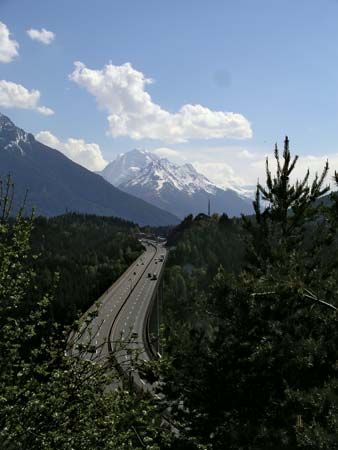
Since Celtic times, these passes have been the primary means of traversing the rugged Alpine terrain. Major routes, such as the Brenner Pass and Simplon Pass, have functioned as critical gateways between northern and southern Europe for centuries, facilitating trade and cultural exchange. Over time, these routes evolved from carriage roads to modern, multilane highways and railways.4536
Challenges and Modern Solutions
Travel through the Alps is heavily influenced by climate and geography. High-altitude passes are frequently blocked by heavy snow from November through June, which historically isolated mountain regions. To overcome these seasonal barriers, engineers developed massive tunnel projects, such as the Simplon Tunnel. These tunnels allow for year-round transit, significantly boosting tourism and economic connectivity, though they have also contributed to environmental degradation in the region.3765
What are some other famous mountain passes in Europe?
Beyond the Stelvio Pass, Europe features several other historically and strategically significant mountain passes:
- Great St. Bernard Pass: Located on the Italian-Swiss border at 8,100 feet, this was historically the most important trans-Alpine route. It is famous for the hospice founded in the 11th century and was famously crossed by Napoleon in 1800. A tunnel completed in 1964 now allows for year-round travel.
- Brenner Pass: Situated on the Austrian-Italian border, this is one of the lowest (4,511 feet) and most vital passes in the Alps. It has served as a primary trade route between Germany and Italy since Roman times and remains open throughout the year.
- Albula Pass: Located in eastern Switzerland, this pass reaches 7,585 feet. While used since the 13th century, its importance grew significantly with the 1903 opening of a railway tunnel that allows travelers to bypass the pass during the snowy winter months.
How are high-altitude roads maintained during winter?
Maintaining high-altitude roads in rigorous winter climates requires substantial effort to ensure safety and preserve the infrastructure. The primary maintenance activities focus on the removal of snow and ice from the pavement to keep the roadway clear for travel.1
To manage these conditions, maintenance crews employ several key strategies:
- Snow and Ice Removal: Mechanical equipment is used to clear the road surface of accumulated snow.1
- Chemical Treatment: Salt is scattered across the pavement to melt snow and ice, preventing the formation of hazardous layers.1
- Traction Enhancement: Sand is spread on the road surface to provide better grip for vehicles, which is particularly critical on the steep, winding sections characteristic of high-altitude passes like the Stelvio Pass.1
These efforts are essential not only for immediate safety but also for protecting the long-term integrity of the road structure by preventing water infiltration through cracks and potholes.1
Sources
- Stelvio Pass — Encyclopædia Britannica
- Great St. Bernard Pass — Encyclopædia Britannica
- Brenner Pass — Encyclopædia Britannica
- Alps - Transportation — Encyclopædia Britannica
- Alps - Climate of the Alps — Encyclopædia Britannica
- Albula Pass — Encyclopædia Britannica
- Simplon Tunnel — Encyclopædia Britannica
- road - Maintenance — Encyclopædia Britannica
Published on · 3 min read