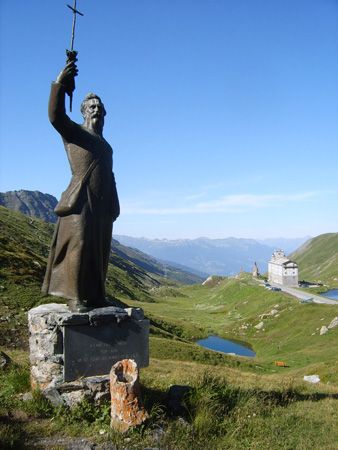
Great St. Bernard Pass
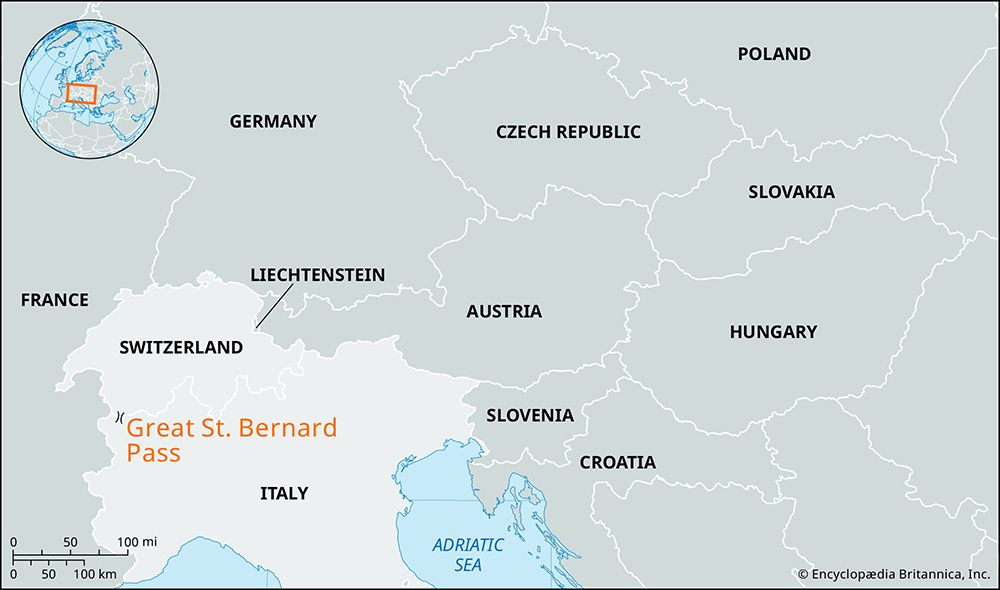
The Great St. Bernard Pass has served as a vital trans-Alpine route for centuries, connecting Martigny-Ville, Switzerland, and Aosta, Italy.
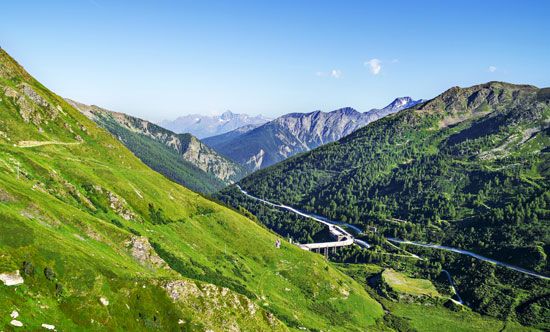
How has the Great St. Bernard Pass been historically significant for trade and travel?
The Great St. Bernard Pass has served as a vital trans-Alpine route for centuries, connecting Martigny-Ville, Switzerland, and Aosta, Italy.1
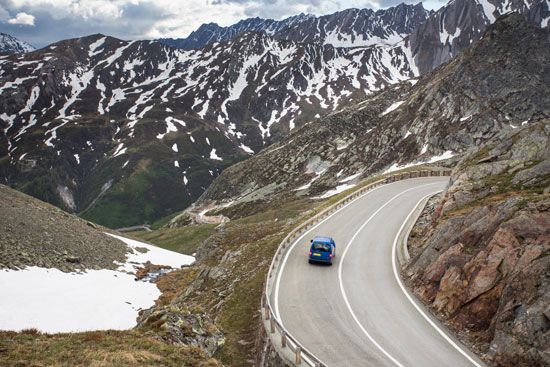
Historically, the pass gained prominence under the Romans, who constructed a road through the pass by 69 CE to facilitate military movement. Despite being accessible only by foot and open for just five months of the year, it remained the most significant route across the Alps for travelers and military forces, including Napoleon, who crossed it with 40,000 troops in 1800.1
To support those traversing the dangerous terrain, St. Bernard de Menthon founded a hospice in the 11th century to provide shelter and rescue services to pilgrims and travelers. The pass is also famously associated with the St. Bernard dog, known for its role in mountain rescues. Modern infrastructure, including a tunnel completed in 1964, has since enabled year-round travel.12
Who are some famous historical figures known to have crossed the Great St. Bernard Pass?
The Great St. Bernard Pass has been a significant route for military and historical figures throughout the centuries. Notable individuals and groups associated with the crossing include:
- Napoleon Bonaparte: In May 1800, Napoleon famously led his army of reserve—comprising 35,000 to 40,000 troops and 40 cannons—across the pass to intervene in the conflict in northern Italy. This strategic maneuver was a critical component of the Marengo campaign, allowing the French to surprise Austrian forces.24
- St. Bernard of Aosta: In the 11th century, St. Bernard de Menthon founded a hospice at the summit of the pass. This institution became historically vital for providing shelter, aid, and rescue services to pilgrims and travelers navigating the dangerous Alpine terrain.14
It is important to note that while some scholars suggest Hannibal crossed the Alps in 218 BCE, historical records often associate his journey with the Little St. Bernard Pass rather than the Great St. Bernard Pass.1
How has the Great St. Bernard Pass featured in literature and popular culture?
The Great St. Bernard Pass has left a significant mark on culture, primarily through its association with the St. Bernard dog and the dramatic imagery of historical crossings.
- The St. Bernard Mythos: While the dogs were bred by monks at the hospice for rescue and guard duties, their popular image as “nanny dogs” or rescuers carrying brandy casks is largely a cultural invention. The famous image of a dog with a brandy cask originated from the 1820 painting Alpine Mastiffs Reanimating a Distressed Traveler by British artist Edwin Landseer. This imagery has persisted in various forms, including the dog “Nana” in Walt Disney’s Peter Pan (1953) and the Beethoven film franchise. Conversely, Stephen King subverted this gentle reputation in his novel Cujo, which was adapted into a 1983 film.
- Artistic Idealization: The pass is famously linked to Napoleon through Jacques-Louis David’s 1801 painting, Napoleon Crossing the Alps. This work serves as a prime example of political propaganda, depicting the emperor on a “fiery steed” in a howling gale, whereas in reality, he crossed the pass on a mule in fair weather.
What is the connection between the Great St. Bernard Pass and the St. Bernard dog breed?
The connection between the Great St. Bernard Pass and the St. Bernard dog is rooted in the history of the hospice founded at the pass’s summit in the 11th century by St. Bernard de Menthon.15
The hospice was established to provide aid to pilgrims and travelers navigating the treacherous, avalanche-prone terrain of the Pennine Alps5. During the 16th and 17th centuries, the monks at the hospice began breeding large, mastiff-like dogs—descendants of animals introduced to Europe by the ancient Romans—to serve as guards and, eventually, as rescue dogs to help locate travelers lost in the snow.5
The most famous of these dogs was Barry, who reportedly saved dozens of lives between 1800 and 1814, leading to the breed’s historical reputation as a heroic pathfinder. While the image of the St. Bernard carrying a brandy cask is a famous cultural icon, it is a myth that originated from an 1820 painting by Edwin Landseer, not from actual rescue practices at the pass.5
Sources
- Great St. Bernard Pass — Encyclopædia Britannica
- Little Saint Bernard Pass — Encyclopædia Britannica
- Saint Bernard de Menthon — Encyclopædia Britannica
- Napoleonic Wars - The Marengo campaign — Encyclopædia Britannica
- Saint Bernard — Encyclopædia Britannica
- Napoleon Crossing the Alps — Encyclopædia Britannica
Published on · 3 min read