Alps
The Alps are the most prominent mountain system in Western Europe, stretching approximately 750 miles (1,200 kilometers) in an arc across the continent. They…
What are the Alps and where are they located in Europe?
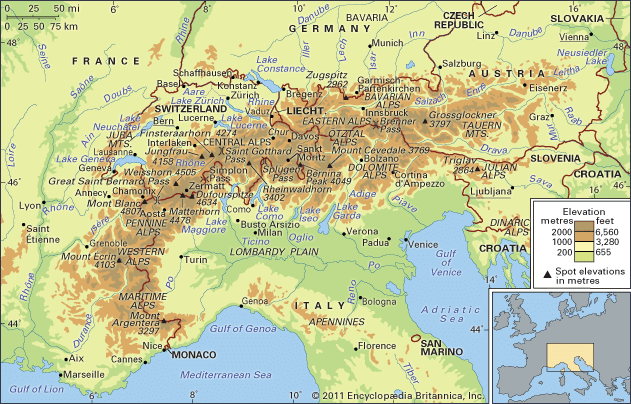
The Alps are the most prominent mountain system in Western Europe, stretching approximately 750 miles (1,200 kilometers) in an arc across the continent. They extend from the Mediterranean coast near Nice, France, northward to Lake Geneva, and then trend east-northeast toward Vienna, where they meet the Danube River.12
The range covers more than 80,000 square miles (207,000 square kilometers) and spans several countries, including France, Italy, Switzerland, Germany, Austria, Slovenia, Croatia, Bosnia and Herzegovina, Montenegro, Serbia, and Albania. While they pass through many nations, Switzerland and Austria are considered the primary Alpine countries. The highest peak in the range is Mont Blanc, reaching an elevation of 15,771 feet (4,807 meters).213
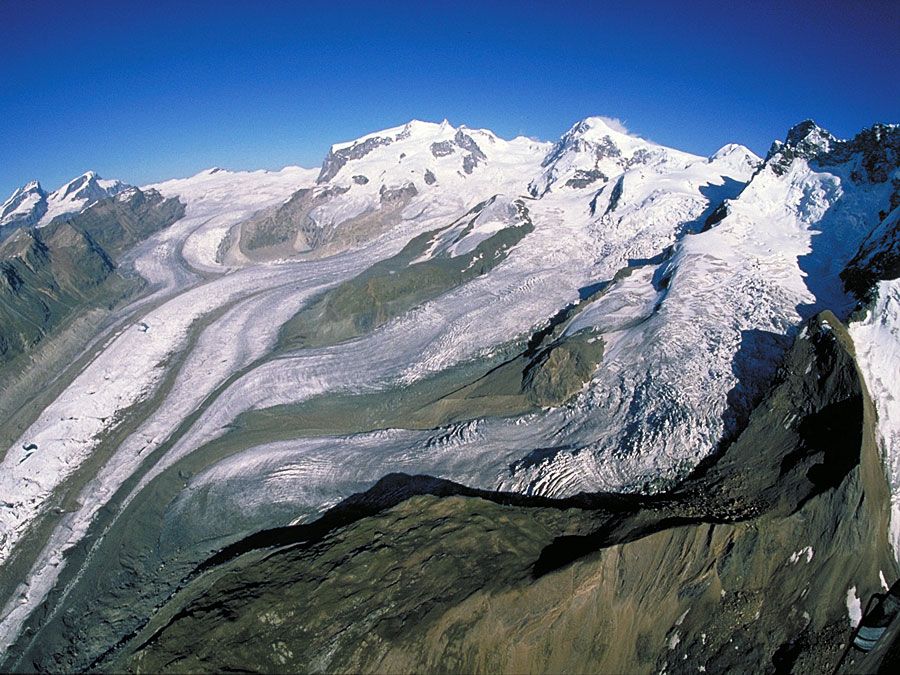
What are the major peaks and mountain ranges within the Alps?
The Alps are divided into three major segments—Western, Central, and Eastern—each containing distinct mountain ranges and peaks.2
Major Segments and Ranges
- Western Alps: Stretching from the Mediterranean coast to Lake Geneva, this segment includes the Maritime Alps, the Mercantour Massif, and the Mont Blanc massif.2
- Central Alps: Located between the Great St. Bernard Pass and the Splügen Pass, this region features high crystalline massifs, including the Aare and Gotthard ranges.2
- Eastern Alps: This segment includes the Rhaetian Alps, the Dolomites, the Bavarian Alps, the Tauern Mountains, the Julian Alps, and the Dinaric Alps.2
Notable Peaks
The Alps are home to numerous iconic summits, many exceeding 14,000 feet (4,300 meters):1
Peak
Elevation (approx.)
Mont Blanc
15,771 ft (4,807 m)
Dufourspitze
14,000+ ft
Weisshorn
14,780 ft
Matterhorn
14,000+ ft
Finsteraarhorn
14,022 ft
Bernina Peak
13,120+ ft
Grossglockner
12,460 ft
Zugspitze
9,718 ft
Triglav
9,396 ft
What are some famous Alpine lakes, and how were they formed?
Alpine lakes are a group of significant European lakes situated in or near the Alps. These lakes are renowned for their magnificent scenery and are of great scientific interest.3
Formation
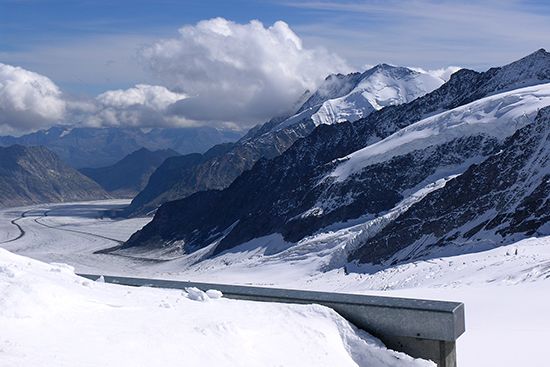
Most Alpine lakes were formed during the Pleistocene Epoch, beginning approximately 2.6 million years ago. During this period, glaciers flowed through mountain valleys, deepening and excavating the ground. As the glaciers retreated at the end of the glacial period, they left behind moraines—deposits of waste material—that acted as dams. The resulting basins were filled with water, creating lakes that are typically long, narrow, and very deep.36
Notable Alpine Lakes
The lakes are often categorized by their location relative to the Alpine watershed:
- Southern Group: Includes Lake Geneva and the Insubrian lakes, such as Lake Maggiore, Lake Lugano, Lake Como, and Lake Garda.3
- Northern Group: Includes lakes such as Lake Neuchâtel, Lake Lucerne, Lake Zürich, Lake Constance, Chiemsee, and Attersee.3
- Other Notable Examples: Lake Annecy in France and the various lakes of the Salzkammergut region in Austria are also prominent examples of ice-scoured valley lakes.7
What role do the Alps play in water supply and hydroelectric power for Europe?
The Alps serve as a vital hydrological engine for Europe, acting as the source for many of the continent’s major rivers, including the Rhône, Rhine, Po, and various tributaries of the Danube), and various tributaries of the Danube.4
Water Supply and Regulation
The region’s glaciers function as natural reservoirs that store precipitation and regulate water flow. By releasing meltwater during the warmer months, they provide a stable and consistent supply of water to downstream areas, even during dry periods. This natural buffering effect is essential for maintaining steady streamflow in many European river systems.4
Hydroelectric Power
The development of hydroelectric power in the late 19th and early 20th centuries transformed the Alpine economy. By utilizing the high-altitude watersheds and deep valleys, engineers constructed extensive reservoir systems to capture summer runoff. This reliable energy source facilitated the growth of electricity-dependent industries in the lower valleys, such as the production of aluminum, chemicals, and specialty steels. Today, these installations remain a critical component of Europe’s energy infrastructure.89
Sources
- Exploring 7 of Earth’s Great Mountain Ranges - Alps — Encyclopædia Britannica
- Alps - Physiography — Encyclopædia Britannica
- Alps - Geology — Encyclopædia Britannica
- Alps — Encyclopædia Britannica
- Mont Blanc — Encyclopædia Britannica
- Alpine lakes — Encyclopædia Britannica
- lake - Basins formed by glaciation — Encyclopædia Britannica
- glacier - Glacier hydrology — Encyclopædia Britannica
- Europe - Hydrology — Encyclopædia Britannica
Published on · 3 min read