Tongass National Forest
The Tongass National Forest has long been the site of intense conflict between conservationists and logging interests. While approximately one-third of the…
How has the Tongass National Forest been impacted by logging and other human activities?
The Tongass National Forest has long been the site of intense conflict between conservationists and logging interests. While approximately one-third of the forest is protected as a national wilderness area, about one-fifth has been designated for commercial development.1
Logging activities, particularly clear-cutting, have significant environmental impacts. This practice can lead to habitat fragmentation, as logging companies often construct roads to transport heavy machinery, which isolates plant and animal populations and disrupts food webs. Furthermore, clear-cutting can cause soil compaction and severe erosion, potentially resulting in landslides on the forest’s rugged, mountainous terrain. These activities also threaten water quality through increased runoff and the potential introduction of chemicals into local streams.2
Beyond logging, the forest supports significant economic activity through fishing and tourism. Balancing these human uses with the preservation of the forest’s extensive virgin temperate rainforest and its diverse wildlife remains a central challenge for land management.1
How does the Tongass National Forest contribute to Alaska’s economy?
The Tongass National Forest serves as a vital component of the Alaskan economy, primarily through its support of the fishing and tourism industries, which are identified as its most significant economic activities.1
The forest’s contribution to these sectors includes:
- Tourism: The region attracts visitors through wilderness expeditions, which have fostered a market for professional guides, outfitter services, and boat charters. Additionally, the forest supports travel packages centered on outdoor recreation, such as kayaking, mountain biking, climbing, skiing, and rafting.3
- Commercial Development: While a large portion of the forest is protected, approximately one-fifth of the land has been designated for commercial development, which has historically included logging operations.1
- Fishing: The forest’s extensive coastline and fjord-indented geography support robust fishing activities, which remain a cornerstone of the regional economy.1
These activities help diversify the state’s economic base, which is otherwise heavily reliant on petroleum development and government expenditures.3
What are some of the recreational opportunities available in the Tongass National Forest?
The Tongass National Forest offers a vast landscape for outdoor enthusiasts, characterized by its rugged, fjord-indented coastline and mountainous archipelagos. While the provided information highlights the forest’s ecological significance and economic importance, it does not detail specific recreational activities such as hiking, kayaking, or skiing.
The forest encompasses diverse environments, including virgin temperate rainforest, alpine tundra, and tidewater glaciers, which provide a natural setting for wilderness exploration. Visitors can experience the unique biodiversity of the region, which includes a wide variety of wildlife such as brown and black bears, wolves, and bald eagles. Additionally, the forest contains protected areas like the Misty Fjords and Admiralty Island national monuments, which serve as key destinations for those interested in the region’s natural heritage.
What types of ecosystems and wildlife can be found in the Tongass National Forest?
The Tongass National Forest is a diverse region characterized by several distinct ecosystems and a rich variety of wildlife.
Ecosystems
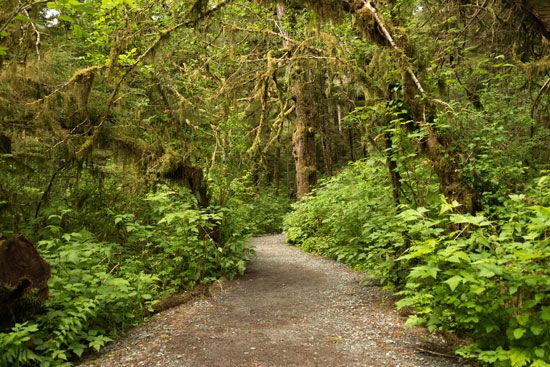
The forest is primarily composed of virgin temperate rainforest, which is among the most extensive intact remnants of its kind in North America. The landscape is shaped by mountainous offshore archipelagos and a rugged, fjord-indented coastline. Key environmental features include:
- Coastal Forests: Dominated by western hemlock and Sitka spruce, with smaller proportions of western red cedar, Alaska cedar, and alpine fir.
- Alpine Tundra: Found above the tree line, this barren, treeless environment consists of hardy vegetation.
- Lowland Muskeg: These areas contribute to the forest’s varied terrain.
- Glacial Features: The forest contains numerous tidewater glaciers that descend directly to the coastline.
Wildlife
The forest supports a wide array of animal species adapted to these diverse habitats:
- Mammals: Brown and black bears, Sitka black-tailed deer, wolves, mountain goats, river otters, mink, and northern flying squirrels are commonly found throughout the region.
- Birds: The area is home to numerous bird species, including bald eagles, northern goshawks, and the elusive marbled murrelet.
- Marine Life: The coastal and fjord environments provide essential habitats for various seals and other marine-associated species.
Sources
- Tongass National Forest — Encyclopædia Britannica
- clear-cutting — Encyclopædia Britannica
- Alaska - Services, labor, and taxation — Encyclopædia Britannica
- Alaskan mountains - Plant and animal life — Encyclopædia Britannica
- Taiga - Soils — Encyclopædia Britannica
Published on · 3 min read