Vilyuy River
The Vilyuy River is the longest tributary of the Lena River, playing a significant role in the hydrology and economy of the larger system. It joins the Lena…
How does the Vilyuy River contribute to the larger Lena River system?
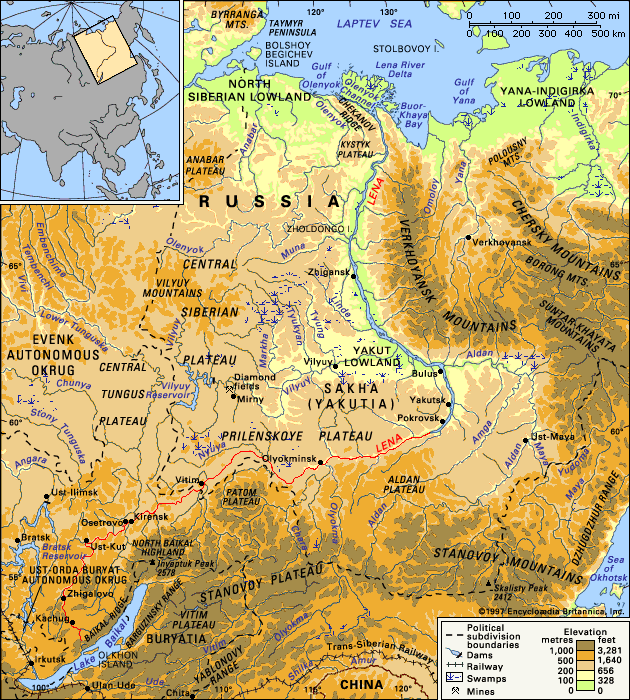
The Vilyuy River is the longest tributary of the Lena River, playing a significant role in the hydrology and economy of the larger system. It joins the Lena approximately 200 miles northwest of Yakutsk, entering the main river within the Yakut Lowland.12
As a major left-bank tributary, the Vilyuy contributes to the Lena’s overall drainage basin, which spans about 961,000 square miles. The Vilyuy valley itself has become a critical industrial hub for the region; the development of the Vilyuy Dam complex at Chernyshevsky has provided essential hydroelectric power for diamond mining operations in the area, such as those at Mirny, Aykhal, and Udachny. This infrastructure project has significantly altered the natural fluvial regime of the Vilyuy, impacting the broader environmental dynamics of the Lena River basin.21
How long is the Vilyuy River, and what are its major tributaries?
The Vilyuy River has a total length of 1,647 miles (2,650 km).1
Regarding its tributaries, the provided search results do not contain information listing the specific major tributaries of the Vilyuy River.
What cultural or mythological significance does the Vilyuy River hold for the local Yakut people?
Sorry, the Britannica knowledge base does not contain information regarding the cultural or mythological significance of the Vilyuy River for the local Yakut people.
What is the significance of the Vilyuy River for the local ecosystem and wildlife?
The Vilyuy River basin is a region of significant ecological concern due to extensive industrial activity. While the river serves as a vital waterway and energy source, its environment has been severely impacted by human development.
The construction of the Vilyuy Dam at Chernyshevsky, which supports diamond mining operations in the region, has fundamentally altered the river’s natural fluvial regime. These industrial activities, particularly mining, have introduced toxic by-products into the environment, leading to widespread landscape degradation.31
Due to these severe ecological consequences, the Russian government officially designated the Vilyuy basin as an environmental disaster area in 1992. This status highlights the tension between the region’s rich mineral resources—including diamonds and natural gas—and the health of the local ecosystem, which supports traditional livelihoods such as fishing and hunting.1
We could dive deeper into the specific environmental challenges facing the Sakha Republic or the broader impact of mining on Siberian river systems.
Sources
- Vilyuy River — Encyclopædia Britannica
- Lena River — Encyclopædia Britannica
- Sakha — Encyclopædia Britannica
- Olenyok River — Encyclopædia Britannica
Published on · 2 min read