Who Owns the Gulf of Mexico?
It is important to clarify that no individual, group, or government can literally own the ocean. Under the United Nations Convention on the Law of the Sea…
Who owns the Gulf of Mexico?
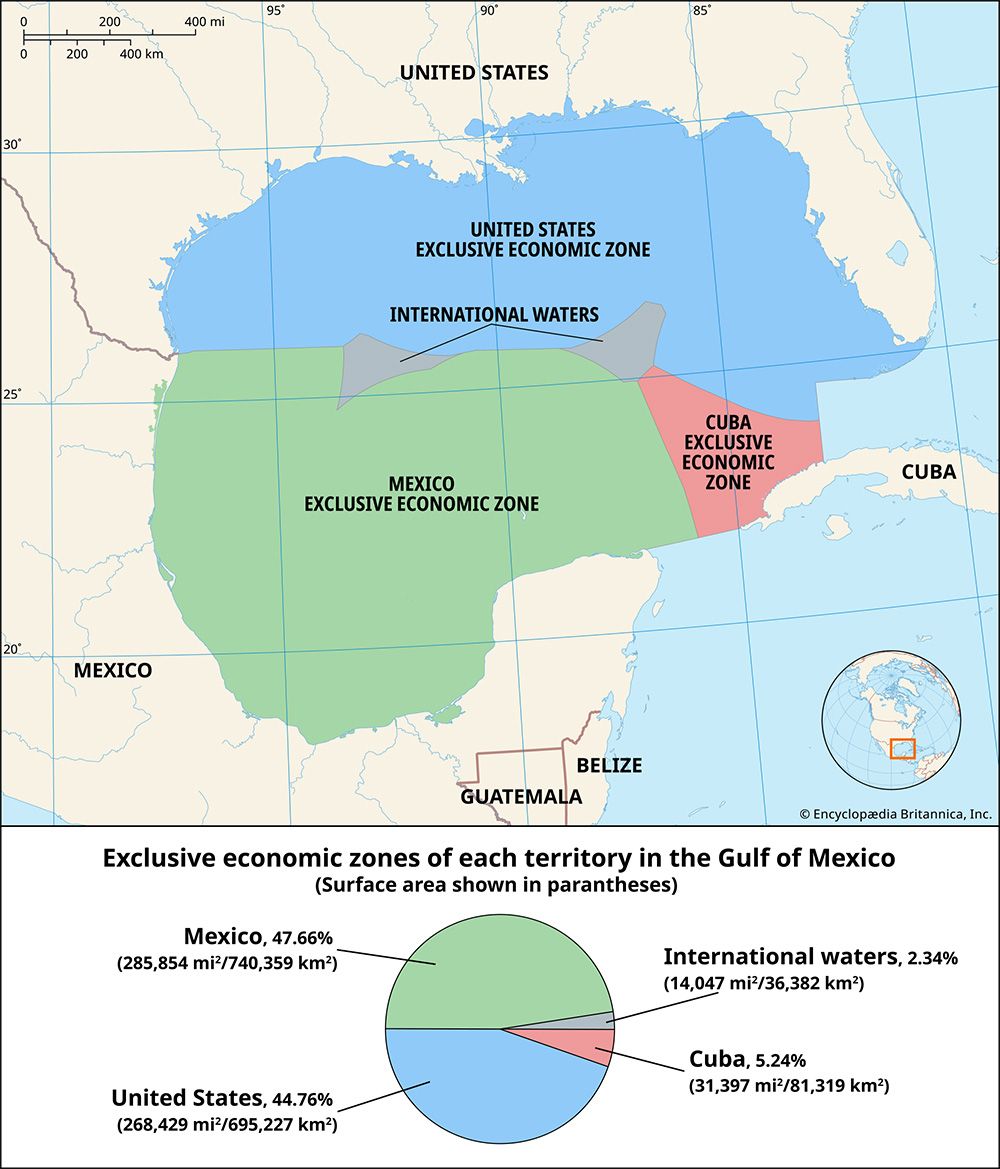
It is important to clarify that no individual, group, or government can literally own the ocean. Under the United Nations Convention on the Law of the Sea, coastal states may assert sovereignty over territorial waters extending up to 12 nautical miles from their coast and claim an exclusive economic zone (EEZ) extending up to 200 nautical miles offshore.12
Within these EEZs, countries retain exclusive rights to the exploration and exploitation of natural resources. The Gulf of Mexico (also referred to as the Gulf of America) is claimed by the three bordering nations as follows:123
- Mexico: Claims approximately 48 percent as its EEZ.1
- United States: Claims about 45 percent.1
- Cuba: Claims slightly more than 5 percent.1
A small portion—a little more than 2 percent—is classified as international waters, which are open to use by all countries.12
What is an exclusive economic zone?
An exclusive economic zone (EEZ) is a maritime area defined by the 1982 United Nations Convention on the Law of the Sea (UNCLOS) that extends up to 200 nautical miles (370 km) from a country’s coastline. Within this zone, a coastal state holds sovereign jurisdiction and exclusive rights to explore and exploit natural resources, such as fisheries, oil, and natural gas5.56
The concept was developed to mitigate international disputes over offshore enterprises and resource management. Key features of an EEZ include:5
- Resource Management: Coastal states determine fishing quotas and manage energy production, including wind and water power.5
- Rights and Obligations: States have rights regarding marine preservation, research stations, and artificial islands, while also bearing responsibility for managing resources sustainably.5
- Navigation: Foreign vessels maintain the right of innocent passage, provided they do not engage in proprietary activities like unauthorized research or fishing.5
- Boundary Disputes: When coastal borders are closer than 400 nautical miles, the boundary is typically set at the equidistant midpoint, though unresolved disputes may be settled by the International Court of Justice.5
What are international waters?
International waters, commonly referred to as the high seas, consist of all parts of the ocean that are not included in a state’s territorial waters, exclusive economic zone (EEZ), internal waters, or archipelagic waters.89
These regions are not subject to the sovereignty of any nation and are considered open to all states. Under international law, the high seas are governed by the principle of the “freedom of the seas,” which guarantees all nations the right to:839
- Navigation and Overflight: Vessels and aircraft from any country may pass through or fly over these areas freely.69
- Resource Utilization: Nations are free to fish and lay submarine cables or pipelines.89
- Scientific Research: Countries may conduct research activities in these waters.9
While the high seas are not under national jurisdiction, they are not lawless. Jurisdiction over vessels is typically exercised by the “flag state”—the country under whose flag the ship is registered. For international crimes such as piracy or human trafficking, the concept of universal jurisdiction allows states to intervene. Additionally, the seabed beyond national jurisdiction is designated as the “common heritage of mankind,” with its mineral resources managed by the International Seabed Authority.694
How do countries resolve overlapping maritime claims?
When maritime zones—such as territorial seas, exclusive economic zones, or continental shelves—overlap between neighboring countries, international law requires that the parties seek an equitable resolution.114
Countries typically resolve these disputes through the following methods:
- Negotiation: States are encouraged to first attempt to settle boundary disputes through direct bilateral negotiations or other mutually agreed-upon means.4
- Equidistance Principle: A common approach is to draw a boundary line that is equidistant from the coasts of the disputing parties. This line is often modified to account for special circumstances, such as the presence of islands or the proportionality of coastline lengths.114
- Third-Party Adjudication: If negotiations fail, states may refer the dispute to the International Court of Justice (ICJ) or an independent arbitration tribunal. These bodies provide binding decisions based on international law and established principles of equity.1145
While the ICJ is the principal judicial organ of the United Nations, its jurisdiction generally requires the consent of the involved states.512
Sources
- Gulf of Mexico / Gulf of America — Encyclopædia Britannica
- Who owns the Gulf of Mexico? — Encyclopædia Britannica
- Territorial waters — Encyclopædia Britannica
- Law of the Sea — Encyclopædia Britannica
- exclusive economic zone — Encyclopædia Britannica
- Who owns the oceans?: Top Questions — Encyclopædia Britannica
- exclusive economic zone — Merriam-Webster
- High seas — Encyclopædia Britannica
- Are There Laws on the High Seas? — Encyclopædia Britannica
- International law - High seas and seabed — Encyclopædia Britannica
- International law - Maritime spaces and boundaries — Encyclopædia Britannica
- International Court of Justice — Encyclopædia Britannica
- United Nations - International Court of Justice — Encyclopædia Britannica
Published on · 3 min read