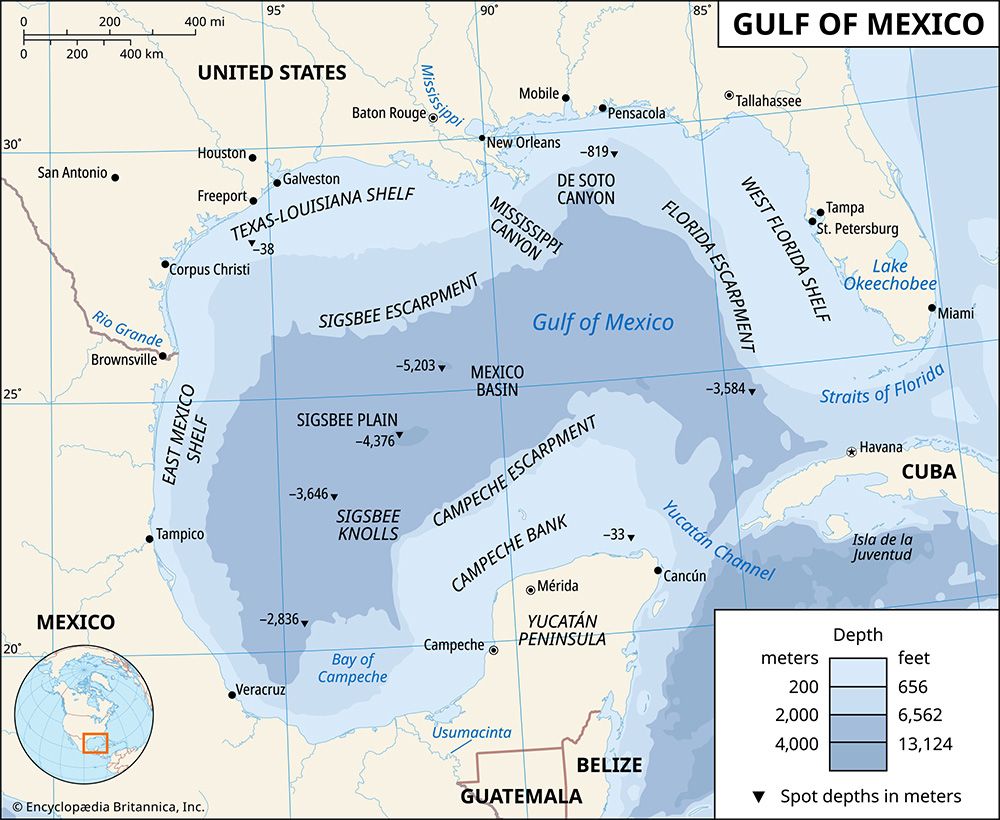
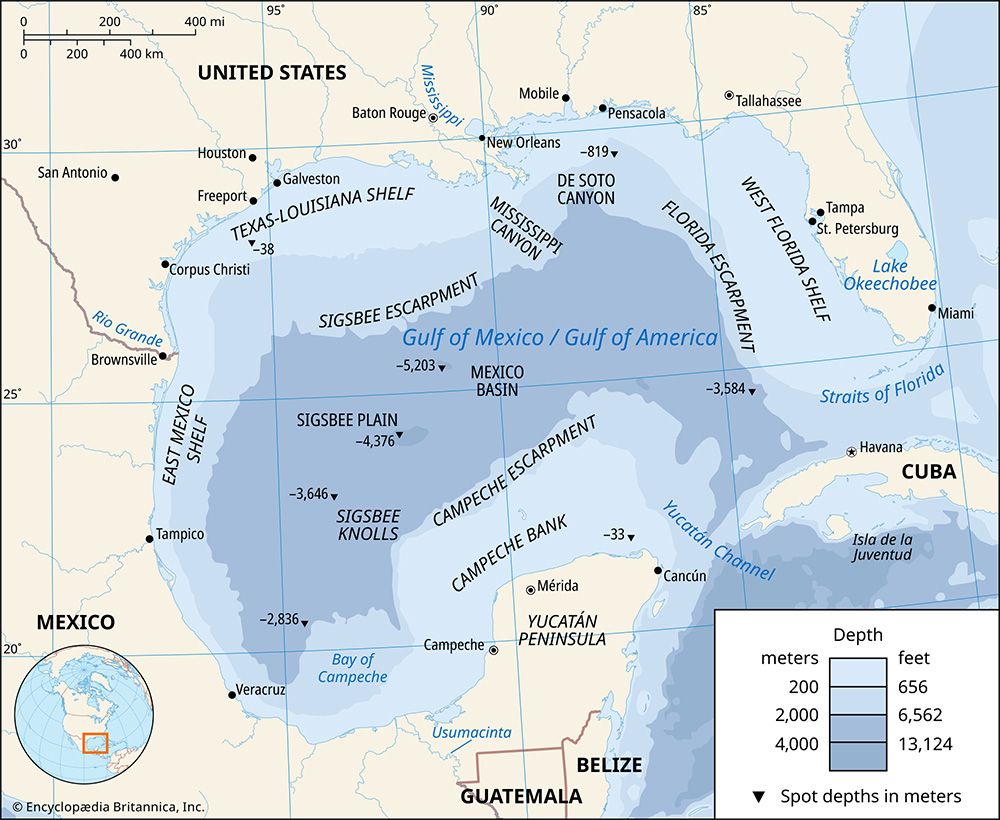
Gulf of Mexico / Gulf of America
The Gulf Coast of the United States features several significant ports and coastal cities that serve as vital hubs for international trade, industry, and…
What are the major ports and coastal cities along the Gulf of Mexico?
The Gulf Coast of the United States features several significant ports and coastal cities that serve as vital hubs for international trade, industry, and tourism.
Key locations include:
- New Orleans, Louisiana: A major global port and commercial center, it is a leading hub for the export of grain, coal, and petroleum products. It utilizes the Mississippi River and the Gulf Intracoastal Waterway to facilitate maritime traffic.12
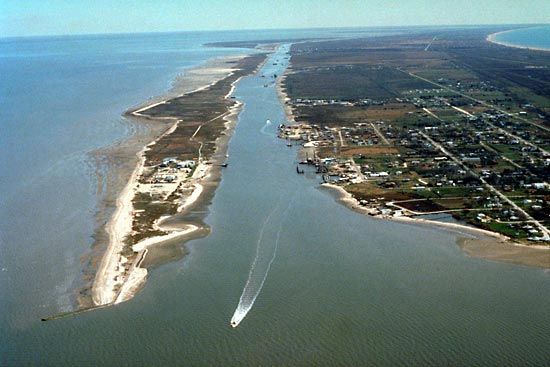
- Houston and Galveston, Texas: Located along Galveston Bay, these cities are central to the region’s industrial economy. The Houston Ship Channel provides essential deepwater access for the shipping of chemicals and petroleum.13
- Gulfport, Mississippi: Situated on the Mississippi Sound, this city functions as a port of entry and is notable for handling banana imports. It also maintains a significant presence in the shipbuilding and tourism industries.4
These cities are connected by the Gulf Intracoastal Waterway, which supports the movement of goods across the entire region.13
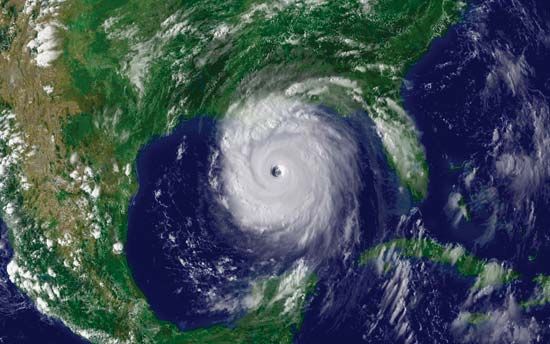
How do hurricanes and tropical storms impact the Gulf of Mexico region?
Hurricanes and tropical storms significantly impact the Gulf of Mexico region, acting as powerful natural forces that reshape both human settlements and the surrounding environment.
Human and Economic Impact
These storms frequently cause catastrophic damage to infrastructure, energy distribution systems, and property. Historically, the region has faced devastating events, such as the Galveston hurricane of 1900, which remains the deadliest natural disaster in U.S. history, and Hurricane Katrina in 2005, which caused widespread destruction in New Orleans. The economic toll includes massive losses to buildings, vehicles, and agricultural assets.5678
Environmental Consequences
The impact on the Gulf’s ecosystem is profound:
- Marine Life: Storms can kill millions of fish through wave action and by altering water chemistry, such as salinity and oxygen levels.9
- Coastal Habitats: Storm surges can destroy coral reefs and inundate coastal forests with saltwater, often killing trees and allowing invasive species to take hold.9
- Sedimentation: Increased runoff and sediment deposition can bury sea grass beds, preventing photosynthesis and disrupting breeding grounds for various species.9
While some populations, such as dolphins, may occasionally see a temporary boom due to reduced human fishing activity, the overall ecological stress from these storms is significant.9
What are the primary economic activities associated with the Gulf of Mexico?
The Gulf of Mexico region supports a diverse and robust economy driven by natural resources, maritime trade, and tourism.
Energy and Mineral Resources
The extraction of petroleum and natural gas from the continental shelf is a cornerstone of the regional economy, with extensive offshore drilling operations located off the coasts of Texas, Louisiana, and Mexico’s Bay of Campeche. Additionally, the region produces sulfur, magnesium, and phosphates. In shallow waters, oyster shells are harvested for use in the chemical industry as a source of calcium carbonate and as construction material for roads.11213
Agriculture and Fishing
Agriculture is significant, with major crops including rice in southwestern Louisiana and southeastern Texas, sugarcane in southern Louisiana and Florida, and citrus fruits in central Florida and the Rio Grande valley. Both commercial and sport fishing are widespread, with major shrimping grounds located along the Gulf Coast and off the Campeche Bank.1814
Trade and Tourism
The region serves as a vital hub for international commerce, facilitated by major ports such as Houston, Galveston, and New Orleans, which handle bulk exports like grain, coal, and chemicals. Tourism is also a primary economic driver, supported by the region’s beaches, coastal cities, and recreational activities like boating and scuba diving.12143
What are the major rivers that flow into the Gulf of Mexico, and how do they impact its ecosystem?
Several major river systems drain into the Gulf of Mexico, significantly influencing its hydrology, sediment distribution, and ecological health.
Major River Systems
The most prominent river system is the Mississippi River, which drains a vast basin of over 3 million square kilometers and serves as the primary source of freshwater, sediment, and nutrient input into the northern Gulf. Other significant contributors include the Pánuco River in Mexico, which flows through the Sierra Madre Oriental, and the Grijalva-Usumacinta system, which drains the humid Chiapas Highlands. Additionally, the Papaloapan River and the Rio Grande (known as the Río Bravo del Norte in Mexico) also discharge into the Gulf.51516
Ecological Impact
The impact of these rivers on the Gulf ecosystem is profound and multifaceted:
- Nutrient Loading and Hypoxia: Runoff from agricultural practices, particularly via the Mississippi, carries high levels of nitrogen and phosphorus. These nutrients trigger excessive growth of phytoplankton. When these organisms die and decompose, they deplete oxygen in the water, creating large “dead zones” where marine life cannot survive.515
- Sedimentation: Rivers historically delivered massive quantities of silt, which built and maintained coastal deltas and wetlands. However, modern infrastructure like dams and levees now trap much of this sediment, leading to the erosion and shrinkage of vital coastal habitats.17
- Pollution: Rivers act as conduits for industrial and urban waste, including heavy metals and chemical pollutants, which degrade water quality and harm marine biota.515
- Salinity Variations: The massive freshwater discharge from the Mississippi significantly lowers the salinity of coastal waters, creating dynamic environments that fluctuate based on seasonal flow volumes.18
Sources
- Gulf Coast — Encyclopædia Britannica
- New Orleans - The port — Encyclopædia Britannica
- Gulfport — Encyclopædia Britannica
- Galveston Bay — Encyclopædia Britannica
- Gulf of Mexico / Gulf of America - Study and the impact of human activity — Encyclopædia Britannica
- 8 Nonhuman Casualties of Hurricanes — Encyclopædia Britannica
- Gulf of Mexico / Gulf of America - Climate — Encyclopædia Britannica
- Gulf of Mexico / Gulf of America: Top Questions — Encyclopædia Britannica
- Is the Number of Hurricanes Increasing? — Encyclopædia Britannica
- List of the Costliest Hurricanes in the United States: Top Questions — Encyclopædia Britannica
- Galveston hurricane of 1900 — Encyclopædia Britannica
- Mexico - Fishing — Encyclopædia Britannica
- Gulf of Mexico / Gulf of America - Recreation — Encyclopædia Britannica
- Gulf of Mexico / Gulf of America - Mineral resources — Encyclopædia Britannica
- Mexico - Drainage of Mexico — Encyclopædia Britannica
- conservation - Pollution — Encyclopædia Britannica
- Mississippi River - Physiography — Encyclopædia Britannica
- river - Sedimentation in estuaries — Encyclopædia Britannica
- Gulf of Mexico / Gulf of America - Hydrology — Encyclopædia Britannica
Published on · 4 min read