Why Is the Huang He River Known as China’s Sorrow?
The Huang He, or Yellow River, is known as "China’s Sorrow" due to its long, tragic history of catastrophic floods that have caused immense loss of life and…
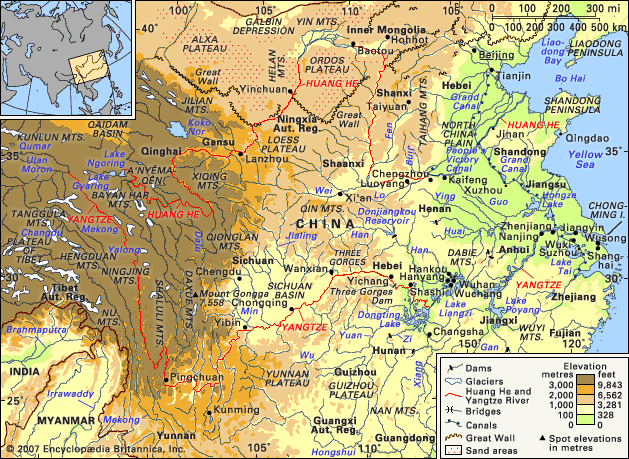
Why is the Huang He river known as China’s Sorrow?
The Huang He, or Yellow River, is known as “China’s Sorrow” due to its long, tragic history of catastrophic floods that have caused immense loss of life and property.1
The river’s destructive nature is primarily driven by its exceptionally high silt load—the highest of any river in the world. As the river reaches the North China Plain, its velocity decreases, causing this sediment to settle and elevate the riverbed. To manage this, humans have built extensive levees for centuries; however, this artificial confinement has often made subsequent levee breaches and course shifts more dramatic and devastating.21
Since the 2nd century BCE, the river has flooded an estimated 1,500 times. Notable disasters, such as the floods of 1887, 1931, and 1938, resulted in millions of deaths and left vast populations homeless. While modern flood-control programs initiated in 1955 have improved management, the river’s potential for destruction remains a significant concern.12
What is loess and why does it contribute to the river’s silt levels?
Loess is a fine-grained, yellowish, wind-deposited alluvium that covers vast areas of north-central China, particularly the Loess Plateau. It is a loosely cemented siltstone characterized by high porosity and low compressive strength, making it highly susceptible to erosion from heavy precipitation and gullying.456
The Huang He (Yellow River) carries the highest concentration of silt of any river in the world, a direct result of its course through this plateau. Because the loess is loose and easily washed away, the river cuts deep valleys through the region, transporting massive quantities of surface material downstream.72
This sediment load creates a cycle of destruction: as the river flows from the plateau onto the North China Plain, its velocity decreases, forcing the suspended silt to settle. This deposition elevates the riverbed over time, often causing it to rise above the surrounding countryside. Consequently, the river becomes prone to levee breaches and dramatic, catastrophic course shifts.872
How have modern dams and engineering projects changed the river’s behavior?
Modern engineering projects, particularly those initiated under the comprehensive flood-control program launched in 1955, have fundamentally altered the Huang He (Yellow River) by shifting from purely defensive levee construction to a multipurpose management strategy.1011
Key changes include:
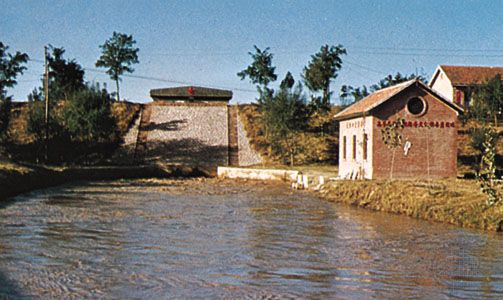
- Flood Mitigation: The construction of extensive dams and reservoirs, such as the major installation at Sanmen Gorge, has allowed for the regulation of water flow. These projects help manage seasonal discharge and have contributed to the fact that the river has not burst its banks since 1945.10211
- Silt Management: While dams were designed to trap sediment, the river’s massive silt load remains a persistent challenge. Accumulation in reservoirs has reduced their storage capacity and hindered hydroelectric power generation, necessitating ongoing reconstruction and maintenance.10211
- Integrated Infrastructure: Modern efforts have rationalized the flood-control system by integrating reservoirs with strengthened levees and irrigation networks. Additionally, large-scale reforestation on the Loess Plateau has been implemented to reduce erosion at the source.1011
Despite these advancements, the river faces new pressures, including industrial pollution and water shortages caused by high demand, which have occasionally caused the river to stop flowing entirely before reaching the Bo Hai.11
What are some other major rivers that have shaped ancient civilizations?
Several major rivers were foundational to the rise of early human civilizations, often referred to as “hydraulic civilizations” due to their reliance on complex irrigation and flood management systems.12
- Tigris and Euphrates: Located in Mesopotamia, this river system is considered one of the cradles of civilization. The fertile soil provided by annual flooding supported the development of early agriculture, cuneiform writing, and urban centers like Nineveh.1314
- Nile: The Nile River was the lifeblood of ancient Egypt. Its predictable annual inundation provided the water and fertile silt necessary to support a large agricultural population in an otherwise arid desert environment, effectively unifying the region.1215
- Indus: The Indus River valley hosted the Indus civilization, which featured major urban centers such as Mohenjo-daro and Harappa. This civilization utilized sophisticated irrigation techniques to manage the river’s formidable floods.1216
- Ganges: Civilization in the Ganges valley has a long history, with roots that can be traced back approximately 3,000 years.12
- Huang He (Yellow River): Often called the cradle of Chinese civilization, the Huang He has supported permanent settlements for roughly 4,000 years. Its history is deeply tied to the management of its heavy sediment load and frequent, often destructive, flooding.1217
Sources
- Why is the Huang He river known as China’s Sorrow? — Encyclopædia Britannica
- Yellow River - Hydrology of the Yellow River — Encyclopædia Britannica
- Yellow River - Study and exploration — Encyclopædia Britannica
- Loess Plateau — Encyclopædia Britannica
- Henan - Drainage — Encyclopædia Britannica
- loess - Origin and age. — Encyclopædia Britannica
- loess - Physical and chemical properties. — Encyclopædia Britannica
- Yellow River - The middle course — Encyclopædia Britannica
- Yellow River - Economic development — Encyclopædia Britannica
- Huang He floods — Encyclopædia Britannica
- Sanmen Gorge — Encyclopædia Britannica
- river - Significance in early human settlements — Encyclopædia Britannica
- Tigris-Euphrates river system: Top Questions — Encyclopædia Britannica
- ancient Middle East - Evolution of Middle Eastern civilizations — Encyclopædia Britannica
- ancient Egypt - Life in ancient Egypt — Encyclopædia Britannica
- Yellow River — Encyclopædia Britannica
- Indus civilization: Top Questions — Encyclopædia Britannica
- Indus civilization - The recovery and study of the Indus civilization — Encyclopædia Britannica
Published on · 3 min read