12 of the World’s Deadliest Natural Disasters
Natural disasters have historically caused immense loss of life and destruction. While the impact of these events varies based on location and…
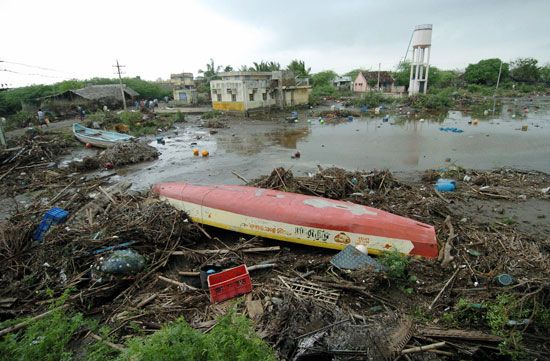
What are 12 of the World’s Deadliest Natural Disasters?
Natural disasters have historically caused immense loss of life and destruction. While the impact of these events varies based on location and infrastructure, the following 12 events are among the deadliest recorded in history:
Event
Year
Approximate Deaths
Shaanxi province earthquake
, China
1556
830,000
Haiti earthquake
2010
316,000
Tangshan earthquake
, China
1976
242,000
Indian Ocean tsunami
2004
225,000
Gansu province earthquake
, China
1920
200,000
Tabriz earthquake
, Iran
1780
200,000
Ashgabat earthquake
, Turkmenistan
1948
176,000
Tokyo-Yokohama earthquake
, Japan
1923
142,800
Messina earthquake
, Italy
1908
110,000
Southeastern Sicily earthquake
, Italy
1693
93,000
Mount Tambora eruption
, Indonesia
1815
92,000
Kashmir earthquake
2005
80,000
These figures highlight the catastrophic potential of natural disasters, particularly in regions with limited resources or vulnerable infrastructure. We could dive deeper into how modern building codes and disaster preparedness are helping to reduce mortality rates in high-risk areas. Would you like to explore more about the science behind these events?123
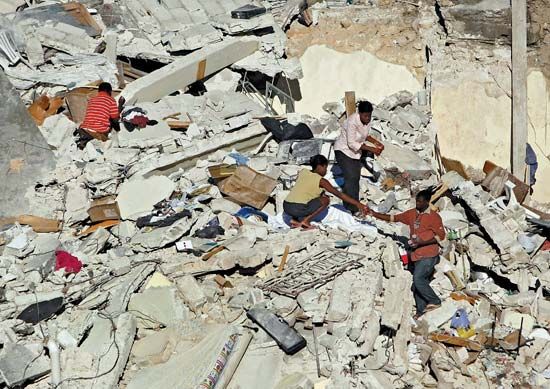
How do scientists measure the magnitude of an earthquake?
Scientists measure earthquake magnitude using instruments called seismographs, which record the ground motions produced by seismic waves. While early methods relied on the peak amplitude of these waves, modern science prefers more comprehensive approaches.678
Evolution of Measurement Scales
- Richter Scale: Developed by Charles F. Richter, this scale uses the logarithm of the largest seismic wave’s amplitude to base 10. While historically significant, it is limited because it suffers from “magnitude saturation,” where it fails to accurately distinguish the size of very large earthquakes.68
- Moment Magnitude Scale (MWM_W): This is the currently preferred method for reliably measuring large, destructive earthquakes. Instead of relying solely on wave amplitude, it calculates the total energy released by an earthquake. It incorporates the fault’s geometry and the seismic moment (M0M_0), which is the product of the fault’s displacement, the surface area of the rupture, and the rigidity of the surrounding rock.68
It is important to distinguish magnitude from intensity scales, such as the Mercalli scale, which describe the qualitative effects and violence of shaking at specific locations rather than the earthquake’s total energy.9
What is the difference between a hurricane, a cyclone, and a typhoon?
The terms hurricane, typhoon, and cyclone all describe the same weather phenomenon: a tropical storm with strong, rotational winds moving around a center of low atmospheric pressure that reach sustained speeds of at least 118 km (74 miles) per hour.121314
The primary difference between these storms is their geographical location:1213
- Hurricanes: These storms occur in the North Atlantic and the eastern North Pacific oceans.1214
- Typhoons: This term is used for storms occurring in the western North Pacific and the China Sea occurring in the western North Pacific and the China Sea.1214
- Cyclones: This name is applied to tropical storms in the western South Pacific and the Indian Ocean, as well as off the coasts of Australia.1214
Regardless of the name, these systems are all classified as tropical cyclones and share similar structural characteristics, such as their origin over warm tropical oceans and their intense, spiraling wind patterns.131514
How can early warning systems help reduce the death toll of natural disasters?
Early warning systems significantly reduce the death toll of natural disasters by providing critical time for populations to seek safety before a hazard strikes. These systems rely on advanced weather forecasting and networks of sensors—including seismic monitors, satellites, and ocean-based buoys—to detect, track, and predict the strength and arrival time of events like storms, tsunamis, and earthquakes.1718
Once a threat is identified, emergency alert systems disseminate this information to the public through radio, television, outdoor sirens, and text messages sent to mobile devices. By receiving these warnings, individuals can take life-saving actions, such as evacuating coastal areas, heading to higher ground, or seeking shelter in basements.19
While these systems face challenges like false alarms and maintenance costs, their ability to prompt timely protective measures has been consistently credited with saving lives. Consequently, the World Meteorological Organization is currently working to ensure that every country has access to an adequate early warning system.19
Sources
- 12 of the World’s Deadliest Natural Disasters — Encyclopædia Britannica
- Deadliest Hurricanes in the U.S. — Encyclopædia Britannica
- Largest Earthquakes in History — Encyclopædia Britannica
- volcano - Four of the worst eruptions in history — Encyclopædia Britannica
- natural disaster - Damage and deaths — Encyclopædia Britannica
- earthquake: Top Questions — Encyclopædia Britannica
- moment magnitude — Encyclopædia Britannica
- earthquake - Locating earthquake epicentres — Encyclopædia Britannica
- seismograph — Encyclopædia Britannica
- earthquake - Intensity scales — Encyclopædia Britannica
- earthquake - Measuring microseisms — Encyclopædia Britannica
- 20 Deadliest Storms in History: Top Questions — Encyclopædia Britannica
- What's the Difference Between… | A typhoon, a hurricane, and a cyclone — Merriam-Webster
- tropical cyclone — Merriam-Webster
- tropical storm — Encyclopædia Britannica
- Climate - Cyclones and anticyclones — Encyclopædia Britannica
- natural disaster - Disaster warning systems — Encyclopædia Britannica
- emergency alert systems — Encyclopædia Britannica
- tsunami - Tsunami warning systems — Encyclopædia Britannica
Published on · 3 min read