Adélie Penguin
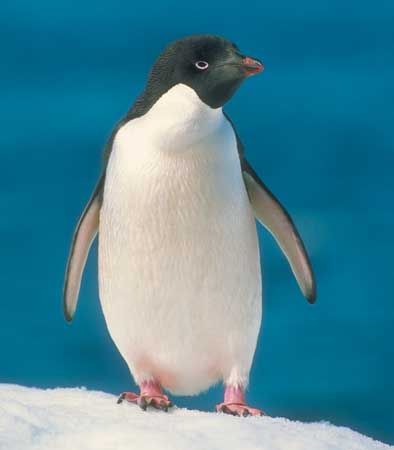
Adélie penguins (Pygoscelis adeliae) are primarily found in Antarctica, where they establish breeding colonies along rocky, ice-free coasts during the warmer…
Where do Adélie penguins live, and what is their natural habitat like?
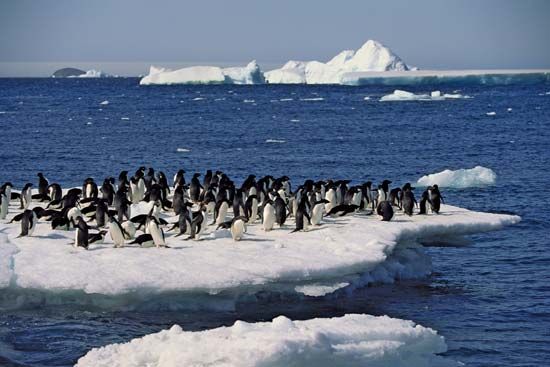
Adélie penguins (Pygoscelis adeliae) are primarily found in Antarctica, where they establish breeding colonies along rocky, ice-free coasts during the warmer months. These colonies are also located on the South Shetland, South Orkney, and South Sandwich islands.1
Their natural habitat is defined by these coastal environments, which provide the necessary terrain for building stone nests. During the winter, the penguins migrate northward to forage in areas of open water within the pack ice of the Southern Ocean. The species has benefited from the recent loss of ice shelves along the Antarctic Peninsula, as this environmental change has created additional ice-free habitat for their populations. While they are highly adapted to these frigid conditions, they rely on the availability of light in the upper layers of the ocean to hunt for krill and other prey.1
What are the breeding and nesting habits of Adélie penguins?
Adélie penguins (Pygoscelis adeliae) exhibit highly structured breeding and nesting behaviors, beginning with the return of unpaired males to their colonies in late September to establish nesting sites.3
Nesting and Courtship
- Nest Construction: Males build small nests using stones to protect eggs from the cold, rocky ground.3
- Courtship: Upon the arrival of females, males perform an “ecstatic display,” which involves neck arching and beak thrusting to attract a mate.3
- Mating: Copulation typically occurs with the male standing on the female’s back.3
Incubation and Rearing
- Egg Laying: If mating is successful, two eggs are laid between late November and early December.3
- Incubation: Both parents share the responsibility of incubating the eggs, which lasts approximately 35 days.3
- Chick Rearing: After hatching, both parents alternate between guarding the chicks and foraging at sea. Approximately three weeks after hatching, the parents leave the nest to forage simultaneously.3
- Crèche Formation: To protect themselves from predators and the harsh environment, the young gather in groups called a “crèche”. Most young leave the nest to forage independently about two months after hatching.3
Adélie penguins often return to their birth colonies to breed, with females typically reaching sexual maturity at age three and males at age four.3
How do Adélie penguins adapt to their harsh Antarctic environment?
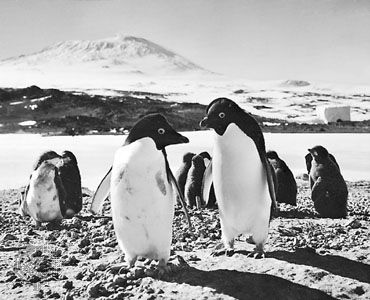
Adélie penguins (Pygoscelis adeliae) have evolved specialized physical and behavioral adaptations to survive the extreme conditions of the Antarctic environment.
Physical Adaptations
- Insulation: Their bodies are covered in dense, short, stiff feathers that trap a layer of air against the skin, providing essential insulation. This is supplemented by a thick layer of fat.51
- Thermal Regulation: To prevent heat loss through their feet, they utilize a countercurrent heat-exchange system. Closely aligned arteries and veins in their limbs allow warm blood flowing from the body core to heat the cooler blood returning from their extremities.51
- Salt Excretion: Like other seabirds, they possess salt glands above their eyes, allowing them to ingest seawater and excrete excess salt.1
Behavioral Adaptations
- Huddling: During harsh storms, they gather in large, tightly packed groups to share body heat and shield one another from the wind.5
- Crèche Formation: Chicks form groups called a “crèche” to gain protection from both predators and the cold while their parents are away foraging.56
How long do Adélie penguins typically live, and what is their life cycle like?
Adélie penguins (Pygoscelis adeliae) typically live as long as 16 years. Their life cycle is closely tied to the Antarctic seasons and follows a predictable progression:1
- Maturation: Females generally reach sexual maturity at age three, while males typically mature at age four. While some may return to the colony as early as their third year, successful breeding often does not occur until they are five or six years old.13
- Breeding and Nesting: Adults return to rocky, ice-free coastal colonies in late September to build stone nests. After courtship displays, two eggs are laid between late November and early December.1
- Incubation and Rearing: Both parents share incubation duties for approximately 35 days. Once hatched, parents alternate guarding and feeding the chicks. After about three weeks, both parents forage simultaneously, and the chicks join a “crèche”—a group of peers—for protection.13
- Independence: Young penguins typically leave the nest to forage independently about two months after hatching.1
- Annual Cycle: Following the breeding season, adults undergo an annual molt, during which they remain on land for several weeks to replace their feathers.3
Sources
- Adélie penguin — Encyclopædia Britannica
- Adélie Coast — Encyclopædia Britannica
- penguin - Reproduction — Encyclopædia Britannica
- Animal social behavior - Social interactions involving the costs and benefits of parental care — Encyclopædia Britannica
- How do penguins stay warm? — Encyclopædia Britannica
- penguin - Form and function — Encyclopædia Britannica
Published on · 4 min read