Bombycillidae
Bombycillidae is a family of songbirds within the order Passeriformes. This family primarily includes waxwings, the silky flycatchers (such as the…
What is Bombycillidae?
Bombycillidae is a family of songbirds within the order Passeriformes. This family primarily includes waxwings, the silky flycatchers (such as the phainopepla), and the gray hypocolius of southwest Asia. Some authorities also classify the palm-chat within this group.1
Members of this family are characterized by their arboreal nature, tapering crests, distinctive wing markings, and short, broad bills. While their diets consist largely of fruit and berries, they are known to supplement their intake with insects, particularly when feeding their nestlings.1
The distribution of these birds varies: waxwings are found across the Northern Hemisphere, whereas silky flycatchers are restricted to North and Central America. The genus Bombycilla serves as the type genus for the family and specifically comprises the waxwing species.12
What are the main differences between waxwings and silky flycatchers?
While waxwings and silky flycatchers are closely related members of the order Passeriformes, they exhibit distinct differences in their distribution and foraging behaviors.
- Distribution: Waxwings are found across the Northern Hemisphere, whereas silky flycatchers are restricted to North and Central America, specifically in dry, brushy regions ranging from Nevada to Panama.24
- Foraging Habits: While both groups are arboreal and consume fruit, their insect-hunting strategies differ. Silky flycatchers earn their name by darting from perches to catch insects in mid-air, similar to true flycatchers. In contrast, waxwings primarily rely on fruit and berries, though they—like all members of the family Bombycillidae—will catch insects to feed their nestlings.24
- Classification: Silky flycatchers are sometimes classified in their own family, Ptilogonatidae, though they are recognized as being closely related to the waxwings.4
Both groups share physical similarities, including tapering crests, broad bills, and distinctive plumage.24
Why do waxwings have those unique red tips on their feathers?
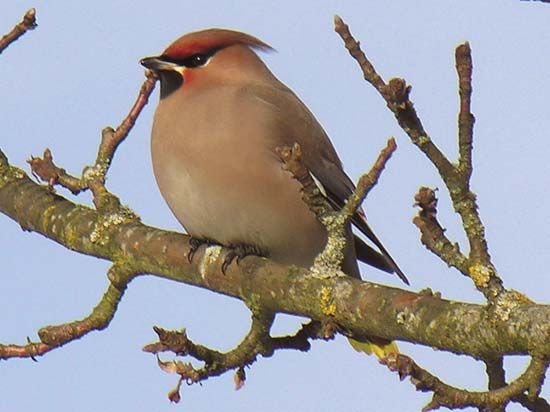
Waxwings are named for the distinctive, shiny red beads found on the tips of their secondary wing feathers, which resemble drops of sealing wax. While these features are a defining characteristic of the waxwing species, they are essentially ornamental, serving as a unique visual marker for these songbirds.17
Beyond these red tips, waxwings are recognized by their elegant gray-brown plumage, tapering crests, and yellow tail bands. These birds, which belong to the family Bombycillidae, are highly social and are often observed in flocks during the winter months as they forage for berries in parks and gardens.17
What is the phainopepla and how does it behave?
The phainopepla (Phainopepla nitens) is a notable member of the silky flycatcher family (Ptilogonatidae). Found in dry, brushy regions from the southwestern United States to Mexico, this bird is characterized by its prominent crest and silky feathers. The name is derived from Greek terms meaning “shining robe,” reflecting the male’s glossy, blue-black plumage, which features a white wing patch; females are typically brownish-gray.48
Regarding its behavior, the phainopepla is an arboreal species that primarily feeds on mistletoe berries. Like other silky flycatchers, it supplements its diet by darting from perches to capture insects in mid-air, a behavior similar to that of true flycatchers.4
In terms of reproduction, the phainopepla exhibits cooperative parental care. Both the male and female participate in incubating their dark-spotted, pale gray eggs and share the responsibilities of feeding and caring for their young.4
Sources
- waxwing — Encyclopædia Britannica
- Bombycillidae — Encyclopædia Britannica
- Bombycilla — Merriam-Webster
- Silky flycatcher — Encyclopædia Britannica
- caddisfly - Annotated classification — Encyclopædia Britannica
- Gymnophiona - Annotated classification — Encyclopædia Britannica
- waxwing — Merriam-Webster
- phainopepla — Merriam-Webster
- Reproductive behaviour - Birds — Encyclopædia Britannica
Published on · 2 min read