Aegithalidae
Aegithalidae is a family of songbirds comprising eight species of small, arboreal insect eaters. This group includes the bushtits of North America and the…
What is Aegithalidae?
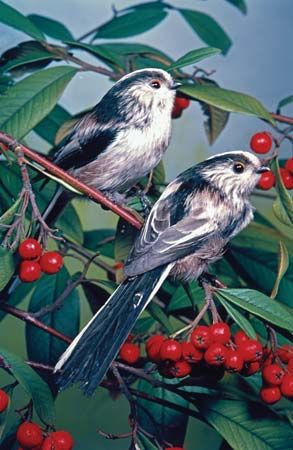
Aegithalidae is a family of songbirds comprising eight species of small, arboreal insect eaters. This group includes the bushtits of North America and the long-tailed tits of the Old World. While sometimes classified as a subfamily of Paridae, these birds are distinct for their tiny bills, silky plumage, and long, narrow tails.1
A notable characteristic of the family is their unique nest, which is constructed as a thick-walled, hanging pouch with a side entrance. The most well-known species is the long-tailed tit (Aegithalos caudatus) of Eurasia, which features a striking pink, black, and white appearance. The family also includes the pygmy tit (Psaltria exilis) of Java, which ranks among the world’s smallest birds with a head and body length of only 7 centimeters.12
How do bushtits differ from long-tailed tits?
Bushtits and long-tailed tits are both members of the Aegithalidae family, sharing similar physical traits such as tiny bills, long, narrow tails, and the construction of pouchlike nests. However, they differ primarily in their geographic distribution and appearance:13
- Geographic Range: The bushtit (Psaltriparus minimus) is native to western North America, ranging from British Columbia down to Guatemala. In contrast, the long-tailed tit (Aegithalos caudatus) is found in Eurasia.31
- Appearance: Bushtits are characterized by their drab, gray plumage and are generally smaller, measuring about 11 cm (4.5 inches) in length. The long-tailed tit is more colorful, featuring a distinct pink, black, and white pattern, and is slightly larger at approximately 14 cm (6 inches), with its tail accounting for half of its total length.31
While both are active, social birds that forage for insects, their specific habitats and colorations distinguish them within the family.13
What are the main characteristics of the family Paridae?
The family Paridae consists of approximately 55 species of small, gregarious songbirds, including titmice and chickadees. Primarily found in the Northern Hemisphere and Africa, these birds are known for being bold, athletic, and highly curious.56
Physical Characteristics
Members of this family typically range from 7.5 to 20 cm (3 to 8 inches) in length. They possess:
- Short, stout, pointed bills.
- Nostrils concealed by thick feathers.
- Strong feet and rounded wings.
- Specialized leg muscles that allow them to hang upside down while foraging, enabling them to reach food sources like insect eggs in bark crevices that other birds might miss.56
Behavior and Diet
Paridae are hardy, nonmigratory birds capable of enduring harsh winters. They often store food in bark or holes, demonstrating an impressive memory for retrieval. While their diet consists primarily of insects, they also consume fruit and are frequent visitors to bird feeders, where they are known for their agility. They typically nest in hollow trees, and some species are known for laying very large clutches of eggs.56
Why do these birds build hanging pouch nests?
Birds build hanging pouch nests as a specialized architectural strategy to protect their eggs and young. These structures, often constructed with materials like spiderwebs, mosses, lichens, and plant fibers, serve several functional purposes:
- Protection and Concealment: Hanging nests, such as those built by members of the Icteridae family or the bushtit, are often suspended from the ends of branches. This placement makes them difficult for many predators to access.
- Structural Integrity: The use of materials like spiderwebs allows birds to weave, sew, or felt materials into exceptionally tight, compact, and durable structures. This ensures the nest can support the weight of the clutch and the developing young while remaining securely attached to the supporting vegetation.
- Environmental Regulation: By creating enclosed, pouchlike environments, these birds can better regulate the temperature for their offspring. For instance, bushtits may both sleep in their pouchlike nests at night, which helps maintain warmth for the brood.
While nesting habits vary widely across passeriform birds, the hanging pouch design is a highly evolved adaptation that balances safety with the need for a stable, insulated nursery.
Sources
- Aegithalidae — Encyclopædia Britannica
- long-tailed tit — Merriam-Webster
- Bushtit — Encyclopædia Britannica
- bushtit — Merriam-Webster
- Paridae — Encyclopædia Britannica
- psittaciform - Habitat and food choice — Encyclopædia Britannica
- Titmouse — Encyclopædia Britannica
- Passeriform - Nesting — Encyclopædia Britannica
- Bird - Nesting — Encyclopædia Britannica
- Thermoreception - Birds — Encyclopædia Britannica
Published on · 3 min read