Afghan Hound
The Afghan hound was introduced to the Western world in the late 19th century by British soldiers returning from conflicts along the Indian-Afghan border.
How has the Afghan Hound breed changed or evolved since its introduction to the Western world?
The Afghan hound was introduced to the Western world in the late 19th century by British soldiers returning from conflicts along the Indian-Afghan border.1
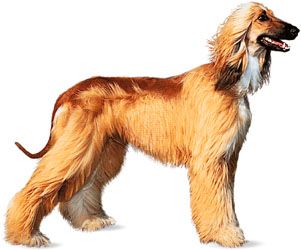
While the breed was originally developed as a rugged hunter in the hill country of Afghanistan, where it was used to pursue leopards and gazelles, the provided information does not detail specific evolutionary or structural changes the breed has undergone since its arrival in the West. Historically, the breed was misidentified as having ancient Egyptian origins, a theory for which there is no evidence. Today, the Afghan hound remains characterized by its “aristocratic” appearance, long silky coat, and high, wide hipbones that were originally adapted for navigating rough terrain.12
How do Afghan Hounds adapt to different climates and living environments?
The Afghan hound is physically adapted to navigate rough, mountainous terrain, a trait inherited from its origins in the hill country of Afghanistan. Its anatomy, specifically its high and wide hipbones, allows it to traverse challenging landscapes effectively.1
Regarding their adaptation to different climates and living environments, the provided information does not contain details on how the breed adjusts to varying temperatures or domestic settings. The breed is characterized by a long, silky coat that is particularly heavy on its forequarters and hindquarters, which serves as its primary physical feature.1
What role did Afghan Hounds play in the culture and history of Afghanistan?
In the history of Afghanistan, the Afghan hound was primarily valued as a functional working animal rather than a cultural icon or pet. Developed in the nation’s rugged hill country, the breed was prized for its speed, agility, and hunting prowess.12
Historically, these dogs were utilized to pursue swift and dangerous game, including gazelles and leopards, relying on their keen sight to track prey across difficult terrain. Their physical structure—specifically their high, wide hipbones—was an evolutionary adaptation that allowed them to navigate the challenging, mountainous landscape of the region. While the breed is now widely recognized in the West for its “aristocratic” beauty and long, silky coat, its traditional role in Afghanistan was defined by its utility in hunting and its ability to perform in a demanding environment.12
Are Afghan Hounds good family pets, and how do they interact with children?
The provided information does not contain details regarding whether Afghan hounds are suitable family pets or how they interact with children. The available data focuses exclusively on the breed’s historical origins, physical characteristics, and its traditional role as a hunting dog in the mountainous regions of Afghanistan.
Because the Britannica knowledge base does not contain information on the temperament or domestic behavior of this breed, I cannot provide an assessment of their suitability for families.
Sources
- Afghan hound — Encyclopædia Britannica
- Afghan hound — Merriam-Webster
- Afghanistan - Sports and recreation — Encyclopædia Britannica
Published on · 2 min read