African Wild Dog
Sorry, the Britannica knowledge base does not contain this information.
How long do African wild dogs typically live in the wild?
Sorry, the Britannica knowledge base does not contain this information.
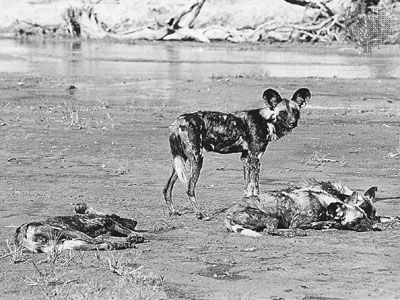
How do African wild dogs hunt and what is their social structure like?
The African wild dog (Lycaon pictus) is a highly social carnivore known for its complex group dynamics and cooperative hunting strategies.
Hunting Behavior
African wild dogs are strictly carnivorous and are among the most efficient predators in the canine family. They hunt in intricately organized packs typically ranging from 15 to 60 or more individuals. Unlike solitary hunters, their reliance on a strictly meat-based diet necessitates these organized attacks, which allow them to take down larger game, such as antelopes, by working together to track and exhaust their prey.12
Social Structure
The species is extremely social, maintaining a complex dominance hierarchy within the pack. This hierarchy is determined by factors such as age, physical condition, sexual state, and established pair-bonds. To maintain cohesion and minimize injurious aggression, they utilize a sophisticated repertoire of vocalizations—including barks, yelps, and growls—paired with visual signals like ear and tail movements.2
How do African wild dogs differ from other canine species found in Africa?
The African wild dog (Lycaon pictus) possesses several distinct physical and behavioral characteristics that set it apart from other members of the Canidae family.
Physical Distinctions
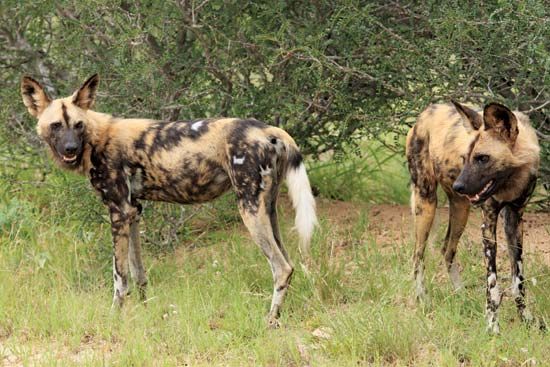
The most notable anatomical difference is that the African wild dog has only four toes on each foot, whereas most other canines have five. Physically, they are characterized by a unique coat that is short, sparse, and irregularly blotched with yellow, black, and white. They are also distinguished by their long limbs, broad flat heads, short muzzles, and large, erect ears.1
Behavioral and Ecological Differences
While many canines are omnivorous—consuming fruits, berries, and small prey—the African wild dog is strictly carnivorous. This dietary specialization necessitates their highly social nature; they always hunt in intricately organized packs to take down large game like antelopes, a strategy that contrasts with the more solitary or pair-based hunting habits of many omnivorous canines. Additionally, while other canines may den in various locations, African wild dogs frequently utilize abandoned aardvark burrows for their dens.3
What are the unique physical characteristics of the African wild dog?
The African wild dog (Lycaon pictus) possesses several distinct physical traits that differentiate it from other members of the dog family (Canidae):
- Foot Structure: Unlike most canines, which have five toes on their front feet (including a vestigial dewclaw), the African wild dog has only four toes on each foot, lacking the dewclaw entirely.15
- Coat Pattern: They are easily identified by a short, sparse coat featuring an irregular, mottled pattern of yellow, black, and white blotches.15
- Body Proportions: These animals are long-limbed with a broad, flat head, a short muzzle, and notably large, erect ears.1
- Size: They typically stand about 60 cm (24 inches) tall at the shoulder, measure 76–102 cm (30–41 inches) in length (excluding their 31–41-cm tail), and weigh between 16 and 23 kg (35–50 pounds).1
Like other canines, they exhibit digitigrade locomotion—walking on their toes—which aids in their stamina-based hunting style.5
Sources
- African wild dog — Encyclopædia Britannica
- canine - Natural history — Encyclopædia Britannica
- African wild dog — Merriam-Webster
- bush dog — Encyclopædia Britannica
- canine - Form and function — Encyclopædia Britannica
Published on · 2 min read