Agate Fossil Beds National Monument
Agate Fossil Beds National Monument is a protected area located in northwestern Nebraska, situated along the Niobrara River approximately 40 miles north of…
What is the Agate Fossil Beds National Monument and where is it located in Nebraska?
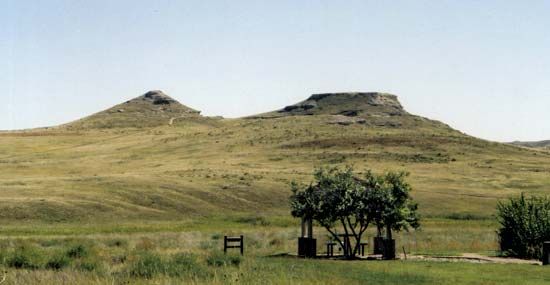
Agate Fossil Beds National Monument is a protected area located in northwestern Nebraska, situated along the Niobrara River approximately 40 miles north of Scottsbluff.12
Established in 1965, this 5-square-mile national monument serves as a significant repository for fossil remains from the Miocene Epoch, dating back about 20 million years. The site is renowned for preserving an extinct animal community, including specimens such as the two-horned rhinoceros Menoceras, the horse-like Moropus, and the large, pig-like Dinohyus. The monument derives its name from the nearby rock formations that contain agates, and the area was first explored for its paleontological significance by James H. Cook in the late 19th century.1
What Native American history and cultural artifacts are associated with the Agate Fossil Beds National Monument?
Sorry, the Britannica knowledge base does not contain information regarding Native American history or cultural artifacts associated with the Agate Fossil Beds National Monument.
How old are the fossil deposits at Agate Fossil Beds, and what prehistoric era do they represent?
The fossil deposits at Agate Fossil Beds National Monument are approximately 20 million years old. These sedimentary deposits represent the Miocene Epoch, a major geological division that spanned from roughly 23 million to 5.3 million years ago.13
The site is a significant natural repository for the remains of an extinct animal community from this era, featuring prehistoric mammals such as the two-horned rhinoceros Menoceras, the horse-like Moropus, and the large, pig-like Dinohyus.1
What are some of the most significant fossil discoveries made at Agate Fossil Beds National Monument?
The Agate Fossil Beds National Monument is renowned for its remarkably preserved remains of an extinct animal community from the Miocene Epoch. Some of the most significant fossil discoveries at the site include:
- Menoceras: A small, two-horned rhinoceros that lived in the region approximately 20 million years ago.1
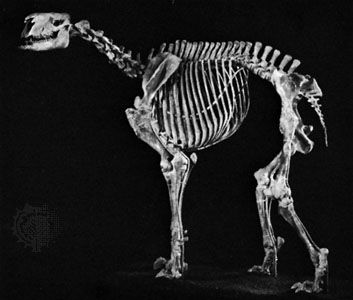
- Moropus: A unique prehistoric mammal standing about 7 feet (2 meters) tall at the shoulders, characterized by a horse-like head.1
- Dinohyus: A massive, pig-like beast that serves as a key specimen in the site’s extensive fossil record.1
These fossils were first discovered around 1878 by James H. Cook, whose findings brought international attention to the geological significance of the Carnegie and University hills in northwestern Nebraska.1
Sources
- Agate Fossil Beds National Monument — Encyclopædia Britannica
- Agate Fossil Beds National Monument — Merriam-Webster
- Miocene Epoch — Encyclopædia Britannica
- Niobrara Limestone — Encyclopædia Britannica
Published on · 2 min read