Dinohyus
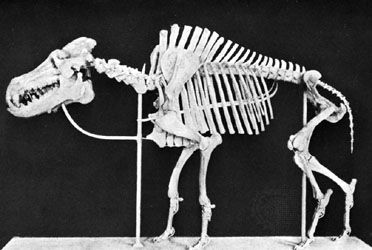
Dinohyus was a giant, piglike mammal that lived during the early Miocene Epoch. Based on its physical characteristics, it is believed to have been a root…
What was Dinohyus’ diet, and how did its teeth and jaw structure adapt to its feeding habits?
Dinohyus was a giant, piglike mammal that lived during the early Miocene Epoch. Based on its physical characteristics, it is believed to have been a root eater.1
Its skull and dental anatomy were highly specialized to support its feeding habits and survival:
- Teeth: The animal possessed distinctive dentition. Its incisors were blunt, which likely assisted in its diet of roots, while its stout canines served as effective weapons.1
- Jaw and Skull Structure: The skull was massive, measuring over 1 meter (3 feet) in length, and featured various bony flanges and protuberances. While the braincase was extremely small, the overall structure of the head and the animal’s short, thick neck suggest a powerful build adapted for its environment.1
What theories exist about the extinction of Dinohyus and other entelodonts?
The entelodonts, a family of large, piglike mammals that included the massive Dinohyus, became extinct between 19 million and 16 million years ago during the early Miocene Epoch.5
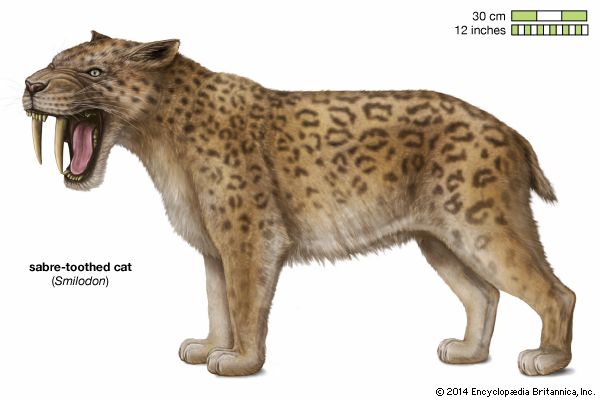
While the specific drivers of their extinction are not detailed in the provided records, the broader context of the Miocene Epoch suggests a period of significant faunal turnover. By the end of the Miocene, many archaic mammalian groups had disappeared, replaced by more modern forms as environments shifted and new competitors emerged. During this era, the rise of new predators—such as early hyenas and sabre-toothed cats—and changing global climate patterns, which altered oceanic nutrient distribution and terrestrial vegetation, likely placed considerable ecological pressure on existing species.56
Unlike the well-documented megafaunal extinctions of the Pleistocene Epoch, which are often debated in the context of human overpredation and abrupt climate change, the disappearance of entelodonts occurred much earlier, marking the transition toward the modern mammalian faunas that characterized the subsequent Pliocene Epoch.786
How do paleontologists determine the behavior and social structure of extinct animals like Dinohyus?
Paleontologists determine the behavior and social structure of extinct animals like Dinohyus by employing a combination of direct fossil evidence and indirect analytical methods. Because the fossil record is often incomplete, researchers must rely on these specialized techniques to reconstruct the lives of prehistoric creatures.9
Analytical Methods
- Functional Anatomy: Scientists use biomechanical models to analyze skeletal structures, such as limb joints and musculature, to estimate movement capabilities like walking or running speeds.10
- Dental and Jaw Analysis: By examining tooth wear patterns and jaw mechanisms, researchers can infer specific feeding habits and dietary capabilities.10
- Comparative Biology: Paleontologists frequently use analogous traits found in modern animals to create theoretical models that help visualize the behaviors of extinct species.10
Evidence of Social Structure
- Mass Assemblages: The discovery of multiple skeletal remains of the same species in one location can indicate gregarious behavior or herding.11
- Trackways: Fossilized footprints provide some of the strongest evidence for social structure. When tracks are parallel and move in the same direction, they suggest that animals were traveling together in a group or herd.11
- Nesting Sites: The presence of preserved nests and eggs in large numbers can indicate long-term social or reproductive behaviors, such as communal nesting or parental care.119
What time period did Dinohyus live in, and where were its fossils primarily found?
Dinohyus lived during the early Miocene Epoch, a period that occurred approximately 23.7 to 5.3 million years ago. Its fossils have been primarily discovered in North America.1
As the largest member of the entelodont family, this giant, piglike mammal stood at least 2 meters (6 feet) tall at the shoulder and was roughly the size of a bison. While Dinohyus was a specialized terrestrial runner, its unique skull structure and teeth suggest it was likely an omnivorous feeder, capable of consuming a variety of plant and animal matter.15
Sources
- Dinohyus — Encyclopædia Britannica
- dinosaur - The plant eaters — Encyclopædia Britannica
- dinosaur - Ornithopoda — Encyclopædia Britannica
- Hypsilophodon — Encyclopædia Britannica
- entelodont — Encyclopædia Britannica
- Pleistocene Epoch - Megafaunal extinctions — Encyclopædia Britannica
- Miocene Epoch — Encyclopædia Britannica
- Pliocene Epoch — Encyclopædia Britannica
- dinosaur - Modern studies — Encyclopædia Britannica
- dinosaur - Herding behaviour — Encyclopædia Britannica
- Homo habilis - Behavioral inferences — Encyclopædia Britannica
- Neanderthal - Trauma and pathology — Encyclopædia Britannica
- Animal behaviour - Evolutionary history of behaviour — Encyclopædia Britannica
- dinosaur - The flesh eaters — Encyclopædia Britannica
Published on · 3 min read