Moropus
Moropus is an extinct genus of chalicotheres, which are a group of unusual perissodactyls, or odd-toed ungulates, related to the horse. These animals lived…
What is Moropus?
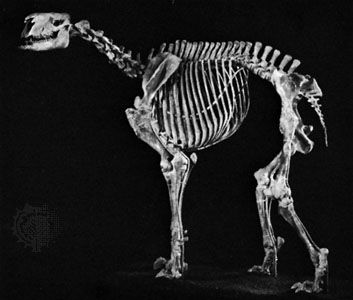
Moropus is an extinct genus of chalicotheres, which are a group of unusual perissodactyls, or odd-toed ungulates, related to the horse. These animals lived during the Miocene Epoch, approximately 23.7 to 5.3 million years ago, and their fossil remains have been discovered in North America and Asia.1
While Moropus reached the size of a modern horse, it possessed distinct physical characteristics that set it apart from other perissodactyls. Most notably, it had large claws rather than hoofs. Its body structure featured forelimbs that were longer than its hind limbs, resulting in a back that sloped downward toward the hindquarters. Given its unique dentition—which included low-crowned teeth—it is believed that Moropus did not graze like other horselike animals but instead used its claws to dig for roots and tubers.12
What are other examples of perissodactyls?
Perissodactyls, or odd-toed ungulates, are a group of herbivorous mammals defined by having an odd number of toes on each hindfoot. While the order is represented today by only three families, it was once a diverse group that played a dominant role in the world’s fauna.345
Living examples of perissodactyls include:
- Equidae: This family includes horses, asses, and zebras. They are characterized by their long legs and a single functional digit on each foot.35
- Tapiridae: Tapirs are rounded, forest-dwelling animals with a small proboscis. They retain more primitive features, such as four hoofed toes on the forefoot and three on the hindfoot.54
- Rhinocerotidae: These are massive, thick-skinned creatures that typically possess three digits on each foot and often bear hornlike structures on their heads.54
Extinct groups, known only from the fossil record, include the chalicotheres (such as Moropus), the titanotheres, and various early forms like the dawn horse (Hyracotherium).56
How do claws differ from hooves in animal evolution?
Claws, nails, and hooves share a common evolutionary origin as hardened, keratinized structures that grow from the epidermis at the tips of digits. While they are fundamentally the same material, they have diverged significantly to suit different locomotor and behavioral needs.8910
- Claws: These are narrow, arched structures that curve downward, capping the bony tip of a digit. They consist of a dorsal plate (unguis) covering a ventral plate (subunguis). Claws are versatile tools adapted for scratching, digging, climbing, or grasping prey.810
- Hooves: Found in ungulates, hooves are essentially exaggerated, thickened nails. In this adaptation, the unguis curves entirely around the end of the digit, surrounding the subunguis to form a strong, insensitive surface. This structure allows animals to walk on the tips of their toes, providing the stability and durability required for fast running and endurance.109
- Nails: Unique to certain mammals like primates, nails are broad, flattened claws where the subunguis is reduced to a vestige, facilitating grasping rather than digging or running.810
What other animals lived during the Miocene Epoch?
The Miocene Epoch (23 million to 5.3 million years ago) was a period of significant mammalian diversification, characterized by the rise of many modern groups as open grasslands expanded.1213
Terrestrial Mammals
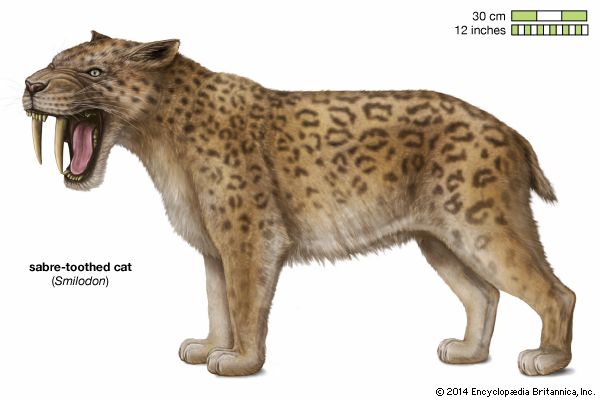
- Carnivores: The epoch saw the emergence of the first dogs and bears, including the bear-dog Hemicyon. The first hyenas and sabre-toothed cats also appeared.12
- Ungulates: Diverse horse genera such as Merychippus, Pliohippus, and Hypohippus thrived in North America. Eurasia saw the arrival of primitive antelope, deer, and giraffes, while elephants spread from Africa to Eurasia.12
- South American Fauna: Due to geographic isolation, South America hosted unique groups, including marsupial carnivores, litopterns, toxodonts, and various edentates (sloths, armadillos, and anteaters).12
- Primates: The Miocene was crucial for ape evolution, featuring forms like Pliopithecus and the dryopithecines, which are considered ancestral to modern apes and humans.12
Marine and Avian Life
By the end of the epoch, most modern whale groups were established, alongside early seals and walruses. Bird populations in Europe included familiar groups such as herons, ducks, eagles, and owls.12
Sources
- Moropus — Encyclopædia Britannica
- Moropus — Merriam-Webster
- perissodactyl — Encyclopædia Britannica
- perissodactyl - General features — Encyclopædia Britannica
- hoof — Encyclopædia Britannica
- perissodactyl - Annotated classification — Encyclopædia Britannica
- perissodactyl — Merriam-Webster
- Claw — Encyclopædia Britannica
- perissodactyl - Evolution and paleontology — Encyclopædia Britannica
- mammal - Locomotion — Encyclopædia Britannica
- Integument - Claws , nails, and hooves — Encyclopædia Britannica
- Miocene Epoch — Encyclopædia Britannica
- Tertiary Period - The rise of mammals — Encyclopædia Britannica
- Miacis — Encyclopædia Britannica
Published on · 3 min read