Miocene Epoch
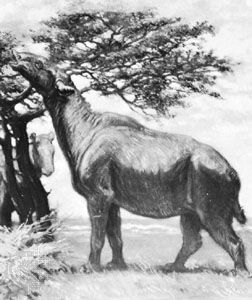
During the Miocene, the expansion of open, grassy habitats significantly transformed the evolution of herbivorous mammals. As forests gave way to savannas…
How did the evolution of grasslands during the Miocene affect animal life?
During the Miocene, the expansion of open, grassy habitats significantly transformed the evolution of herbivorous mammals. As forests gave way to savannas, many animals adapted to a diet of gritty grasses rather than soft, leafy vegetation.1
This shift in environment drove several key evolutionary changes:
- Dental Specialization: Mammals evolved from primitive forms with low-crowned, browsing teeth to those with high-crowned, or hypsodont, teeth. These specialized teeth, often reinforced with secondary cement, were better equipped to withstand the wear caused by abrasive grasses.12
- Locomotor Adaptations: To survive in more open landscapes where cover was scarce, many herbivores developed longer limbs, which increased their speed and efficiency in escaping predators.1
- Community Structure: By the late Miocene, grassland communities similar to modern savannas were established globally. This environment favored the rise of modern groups, including horses, rhinoceroses, camels, and antelopes, which coevolved alongside the spreading grasses.13
What were the major changes in sea levels during the Miocene, and what caused them?
During the Miocene Epoch, significant changes in sea levels were primarily driven by the growth of polar ice sheets and tectonic activity.
Major Sea-Level Changes
A notable drop in global sea level occurred near the end of the Miocene, approximately six million years ago. Estimates suggest this decline was between 40 and 50 metres (130 to 165 feet). This event was significant enough to isolate the Mediterranean Sea from the global ocean, leading to its repeated evaporation and the formation of extensive evaporite deposits on its floor.4
Primary Causes
- Antarctic Ice Sheet Growth: The primary driver for the sea-level drop was the further expansion of the Antarctic ice sheet. As more water was sequestered into glacial ice, global sea levels fell accordingly.4
- Tectonic Movements: The closure of narrow seaways, caused by shifting tectonic plates, played a critical role in isolating regional basins like the Mediterranean. This isolation, combined with the lower sea level, triggered cycles of drying and refilling.4
- Oceanic Feedback: The evaporation of the Mediterranean removed a significant portion of salt from the world’s oceans. This change in salinity raised the freezing point of seawater, which further promoted the growth of sea ice around Antarctica, creating a feedback loop that influenced global climate and sea levels.4
How does the Miocene Epoch compare to the epochs immediately before and after it?
The Miocene Epoch (23 million to 5.3 million years ago) serves as a pivotal transition in the Cenozoic Era, bridging the Oligocene Epoch and the Pliocene Epoch.78
Comparison with Preceding and Succeeding Epochs
- Oligocene (Preceding): By the end of the Oligocene, many archaic mammalian groups had gone extinct, setting the stage for the Miocene, where land mammal communities became dominated by modern groups like horses, rhinoceroses, and camels. While the early to mid-Miocene remained relatively warm, it followed the cooling trends that began in the late Eocene and Oligocene.891
- Miocene (The Epoch): This period was defined by the expansion of open, grassy habitats. Mammals evolved specialized high-crowned teeth for grazing and longer limbs for running, adapting to the rise of savanna-like environments. It was also a critical time for primate evolution, including the development of advanced apes.89
- Pliocene (Succeeding): The Pliocene was generally cooler and drier than the Miocene. It saw the emergence of the first creatures termed human, the australopithecines7. Furthermore, the Pliocene featured significant faunal shifts, such as the reestablishment of the land connection between North and South America, which allowed for the migration of diverse species.7
How did the climate change during the Miocene Epoch and what were its effects?
During the Miocene Epoch (23 million to 5.3 million years ago), the global climate underwent significant shifts that fundamentally altered Earth’s ecosystems. While the early to mid-Miocene was relatively warm, a cooling trend resumed approximately 15 million years ago, leading to the expansion of the Antarctic Ice Sheet and increasingly seasonal conditions, particularly in regions north of the Equator.9
Effects of Climate Change
These climatic shifts had profound effects on both terrestrial and marine environments:
- Vegetation and Habitat Transformation: As the climate became cooler and more seasonal, evergreen broad-leaved forests were replaced by open woodlands, shrublands, and grasslands. By the late Miocene, savanna-like environments were established on most continents.101
- Mammalian Evolution: The rise of open grassy habitats drove significant evolutionary adaptations. Herbivores evolved specialized high-crowned teeth to graze on gritty grasses and developed longer limbs for running. This period also saw the diversification of modern mammalian groups, including the emergence of early apes and the ancestors of modern dogs, bears, and hyenas.1018
- Marine Changes: Changing ocean circulation patterns, driven by global cooling, altered nutrient distribution. This led to shifts in marine productivity and accelerated the evolution and biological diversity of plankton and mollusks.8
Sources
- Tertiary Period - The rise of mammals — Encyclopædia Britannica
- Poaceae - Evolution — Encyclopædia Britannica
- perissodactyl - Teeth — Encyclopædia Britannica
- paleoceanography — Encyclopædia Britannica
- Pleistocene Epoch - Coastal environments and sea-level changes — Encyclopædia Britannica
- sea level — Encyclopædia Britannica
- Pliocene Epoch — Encyclopædia Britannica
- Miocene Epoch — Encyclopædia Britannica
- Climate change - Cenozoic climates — Encyclopædia Britannica
- human evolution - Background and beginnings in the Miocene — Encyclopædia Britannica
Published on · 4 min read