Agouti
Agoutis are generally wary, elusive rodents that are difficult to approach in their natural habitats. They are primarily terrestrial and maintain a…
What are the social behaviors and habits of agoutis?
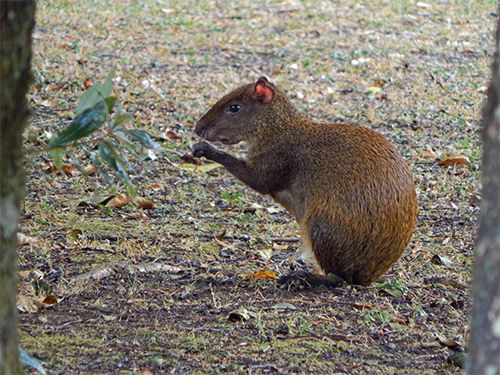
Agoutis are generally wary, elusive rodents that are difficult to approach in their natural habitats. They are primarily terrestrial and maintain a crepuscular or nocturnal lifestyle, spending their nights in burrows located among tree roots, boulders, hollow logs, or dense brush on the forest floor.1
Regarding their behavioral habits, agoutis are known for being swift; they can walk, trot, or gallop and are capable of leaping up to 2 meters from a standing position when threatened. A significant aspect of their ecological behavior is their role as seed dispersers. They forage for fruit, nuts, and seeds, and they habitually bury nuts in the ground to store them for periods when food is scarce.1
While they are often solitary or found in small family units, they are highly adapted to their environments. Their wary nature serves as a defense mechanism against predators, and their tendency to cache food contributes significantly to the regeneration of tropical forests.1
What role do agoutis play in seed dispersal?
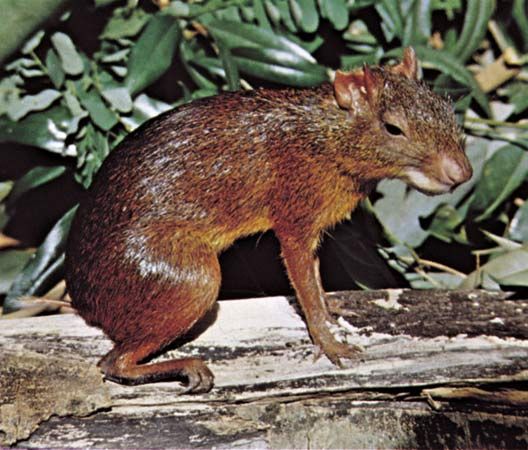
Agoutis are among the most important mammalian seed dispersers in tropical rainforests, playing a critical role in the regeneration of various tree species. Their contribution is primarily driven by their habit of caching food; they forage for fruits and nuts, then bury them in the ground to store for periods when food is scarce.41
This behavior is essential for the survival of many plants:
- Protection from Pests: For trees like the black palm, agoutis provide a vital service by peeling away the fruit pulp and burying the nuts. Without this, weevil larvae would typically destroy the seeds.1
- Facilitating Germination: Some trees, such as the almendro, rely on a multi-stage dispersal process. Fruit bats may initially transport the fruit away from the parent tree, but agoutis further assist by burying the seeds, which is often a requirement for successful germination.1
- Ecological Necessity: In many cases, if seeds are not buried by agoutis, they have little prospect of developing into new trees, making these rodents vital to forest conservation.14
How do agoutis differ from other rodents in their family?
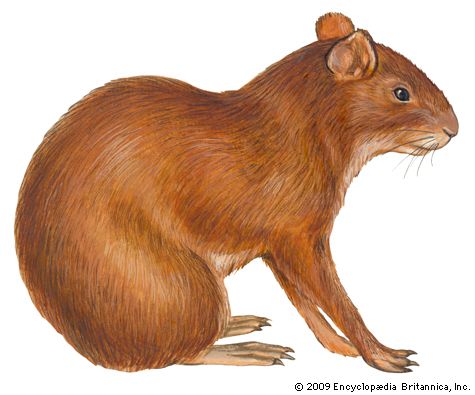
Agoutis (genus Dasyprocta) are members of the family Dasyproctidae, which they share with their close relatives, the acouchys (genus Myoprocta). While they share many similarities, such as their hooflike claws and resemblance to small forest-dwelling ungulates, they differ from other rodents in their family and the related pacas in several ways:15
- Size and Build: Agoutis are larger than acouchys, weighing up to 6 kg (13 pounds) with a body length of up to 76 cm, whereas acouchys are significantly smaller, weighing only 1 to 1.5 kg. Pacas are generally stouter and heavier than agoutis, weighing between 5 and 13 kg.156
- Tail Characteristics: Agoutis have a tiny, inconspicuous, bald tail. In contrast, acouchys possess a short, pencil-thin tail with a tufted tip, and pacas have a very short, stumpy tail hidden beneath their rump hair.165
- Shelter Habits: Agoutis are known for digging their own burrows among tree roots or logs. Acouchys, however, do not dig their own shelters, instead utilizing cavities created by other animals, such as armadillos.15
- Activity Patterns: Agoutis are primarily crepuscular or nocturnal, while acouchys are active during the day.15
How long do agoutis typically live in the wild?
Sorry, the Britannica knowledge base does not contain this information.
Sources
- agouti — Encyclopædia Britannica
- acouchy — Encyclopædia Britannica
- Territorial behaviour — Encyclopædia Britannica
- Hitching a ride — Encyclopædia Britannica
- rodent - Evolution and classification — Encyclopædia Britannica
- paca — Encyclopædia Britannica
Published on · 3 min read