Chimpanzee
Chimpanzees live in highly social, flexible communities that typically range from 20 to over 100 members. These groups are characterized by a…
What is the social structure of chimpanzee communities?
Chimpanzees live in highly social, flexible communities that typically range from 20 to over 100 members. These groups are characterized by a “fission-fusion” structure, where individuals frequently join and leave smaller, unstable subgroups called parties.1
The social hierarchy is fluid and male-dominated, with adult males generally holding dominance over females and adolescents. While an alpha male may attempt to monopolize mating opportunities, his status is often challenged by coalitions of subordinate males. Males typically remain in their birth community for life, whereas most females emigrate to neighboring groups upon reaching maturity.1
Social cohesion is maintained through complex strategies, including reciprocal grooming, food sharing, and the formation of strategic alliances. These communities are territorial, with males engaging in boundary patrols to defend their home range against outsiders. Relations between neighboring groups are often hostile, sometimes resulting in lethal intergroup violence. Within the group, individuals exhibit sophisticated behaviors such as reconciliation, deception, and the use of coalitions to navigate their social environment.12
What are the main differences between chimpanzees and other great apes like gorillas and orangutans?
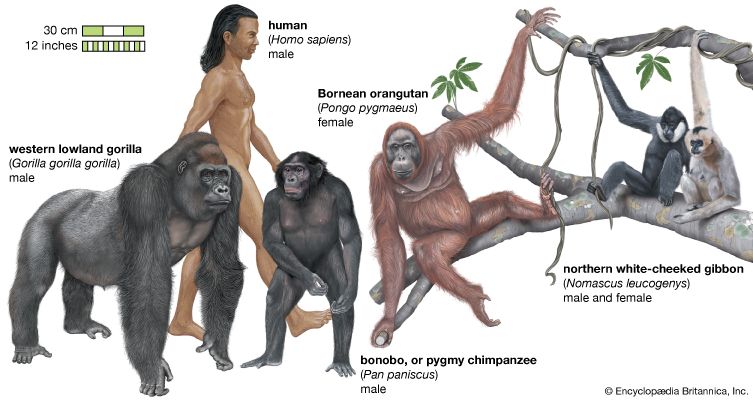
Chimpanzees, gorillas, and orangutans are all great apes, but they exhibit significant differences in their social structures, habitats, and behaviors.
Social Organization
- Chimpanzees: They live in large, fluid “fission-fusion” communities of up to 100 or more individuals that frequently split into smaller, unstable subgroups. Their society is male-dominated with a fluid hierarchy, and males typically remain in their birth community for life, while females often emigrate.45
- Gorillas: They typically live in cohesive groups centered around a dominant older male, known as a silverback, who leads a group of subordinate males, adult females, and their offspring.6
- Orangutans: They are unique among great apes for their semisolitary social organization. Adults generally live alone, with males maintaining larger home ranges than females, and they only associate for mating or when females are with dependent young.1
Habitat and Locomotion
- Chimpanzees and Gorillas: Both are African apes that spend significant time on the ground, moving via knuckle walking, though they also nest in trees.4
- Orangutans: These Asian apes are the largest arboreal animals, spending over 90 percent of their time in trees. Unlike the African apes, they are not knuckle walkers; they move through the canopy using all four limbs or by swinging, and they walk on closed fists or extended palms when on the ground.1
Behavior and Intelligence
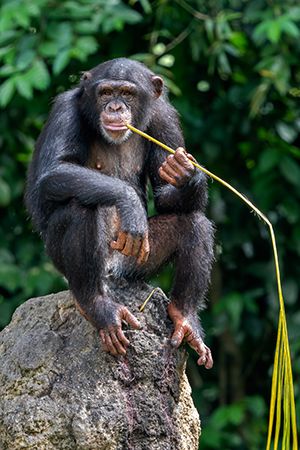
- Tool Use: While all great apes show high intelligence, chimpanzees are particularly noted for their complex tool use and cultural transmission of behaviors, such as using “tool sets” to fish for termites. Orangutans also demonstrate ingenuity, and some populations have been observed using tools to extract food or even treat injuries with medicinal plants.71
- Diet: Apes are generally fruit eaters, but chimpanzees are distinct in that they regularly hunt and consume large vertebrates, including monkeys.48
How do chimpanzees communicate with each other in the wild?
In the wild, chimpanzees utilize a sophisticated range of communication methods to interact, maintain social bonds, and navigate their environment. Their primary modes of expression include:
- Vocalizations: Chimpanzees employ a diverse array of sounds, such as hoots, screams, grunts, and roars, to convey information. They also use “play panting,” which bears a resemblance to human laughter.1
- Gestures and Facial Expressions: They use complex body language, including specific gestures and facial expressions, to interact with others. These are often used for short-distance communication and can even be used deceptively to manipulate others for personal advantage.61
- Long-Distance Signaling: For communication over greater distances, chimpanzees use louder calls and physical displays, such as drumming on tree buttresses.1
- Physical Displays: Males often display excitement or dominance by standing erect, stamping, or swaying. During social interactions or threats, they may also use objects, such as throwing rocks or dragging and throwing branches.1
These communicative behaviors are part of a broader culture where information is transmitted across generations through social learning, leading to regional variations in gestural communication.1
What is the typical diet of chimpanzees in their natural habitat?
Chimpanzees are primarily vegetarian, with a diet consisting of more than 300 different items. Their nutritional intake is largely composed of fruits, berries, leaves, blossoms, and seeds.103
In addition to plant matter, chimpanzees are omnivorous and supplement their diet with insects, bird eggs, and chicks, as well as occasional carrion. Notably, chimpanzees are unique among nonhuman primates for regularly hunting and consuming the flesh of larger mammals, including monkeys, duikers, bushbucks, and wild pigs. They may hunt these animals either alone or in groups.101
Furthermore, chimpanzees have been observed using certain plants for medicinal purposes to treat diseases and expel intestinal parasites.10
Sources
- chimpanzee - Social behaviour — Encyclopædia Britannica
- Why do apes live in groups? — Encyclopædia Britannica
- chimpanzee - Natural history — Encyclopædia Britannica
- ape — Encyclopædia Britannica
- orangutan — Encyclopædia Britannica
- chimpanzee - Intelligence — Encyclopædia Britannica
- primate - Distribution and abundance — Encyclopædia Britannica
- primate - Diet — Encyclopædia Britannica
- human evolution - Learning from the apes — Encyclopædia Britannica
- Are Chimpanzees Cannibals? — Encyclopædia Britannica
Published on · 4 min read