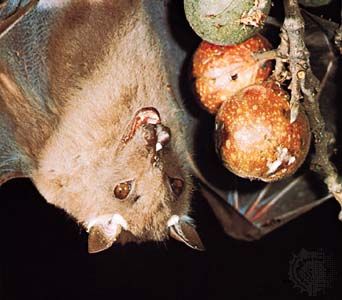
New Zealand Short-tailed Bat
The New Zealand short-tailed bat (genus Mystacina) refers to two species of small bats that constitute the rare family Mystacinidae, found exclusively in New…
What is New Zealand short-tailed bat?
The New Zealand short-tailed bat (genus Mystacina) refers to two species of small bats that constitute the rare family Mystacinidae, found exclusively in New Zealand.1
These bats are characterized by their grayish-brown, thick fur and a short 1.8-cm tail. They possess leathery wing membranes near the body, allowing them to furl their wings tightly. One species, M. tuberculata, is notably terrestrial and agile on the ground, where it may roost in caves, crevices, or hollow trees, and occasionally dig tunnels in rotten wood. Their diet is diverse, consisting of fruit, nectar, pollen, and insects. The second species, M. robusta, is considered likely extinct. Unlike many other mammals, their young are born with their eyes open.1
Why is the New Zealand short-tailed bat considered a terrestrial animal?
The New Zealand short-tailed bat (Mystacina tuberculata) is considered the most terrestrial of all bats because of its unique physical adaptations and behaviors that allow it to be highly agile on the ground.1
Unlike most bats, which are primarily aerial, this species has evolved to forage and move effectively across the forest floor. Its wings feature leathery membranes near the body that allow them to be furled tightly, preventing damage while the animal navigates the ground. In its natural habitat, it demonstrates terrestrial behavior by roosting in hollow trees, caves, or crevices, and it is known to actively dig tunnels into rotten wood to create shelter. This combination of ground-based foraging and specialized burrowing habits distinguishes it from other bat species that rely almost exclusively on flight and elevated roosting sites.13
What makes the Mystacinidae family different from other bat families?
The Mystacinidae family, which consists of only two species in the genus Mystacina found exclusively in New Zealand, is distinguished from other bat families by several unique evolutionary adaptations:
- Terrestrial Specialization: Unlike most bat families that are primarily aerial, Mystacinidae are highly adapted for walking. They possess long, sharp claws on their thumbs and toes, which facilitate agile movement on the ground.
- Wing Structure: Their wings are uniquely designed to fold very compactly, with leathery membranes near the body that allow the wings to be furled tightly. This protects the delicate wing structure while the animal navigates the forest floor or digs tunnels in rotten wood.
- Dietary Habits: While many bat families specialize in either aerial insect hunting or fruit consumption, Mystacinidae are known to feed on both flying and terrestrial insects, as well as fruit, nectar, and pollen.
- Developmental Traits: A notable biological characteristic is that their young are born with their eyes open, a trait that differs from many other bat species.
How do bats contribute to plant pollination and seed dispersal?
Bats play a vital role in tropical ecosystems by acting as both pollinators and seed dispersers, facilitating the reproduction and distribution of numerous plant species.
Pollination
More than 500 species of tropical plants are pollinated by nectar- and pollen-eating bats, a relationship known as chiropterophily. These “bat-loving” plants have evolved specific traits to attract nocturnal visitors, such as producing large, sturdy, white or drab-colored flowers that open after sunset. To guide bats, these flowers often emit strong, musky, or fermented odors. Many are shaped like vases to accommodate a bat’s face, or they feature brushy structures that load the bat’s whiskers with pollen. In return, the plants provide high-protein pollen and abundant nectar, which are essential for the bats’ health and energy. Specialized bats, such as those in the genera Macroglossus and Glossophaga, utilize long, extensible tongues with fleshy bristles to efficiently extract these resources.56
Seed Dispersal
Bats are also critical for seed dispersal, often transporting seeds far from parent trees. Fruit bats, such as the Jamaican fruit bat, locate ripe fruit by scent and carry it to feeding roosts. Small seeds are often ingested and excreted in flight, while larger seeds are discarded at the roost site. In some cases, such as with the almendro tree, bats initiate the dispersal process by carrying fruit away from the parent tree, where they consume the pulp and drop the seeds, which may then be further buried by ground-dwelling animals like agoutis. This complex interaction is essential for the survival and regeneration of many forest tree species.7
Sources
- New Zealand short-tailed bat — Encyclopædia Britannica
- bat - Food habits — Encyclopædia Britannica
- bat - Roosting — Encyclopædia Britannica
- bat - Annotated classification — Encyclopædia Britannica
- Bat-loving flowers — Encyclopædia Britannica
- Hitching a ride — Encyclopædia Britannica
- pollination - Mammals — Encyclopædia Britannica
Published on · 3 min read