Airedale Terrier
The Airedale Terrier, often called the "King of Terriers," is the largest of the terrier breeds. Developed in the 19th century by working-class residents in…
What is an Airedale Terrier?
The Airedale Terrier, often called the “King of Terriers,” is the largest of the terrier breeds. Developed in the 19th century by working-class residents in the River Aire valley of Yorkshire, England, this breed was originally used as a tenacious hunter of rats, otters, and ducks.1
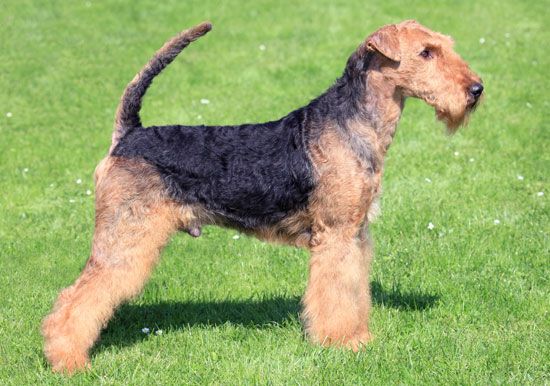
Physically, the Airedale is a strong, agile dog standing about 23 inches tall and weighing 50–70 pounds. It features a dense, wiry coat that is tan with a black or grizzle saddle, along with a distinctive rectangular head, heavy eyebrows, and a beard.1
Known for being intelligent, feisty, and courageous, the breed has served as a police dog, guard, and even a World War I dispatch carrier. While they are playful and family-oriented, they require vigorous daily exercise and consistent training to manage their high energy levels.1
Where did the Airedale Terrier originate?
The Airedale Terrier originated in the 19th century in the River Aire valley—or Airedale—of Yorkshire, England.21
Developed by working-class residents in this industrial region, the breed was initially known as the Bingley or Waterside Terrier. It was created to serve as a versatile hunter and companion, likely descending from the otterhound and the now-extinct black-and-tan Old English Terrier. The breed was officially named after the valley where it was developed.12
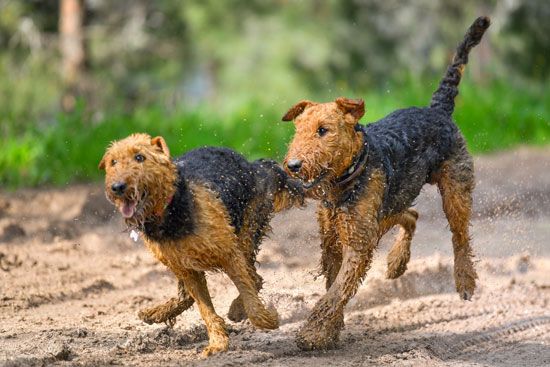
What does an Airedale Terrier look like?
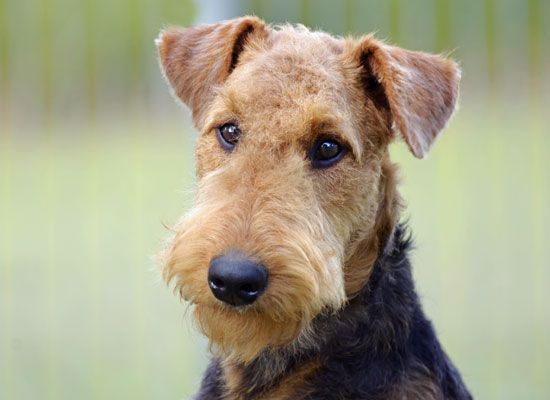
The Airedale Terrier is a long-legged, powerful, and agile dog, recognized as the largest of the terrier breeds. Its physical appearance is defined by several distinct characteristics:
- Head and Face: The head and muzzle are long and rectangular. In profile, the forehead forms a straight line down to the nose. They possess small eyes, semi-pricked ears, and are notable for their heavy eyebrows and beard.
- Coat: The breed features a dense, wiry coat. The coloration is a rich tan with a black or grizzle-colored saddle.
- Stature: They stand approximately 23 inches (58 cm) at the withers and typically weigh between 50 and 70 pounds (23–32 kg).
- Posture: They are known for carrying their tails high, reflecting their alert and spirited nature.
While the coat is naturally wiry, professional clipping can result in a softer texture, though hand-stripping is the traditional method used to maintain the coat’s rich coloring and proper texture.
What were Airedale Terriers originally bred to do?
The Airedale Terrier was originally developed in the 19th century by working-class residents in the River Aire valley of Yorkshire, England, to serve as a versatile hunter and companion.1
Unlike many other terrier breeds primarily tasked with digging into burrows to flush out vermin, the Airedale was bred to be a tenacious hunter of larger game, including rats, otters, and ducks. Because of their intelligence, strength, and agility, they were also valued as powerful, all-purpose working dogs.13
Over time, the breed’s utility expanded significantly beyond its original hunting roots. Their courage and trainability led them to be utilized in various demanding roles, including:
Sources
- Airedale Terrier — Encyclopædia Britannica
- Airedale terrier — Merriam-Webster
- dog - Terriers — Encyclopædia Britannica
Published on · 2 min read