Asiatic Lion
The Asiatic lion (Panthera leo leo) is a subspecies of lion currently found in the wild only within the Gir Protected Area and surrounding habitats in the…
What is an Asiatic lion?
The Asiatic lion (Panthera leo leo) is a subspecies of lion currently found in the wild only within the Gir Protected Area and surrounding habitats in the Indian state of Gujarat.1
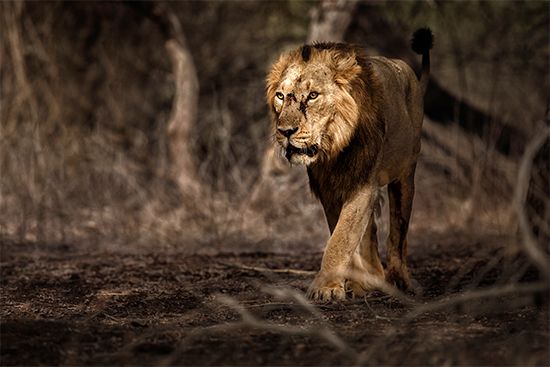
Physically, they are slightly smaller than African lions and possess a distinct fold of skin along their abdomen. Males have thinner, darker manes that leave their ears more visible, and both sexes feature longer hair on their elbows and tails. Unlike African lions, Asiatic lion prides are typically separated by gender, with males and females associating primarily for mating.21
Once ranging from Turkey to India, the population declined drastically due to hunting and habitat loss, reaching a low of roughly 12 individuals in the 1880s. Conservation efforts have since helped the population recover to between 500 and 700 individuals. The IUCN currently classifies the species as vulnerable.1
Where do Asiatic lions live?
In the present day, wild Asiatic lions are found exclusively in India, specifically within the Gir Protected Area and a few smaller habitats located on the Kathiawar Peninsula in the western Indian state of Gujarat.23
While their historical range once stretched from Turkey to India, their current geographic distribution is limited to this specific region of dry deciduous forest and scrubland. Beyond these wild populations, there are approximately 400 individuals kept in captivity in zoos across India and Europe.24
Conservationists emphasize that because the entire wild population is concentrated in this single, relatively small area, the species remains vulnerable to localized threats such as disease or natural disasters.2
How does the Asiatic lion look different from the African lion?
Asiatic lions (Panthera leo leo) exhibit several distinct physical characteristics that differentiate them from their African counterparts (P. leo melanochaita):
- Size: Asiatic lions are generally smaller than African lions. Adult males typically weigh 160–190 kg (350–420 pounds), while females weigh 110–120 kg (240–265 pounds).1
- Abdominal Fold: A defining feature of the Asiatic lion is a longitudinal fold of skin that runs along the length of the abdomen, a trait rarely found in African lions.21
- Mane: The manes of male Asiatic lions are thinner and darker than those of African lions. This sparser mane leaves the ears more visible.1
- Hair: They possess longer tufts of hair on their elbows and longer hair on their tails.21
- Skull Structure: Asiatic lions often feature bifurcated infraorbital foramina—two portals in the skull on either side of the muzzle. While this can appear in African lions, it is significantly more prevalent in the Asiatic subspecies.1
- Coloration: Their fur ranges from reddish tawny to silvery gray, and some individuals may display black specks.1
What do Asiatic lions eat in the wild?
As apex predators, Asiatic lions primarily hunt at night, targeting mammals of various sizes within their habitat. Their diet typically includes:2
In addition to hunting live prey, these lions are known to scavenge and will sometimes feed on the carcasses of dead livestock. on the carcasses of dead livestock.2
Sources
- Asiatic lion — Merriam-Webster
- Asiatic lion — Encyclopædia Britannica
- Gir National Park — Encyclopædia Britannica
- lion - Conservation status — Encyclopædia Britannica
- lion - General characteristics — Encyclopædia Britannica
- lion: Top Questions — Encyclopædia Britannica
- Gujarat - Plant and animal life — Encyclopædia Britannica
Published on · 3 min read