Akhḍar Mountains
The Akhdar Mountains in northeastern Libya and the Jabal Al-Akhdar (Green Mountain) in Oman are distinct geographical features that influence local…
How do the Akhḍar Mountains influence local agricultural practices?
The Akhdar Mountains in northeastern Libya and the Jabal Al-Akhdar (Green Mountain) in Oman are distinct geographical features that influence local agriculture in different ways.
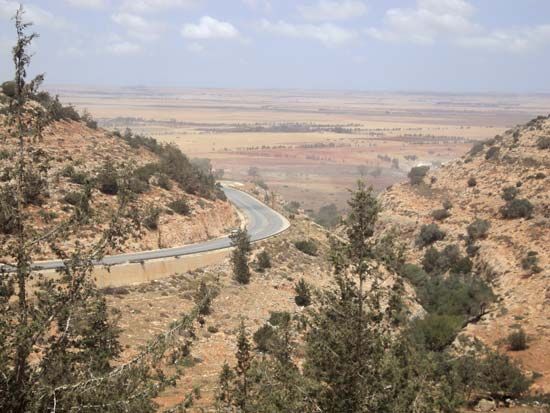
In the Libyan Akhdar Mountains, the region’s relatively high annual rainfall (15–20 inches) supports limited agriculture, primarily producing grain, olives, grapes, and almonds, particularly near al-Marj and Darnah. The area also sustains livestock herding, including camels, goats, and sheep, which involves a degree of nomadism. Recent efforts have included large-scale agricultural projects focused on land reclamation and irrigation to improve productivity.1
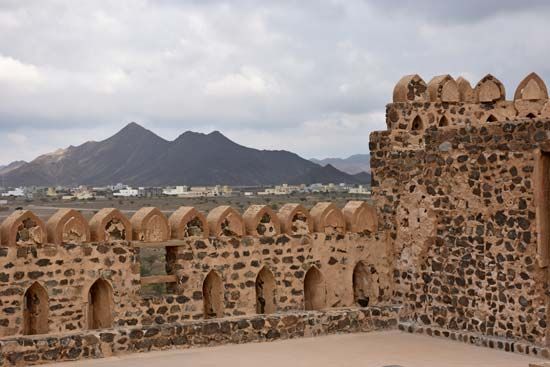
In Oman, the Jabal Al-Akhdar massif is notable for its unique microclimate. While much of the surrounding Al-Hajar range is bleak, the higher rainfall on this mountain permits the cultivation of alfalfa, date palms, lime bushes, and various fruit trees. Additionally, northward-flowing wadis have carved bowl-like valleys into the northern face of the range, which host small, isolated agricultural settlements.2
What types of wildlife can be found in the Akhḍar Mountains?
The term “Akhdar Mountains” refers to two distinct geographical locations, each with different wildlife profiles:
Al-Hajar Mountains (Oman)
The Jabal Al-Akhdar is part of the Al-Hajar mountain chain in Oman. This region is home to a variety of wildlife, most notably:
- Leopards: These predators inhabit the rugged terrain of the range.1
- Arabian Tahr: This species is a wild goat unique to this region and is not found elsewhere in the country.1
Akhdar Mountains (Libya)
The Akhdar Mountains in northeastern Libya are characterized by sparse low bush and remnants of scrub forest. While the provided information does not detail specific wildlife species for this range, the area is known for supporting livestock herding, including camels, goats, and sheep.2
How do the Akhḍar Mountains affect the climate and vegetation of the surrounding region?
The term “Akhdar Mountains” refers to two distinct geographical regions, both of which significantly influence their local environments through their elevation and impact on precipitation.
Akhdar Mountains (Libya)
Located in northeastern Libya, this limestone range acts as a critical buffer between the Mediterranean coast and the arid Sahara.
- Climate: The mountains experience a Mediterranean climate characterized by comparatively high annual rainfall (15–20 inches [375–500 mm]) and high humidity, which contrasts sharply with the surrounding arid regions.21
- Vegetation: The northern slopes, where Mediterranean influence is strongest, support relatively dense maquis or scrub forest, primarily consisting of juniper and lentisc. As one moves south of the mountain crest, the vegetation becomes increasingly scattered and stunted.6
Jabal Al-Akhdar (Oman)
Part of the Al-Hajar range, this massif creates a unique microclimate within an otherwise bleak landscape.
- Climate: The higher elevation of the massif captures greater rainfall compared to the surrounding terrain.7
- Vegetation: This increased moisture allows for the cultivation of crops such as date palms, alfalfa, lime bushes, and various fruit trees, which are not typically supported in the drier, surrounding areas of the range.7
What is the geological composition of the Akhḍar Mountains?
The geological composition of the Akhḍar Mountains depends on which range is being referenced, as the name is used for two distinct geographical features:
Akhḍar Mountains (Libya)
The Akhḍar Mountains in northeastern Libya are primarily a limestone range. This massif rises steeply from the Mediterranean coast in two distinct steps, eventually blending into a plateau that reaches elevations of nearly 3,000 feet (900 meters).21
Jabal Al-Akhḍar (Oman)
Located within the Al-Hajar mountain chain, the Jabal Al-Akhḍar massif has a more complex geological structure. The entire Al-Hajar chain is composed of a series of superimposed sheets known as nappes. These include:5
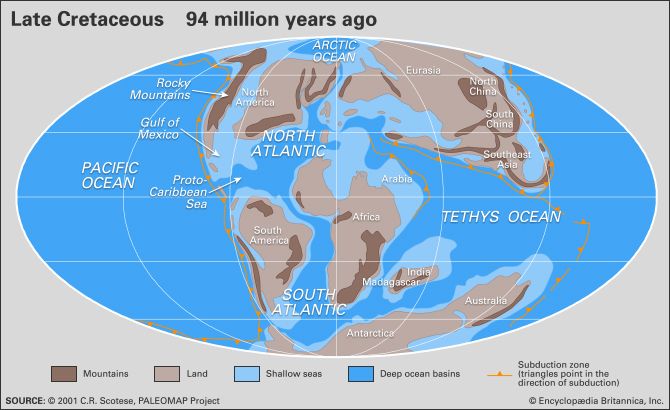
- Ophiolites: Slices of ancient ocean floor that were thrust onto the continental crust during the Cretaceous Period (145 million to 66 million years ago).5
- Sedimentary Rocks: Layers of sedimentary rock that were deposited earlier during the Cretaceous Period and lie beneath the ophiolite sheets.5
Sources
- Al-Ḥajar — Encyclopædia Britannica
- Akhḍar Mountains — Encyclopædia Britannica
- Cyrenaica — Encyclopædia Britannica
- Libya - Cultural institutions — Encyclopædia Britannica
- Libya - Relief — Encyclopædia Britannica
- Libya - Climate of Libya — Encyclopædia Britannica
- Libya - Plant and animal life — Encyclopædia Britannica
Published on · 3 min read