Cretaceous Period
The Cretaceous Period is divided into two primary epochs: the Early Cretaceous (145 million to 100.5 million years ago) and the Late Cretaceous (100.5…
How is the Cretaceous Period divided into epochs, and what are their names?
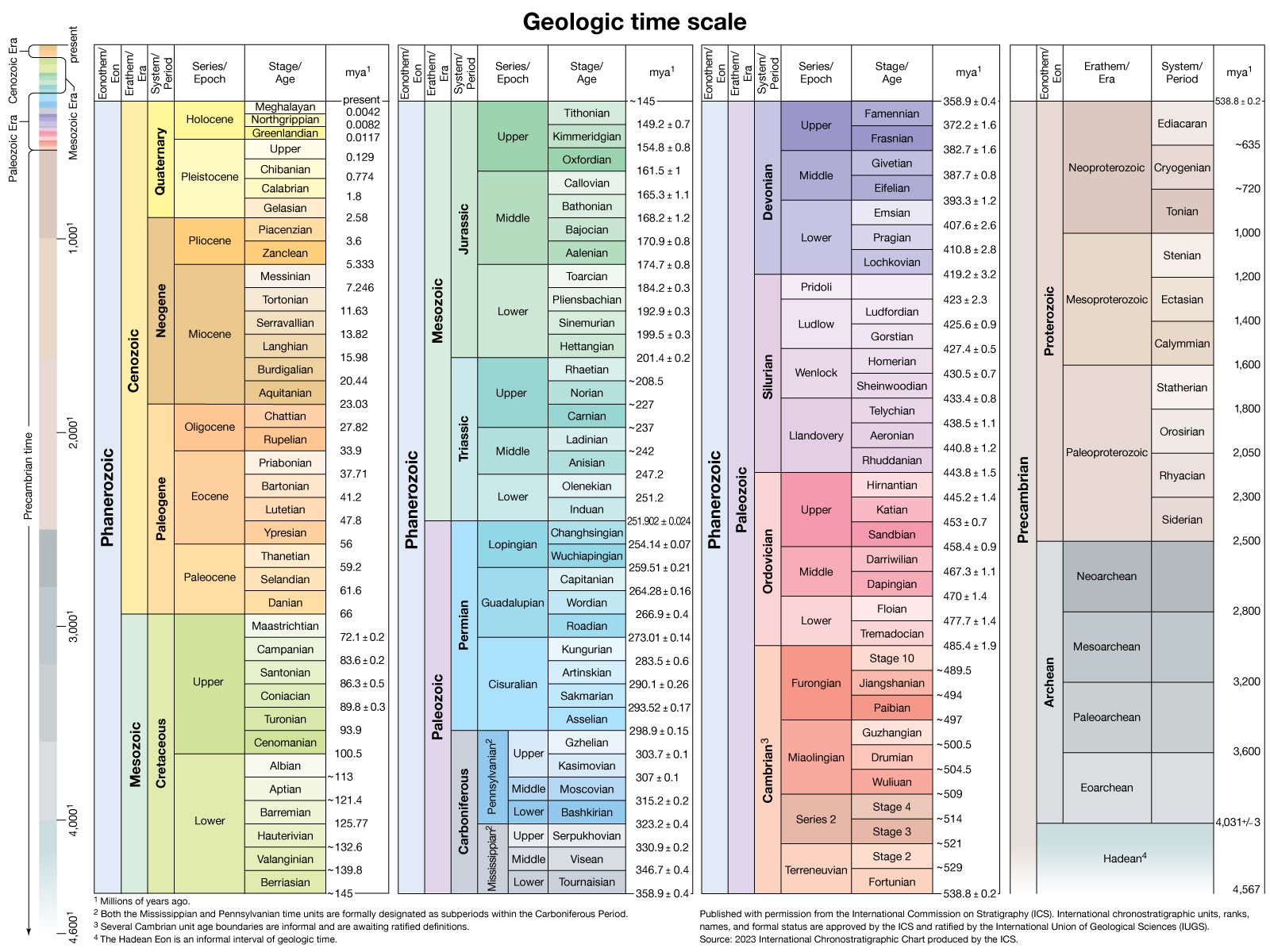
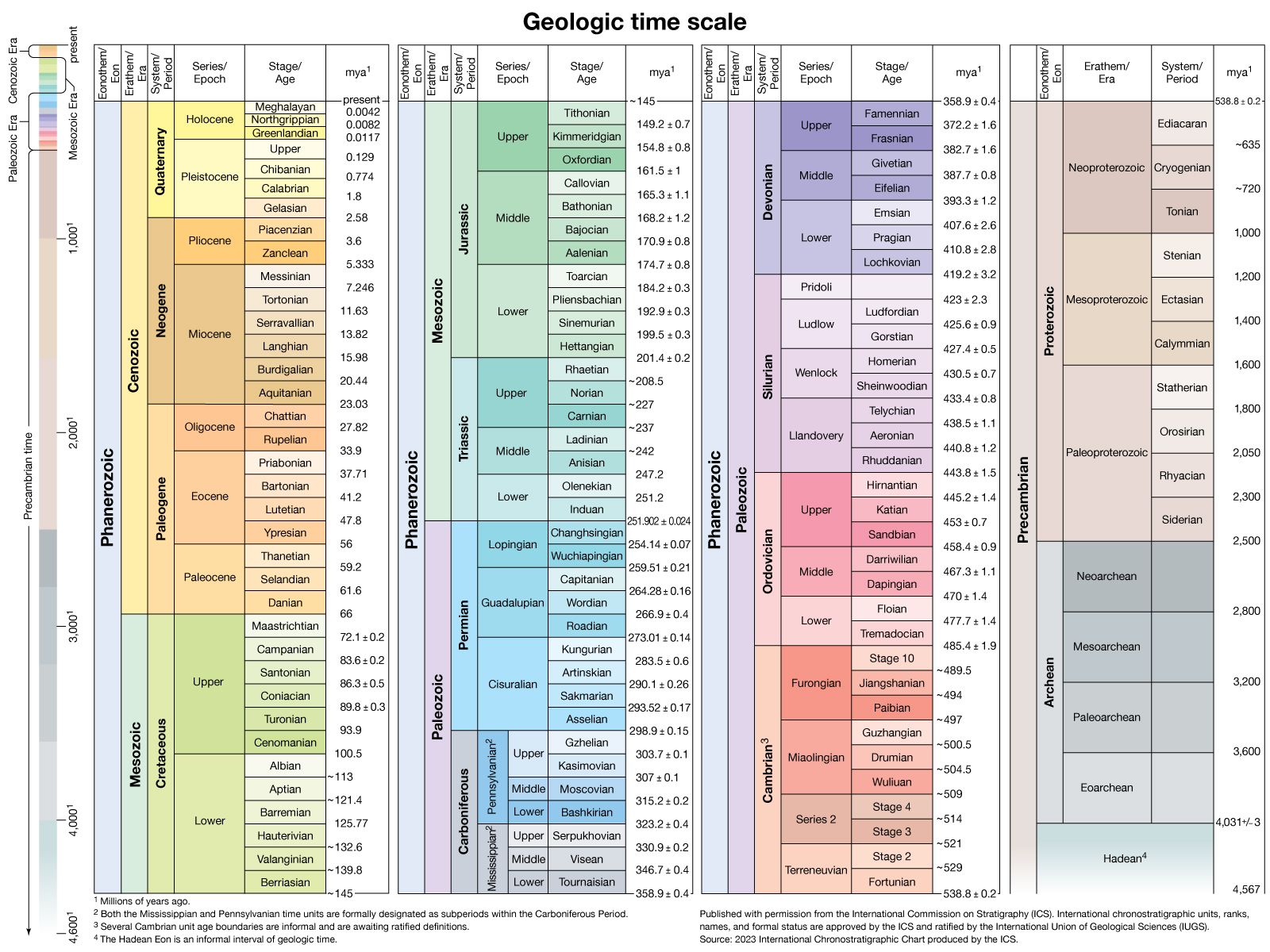
The Cretaceous Period is divided into two primary epochs: the Early Cretaceous (145 million to 100.5 million years ago) and the Late Cretaceous (100.5 million to 66 million years ago).1
Each of these epochs is further subdivided into six ages, which correspond to specific rock stages defined by geologists in the 19th century.1
Early Cretaceous Epoch
The stages of the Early Cretaceous are:
- Berriasian
- Valanginian
- Hauterivian
- Barremian
- Aptian
- Albian
Late Cretaceous Epoch
The stages of the Late Cretaceous are:
- Cenomanian
- Turonian
- Coniacian
- Santonian
- Campanian
- Maastrichtian
These stages are defined by the fossils and sedimentary characteristics found in their respective type localities, primarily in Europe.1
What is the Cretaceous Period, and when did it occur in Earth’s history?
The Cretaceous Period was the final and longest period of the Mesozoic Era, spanning from 145 million to 66 million years ago. Its name is derived from the Latin word creta, meaning “chalk,” reflecting the vast deposits of limestone formed by tiny marine algae during this time.1
Throughout this 79-million-year span, Earth underwent significant geographic changes as the supercontinents of Laurasia and Gondwana rifted apart, eventually forming the modern configuration of our continents. The climate was notably warmer and more humid than today, with forests covering polar regions that lacked continental ice sheets.1
Biologically, the period was a time of major transition. While dinosaurs remained the dominant land animals, the Cretaceous saw the emergence of angiosperms (flowering plants) and the debut of many modern animal groups, including placental mammals. The period concluded with a massive extinction event that wiped out the dinosaurs and many other reptilian species.15
How did sea levels change throughout the Cretaceous, and what impact did this have on the Earth’s geography?
Sea levels during the Cretaceous Period were higher than at any other time in Earth’s history, primarily due to the displacement of water by the enlargement of midoceanic ridges. During the Early Cretaceous, global oceans were approximately 100 to 200 metres (330 to 660 feet) higher than today, rising further to roughly 200 to 250 metres (660 to 820 feet) during the Late Cretaceous.3
This elevation had a profound impact on Earth’s geography:
- Continental Inundation: Marine waters flooded continental margins, creating shallow epicontinental seas across North America, South America, Europe, Russia, Africa, and Australia. At its peak, land covered only about 18 percent of Earth’s surface, compared to 28 percent today.3
- Seaway Formation: High water levels allowed for the creation of massive internal seaways, such as a connection between Arctic waters and the Tethys seaway through the middle of North America and central Russia.3
- Migration Routes: Marine animals gained new pathways for migration, such as a seaway connecting the South Atlantic to the Tethys via present-day Nigeria, Niger, Chad, and Libya.3
What were the major tectonic changes during the Cretaceous Period?
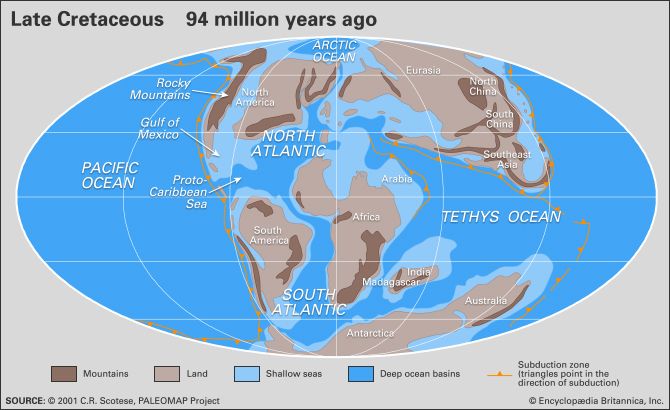
The Cretaceous Period was a time of profound tectonic transformation, characterized by the continued breakup of the supercontinents Gondwana and Laurasia into the modern continental configuration.67
Key tectonic developments included:
- Atlantic Expansion: The South Atlantic Ocean widened significantly as Africa and South America drifted apart, eventually joining with the expanding North Atlantic.67
- Gondwana Fragmentation: The southern supercontinent underwent major rifting. India and Madagascar separated from the combined landmass of Australia and Antarctica. Later in the period, India broke away from Madagascar to begin its northward journey toward Asia, while Australia began to slowly rift away from Antarctica.36
- Laurasian Changes: Greenland separated from North America, further altering the northern landmasses.6
- Seafloor Spreading: High rates of seafloor spreading and active volcanism were hallmarks of the period. This increased tectonic activity displaced massive volumes of water, contributing to the highest sea levels in Earth’s history.67
These movements fundamentally reshaped the globe, transitioning the Earth from a world dominated by two massive landmasses to one defined by the familiar continents and ocean basins we recognize today.7
Sources
- A Journey Through Time Since the Precambrian - Cretaceous Period: 145 million to 66 million years ago — Encyclopædia Britannica
- Cretaceous Period — Encyclopædia Britannica
- Cretaceous Period - Paleogeography — Encyclopædia Britannica
- Cretaceous Period - Major subdivisions of the Cretaceous System — Encyclopædia Britannica
- Cretaceous Period - Cretaceous life — Encyclopædia Britannica
- Gondwana — Encyclopædia Britannica
- ocean basin - Evolution of the ocean basins through plate movements — Encyclopædia Britannica
- Cretaceous Period - Paleoclimate — Encyclopædia Britannica
- Jurassic Period - Paleoclimate — Encyclopædia Britannica
Published on · 3 min read