Albatross
The wandering albatross (Diomedea exulans) is recognized as having the largest wingspan of any living bird, reaching measurements of more than 340 cm (11…
Which species of albatross is considered the largest flying bird in the world?
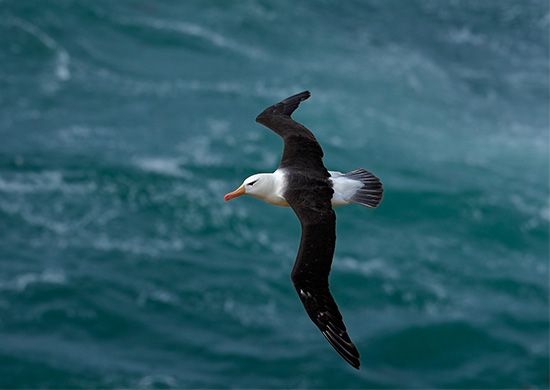
The wandering albatross (Diomedea exulans) is recognized as having the largest wingspan of any living bird, reaching measurements of more than 340 cm (11 feet). These impressive seabirds are members of the family Diomedeidae and are renowned for their ability to glide for hours in windy conditions without flapping their long, narrow wings.12
While other species, such as the royal albatross, also possess significant wingspans of approximately 315 cm (10 feet), the wandering albatross holds the record among extant species. These birds spend the majority of their lives at sea, coming ashore only to breed on remote islands in the southern oceans.1
In which parts of the world can albatrosses be found?
Albatrosses are primarily found across the world’s oceans, with their distribution heavily concentrated in the Southern Hemisphere. While they spend the majority of their lives at sea, they come ashore to breed in colonies, typically on remote oceanic islands.14
Geographic Distribution
- Southern Hemisphere: Approximately 10 species range throughout the southern oceans, frequently gliding over the “Roaring Forties” (the region between 40° and 50° latitude) and following food-rich cold currents along the west coasts of South Africa, Australia, New Zealand, and South America.41
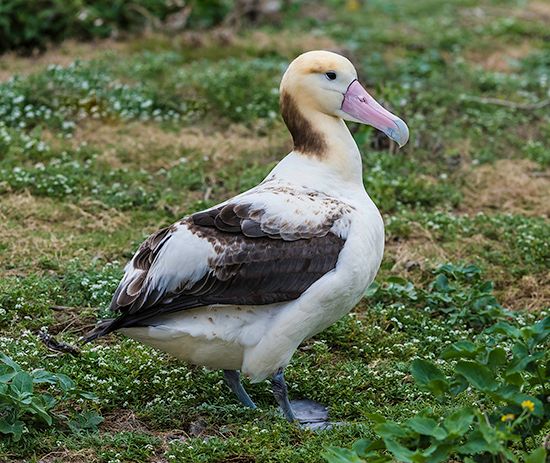
- Northern Hemisphere: Only a few species, such as the short-tailed albatross and those nesting on the Midway Atoll, nest well north of the equatorial doldrums. The black-footed albatross and Laysan albatross are well-known species that wander widely throughout the North Pacific.14
- Equatorial Regions: The waved albatross is unique for breeding exclusively in the Galapagos Islands at the Equator.1
Because these birds rely on wind to stay aloft, they are less common in the calm equatorial doldrums where wind is scarce.41
What are the main threats to albatross populations in the modern world?
Despite historical pressures from the millinery trade and hunting, modern albatross populations face significant contemporary threats primarily driven by human activity and environmental degradation.
Primary Threats
- Plastic Pollution: Albatrosses are particularly vulnerable to plastic pollution. Because they scoop food from the ocean surface, they frequently mistake floating plastic debris for prey. Many birds have been found dead on their nests with stomachs so full of plastic—ranging from bottle caps to tiny fragments—that they cannot survive.6
- Commercial Fishing: The food supply for many albatross species is increasingly threatened by fishing fleets that overharvest critical squid populations. Furthermore, albatrosses suffer high mortality rates as bycatch in unregulated longline fishing operations.7
- Introduced Predators: The introduction of non-native predators, such as rats, pigs, and cats, to remote breeding islands has historically caused, and continues to cause, significant harm to nesting colonies.7
While direct exploitation for food and feathers has largely ceased, these ongoing environmental and industrial challenges continue to place many species at risk.
How do albatrosses use dynamic soaring to fly efficiently?
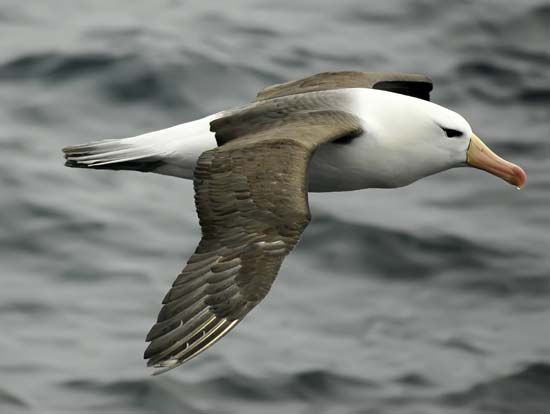
Albatrosses utilize a highly efficient flight technique known as dynamic soaring, which allows them to travel long distances over the ocean with minimal energy expenditure. Unlike static soaring, which relies on vertical air currents, dynamic soaring exploits the horizontal wind gradient created by the frictional interaction between the water and the air, where wind velocity is significantly lower near the surface than at higher altitudes.89
The flight pattern typically consists of a series of inclined loops or broad ellipses perpendicular to the wind direction:
- Gathering Momentum: The bird begins a gravitational glide from approximately 15 metres (50 feet) above the sea. As it glides downwind, its velocity increases due to both the descent and the tailwind.8
- Energy Extraction: As the bird nears the water, it turns into the wind. The forward velocity gained from the downwind glide provides the lift necessary to rise back to its initial height.89
- Repetition: Although this ascent results in a loss of horizontal velocity, the bird then turns downwind again to repeat the cycle, effectively harvesting energy from the wind gradient.89
This process allows albatrosses to maintain high speeds and remain airborne for extended periods without flapping their wings.9
Sources
- albatross — Encyclopædia Britannica
- wandering albatross — Merriam-Webster
- What is the wingspan of an eagle? — Encyclopædia Britannica
- procellariiform - Distribution — Encyclopædia Britannica
- procellariiform - Importance to humans — Encyclopædia Britannica
- Charadriiform - Importance to humans — Encyclopædia Britannica
- Plastic Disaster: How Your Bags, Bottles, and Body Wash Pollute the Oceans — Encyclopædia Britannica
- Locomotion - Soaring — Encyclopædia Britannica
- procellariiform - Locomotion — Encyclopædia Britannica
Published on · 3 min read