Buffalo Weaver
A buffalo weaver is any of the two African bird species that make up the subfamily Bubalornithinae within the family Ploceidae. These birds are characterized…
What is Buffalo weaver?
A buffalo weaver is any of the two African bird species that make up the subfamily Bubalornithinae within the family Ploceidae. These birds are characterized by their stout bodies, heavy bills, and a length of 20–25 cm (8–10 inches).1
There are two primary species:
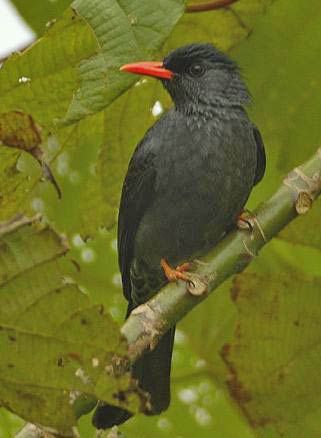
- Black buffalo weaver (Bubalornis albirostris): A widespread species that is black with white wing markings.1
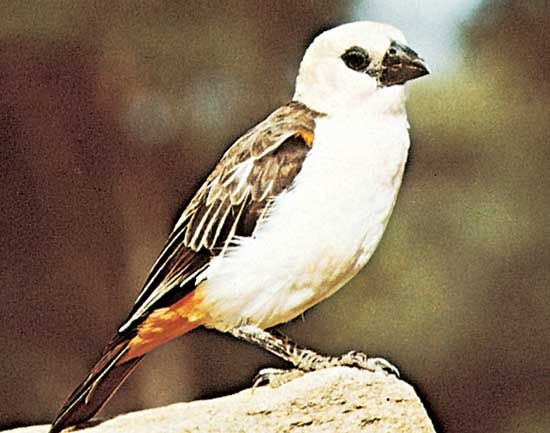
- White-headed buffalo weaver (Dinemellia dinemelli): Found in eastern Africa, this bird is brown and white with a distinctive red rump and vent.1
These birds inhabit dry regions and are known for foraging in noisy, small flocks, often following buffalo herds. Unlike many other weavers that suspend their nests from branches, buffalo weavers build bulky, untidy nests made of thorny twigs directly on branches. These nests are communal, containing compartments for multiple pairs, and several nests may be found in a single tree.12
Why do buffalo weavers build such large, communal nests?
Buffalo weavers (subfamily Bubalornithinae) build large, communal nests as a structural adaptation to their environment. Unlike many other weaver species that construct intricate, hanging chambers, buffalo weavers create bulky, untidy heaps of thorny twigs directly on tree branches.34
These nests are communal, featuring multiple internal compartments that accommodate two or more breeding pairs. By building these large, shared structures, the birds can house several pairs within a single nest, and multiple such nests may be situated in the same tree. This colonial nesting behavior is common among many members of the Ploceidae family, which often inhabit hot, dry regions where social cooperation and shared nesting sites may offer advantages for survival and reproduction.43
While the provided information highlights the communal nature and construction of these nests, it does not explicitly detail the specific evolutionary pressures—such as thermal regulation or predator defense—that drive this behavior.
What other birds belong to the Ploceidae family?
The Ploceidae family, commonly known as the weaverbird family, comprises approximately 120 species of small, compact songbirds native primarily to Africa. These birds are generally characterized by their short, stout bills and gregarious nature, often foraging in groups for seeds and insects in hot, dry environments.4
Birds belonging to this family include:
- True Weavers (Ploceus): This genus contains 57 species, such as the village weaver and the baya weaver. They are noted for their colonial breeding and complex, flask-shaped hanging nests.5
- Social Weavers (Philetairus socius): Famous for constructing massive, communal nests in acacia trees that can house over 100 pairs of birds.5
- Buffalo Weavers: Members of the subfamily Bubalornithinae, these birds are known for their bulky, untidy nests built directly on branches.5
- Bishop Birds (Euplectes): These birds typically weave nests with side entrances, often located in wet, grassy habitats.5
- Queleas (Quelea quelea): Also known as the red-billed weaver, this species is highly gregarious and can form massive nesting colonies.5
- Whydahs (Vidua): These are social parasites that lay their eggs in the nests of other weaver species, which then raise the whydahs’ young.5
How do these birds interact with buffalo herds in the wild?
Buffalo weavers, such as the black buffalo weaver (also known as the oxbird), frequently forage in small, noisy flocks in the wake of buffalo herds.
While the birds are omnivorous, their tendency to follow these large mammals suggests they benefit from the disturbances caused by the herds as they move through dry regions. By trailing the buffalo, the weavers likely gain easier access to insects or seeds exposed by the animals’ movement, a common foraging strategy among birds in savanna environments.1
Sources
- Buffalo weaver — Encyclopædia Britannica
- buffalo weaver — Merriam-Webster
- Passeriform - Nesting — Encyclopædia Britannica
- weaver — Encyclopædia Britannica
- Ploceidae — Merriam-Webster
- Ploceidae — Encyclopædia Britannica
- heteropteran - Annotated classification — Encyclopædia Britannica
Published on · 3 min read