Alderfly
An alderfly is any insect belonging to the megalopteran family Sialidae. These insects are characterized by long, filamentous antennae and two pairs of…
What is alderfly?
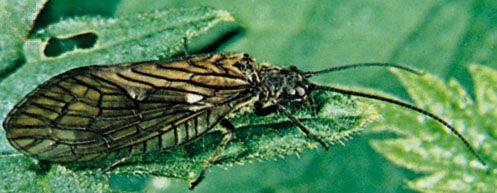
An alderfly is any insect belonging to the megalopteran family Sialidae. These insects are characterized by long, filamentous antennae and two pairs of large, well-developed wings, with the hind wings featuring a fan-like fold. Adults are typically dark-colored, measure 15 to 30 mm in length, and are known to be sluggish, weak fliers that inhabit shore vegetation, particularly alder trees.1
The life cycle of an alderfly is completed in one year. Their aquatic larvae possess biting jaws and seven or eight pairs of filamentous abdominal gills; they crawl along the bottoms of ponds and streams, feeding on small insects. Pupation occurs in soil and moss. Alderflies, along with dobsonflies, are sometimes of interest to anglers, and their larvae are occasionally used as bait. There are over 500 species of alderflies and dobsonflies combined.123
How do alderfly larvae breathe underwater?
Alderfly larvae breathe underwater using specialized respiratory structures known as tracheal gills. These gills consist of seven or eight pairs of thin-walled, filamentous protrusions located along the abdomen.14
These structures contain networks of tracheae—a system of branching tubes that deliver oxygen directly to the insect’s tissues. By bringing the internal tracheal system into close contact with the surrounding water, these gills allow the larvae to extract dissolved oxygen directly from their aquatic environment. In addition to these gills, some gas exchange can also occur across the general body surface of the larvae.45
What are the main differences between alderflies and dobsonflies?
While alderflies and dobsonflies both belong to the order Megaloptera, they are classified into distinct families and exhibit notable differences in their biology and habitat preferences.
Taxonomic Classification
Habitat and Larval Behavior
The most significant ecological difference lies in their preferred aquatic environments:
- Alderfly larvae are typically found in the muddy bottoms of ponds and slow-moving streams.12
- Dobsonfly larvae, often called hellgrammites, prefer the rocky beds of fast-flowing streams and rivers.312
Physical Characteristics and Life Cycle
- Size: Dobsonflies are generally larger; for example, the eastern dobsonfly can reach a body length of 5 cm with a 13 cm wingspread. Alderflies are typically smaller, with body lengths ranging from 15 to 30 mm.34
- Sexual Dimorphism: Dobsonflies are known for pronounced sexual dimorphism, particularly in the males of certain genera, which possess exceptionally long, well-developed mandibles used for fighting and defense.3
- Development: Dobsonfly larvae have a longer maturation period, often taking two to three years to reach adulthood, whereas alderflies typically complete their life cycle in one year.312
Why are alderfly larvae often used as fishing bait?
Alderfly larvae are frequently used as fishing bait because they are a natural food source for many freshwater fish species. As aquatic larvae, they inhabit the bottoms of ponds and streams, where they crawl along the substrate and feed on small insects. Their presence in these environments makes them a familiar and attractive prey item for fish, leading anglers to collect them for use as effective, live bait.12
Sources
- alderfly — Encyclopædia Britannica
- alderfly — Merriam-Webster
- neuropteran - General features — Encyclopædia Britannica
- neuropteran - Life cycles of Megaloptera and Raphidiodea — Encyclopædia Britannica
- neuropteran - Locomotion — Encyclopædia Britannica
- Respiratory system - Trachea — Encyclopædia Britannica
- Gill — Encyclopædia Britannica
- heteropteran - Respiratory system — Encyclopædia Britannica
- insect - Aquatic insects — Encyclopædia Britannica
- Respiratory system - Gills of invertebrates — Encyclopædia Britannica
- dobsonfly — Encyclopædia Britannica
- List of insects - megalopterans (order Megaloptera) — Encyclopædia Britannica
Published on · 2 min read