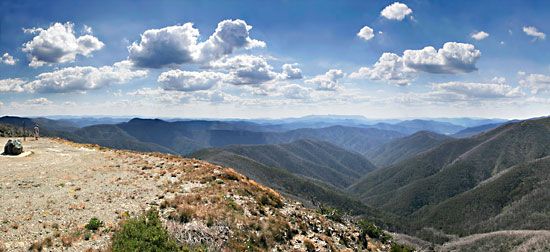
Amambaí Mountains
The Amambaí Mountains are a range of highlands located in western Mato Grosso do Sul state, Brazil, and eastern Paraguay.
What is Amambaí Mountains?
The Amambaí Mountains are a range of highlands located in western Mato Grosso do Sul state, Brazil, and eastern Paraguay.1
Extending south-southwest from Campo Grande for approximately 200 miles (320 km), these mountains form the western edge of the Brazilian Highlands. They serve as a vital drainage divide between the tributaries of the Paraguay River and those of the Paraná River.1
Geologically, the range consists of tabular uplands rather than sharp peaks, with an average elevation of 1,300 feet (400 metres) and a maximum height of 2,300 feet (700 metres). The southern portion of the range marks part of the international border between Brazil and Paraguay, with the principal towns of Ponta Porã (Brazil) and Pedro Juan Caballero (Paraguay) situated within the region.1
What are the Brazilian Highlands?
The Brazilian Highlands are an expansive, eroded plateau region that covers more than half of Brazil’s total landmass. Primarily located across the states of Minas Gerais, São Paulo, Goiás, and Mato Grosso, this region is the country’s primary source of mineral wealth.31
Geography and Relief
The highlands are characterized by a diverse landscape of low mountains, rolling hills, ravines, and flat-topped plateaus, with an average elevation of about 3,300 feet (1,000 meters) above sea level. A massive escarpment marks the eastern edge of the region, extending 1,600 miles along the Atlantic coast and including major ranges like the Serra do Mar and the Serra da Mantiqueira. To the west, the highlands include features such as the Amambaí Mountains and the Mato Grosso Plateau3.314
Climate
The region experiences a humid tropical and subtropical climate. Precipitation is seasonal, with most rainfall occurring as torrential downpours during the summer months (November to April), while winters are generally dry. Temperatures are influenced by elevation, with the highlands remaining cooler than the surrounding lowlands.5
How do the Amambai Mountains influence local river systems?
The Amambaí Mountains serve as a critical geographical feature that influences local river systems by acting as a major watershed divide. This highland range separates the tributaries of the Paraguay River from those of the Paraná River.16
Because of their elevation, the mountains function as a source for several significant waterways. For example, the Apa River rises within the Amambaí range in southwestern Brazil before flowing northwest to join the Paraguay River. By directing the flow of water into these two distinct river basins, the mountains play a fundamental role in the drainage patterns of the region, shaping the hydrological landscape of both eastern Paraguay and western Mato Grosso do Sul.716
What are tabular uplands and how do they differ from typical mountain peaks?
Tabular uplands, often referred to as plateaus or mesas, are extensive areas of elevated land characterized by their remarkably flat surfaces and steep, escarpment-bounded sides. While they share high altitudes with mountain ranges, they are fundamentally different in their topography and formation.
Key Differences from Mountain Peaks
- Topography: The primary distinction is relief. Mountain ranges are defined by peaks, ridges, and complex, rugged terrain. In contrast, tabular uplands maintain a relatively flat, uniform elevation across a broad area.8
- Formation: Mountains are often the result of intense tectonic activity, such as crustal shortening, which creates jagged, deformed landscapes. Tabular uplands can form through different processes, including the thermal expansion of the lithosphere, the deposition of flood basalts, or the erosion of resistant sedimentary rock layers that protect underlying land from denudation.910
- Erosion: While mountains are often shaped by the removal of material into surrounding valleys, mesas and plateaus are frequently defined by the presence of hard, erosion-resistant “caps” that preserve the flat surface as surrounding areas are worn away.10
Sources
- Amambaí Mountains — Encyclopædia Britannica
- list of mountain ranges - South America — Encyclopædia Britannica
- Brazilian Highlands — Encyclopædia Britannica
- Brazil - Climate of Brazil — Encyclopædia Britannica
- Brazil - Brazilian Highlands — Encyclopædia Britannica
- Paraguay - Drainage — Encyclopædia Britannica
- Apa River — Encyclopædia Britannica
- plateau — Encyclopædia Britannica
- plateau - Formative processes — Encyclopædia Britannica
- mesa — Encyclopædia Britannica
- mesa — Merriam-Webster
Published on · 3 min read