American Alligator
The American alligator (Alligator mississippiensis) is a large crocodilian native to the southeastern United States and northeastern Mexico. As an apex…
What is an American alligator?
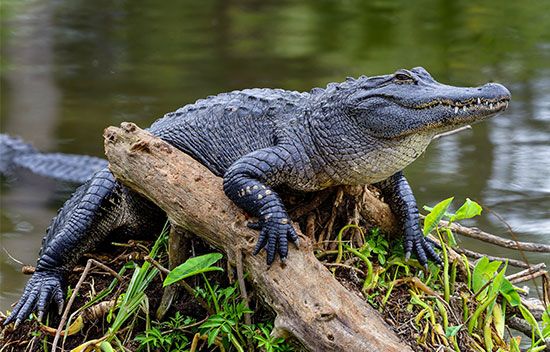
The American alligator (Alligator mississippiensis) is a large crocodilian native to the southeastern United States and northeastern Mexico. As an apex predator, it inhabits freshwater environments such as rivers, lakes, and swamps.12
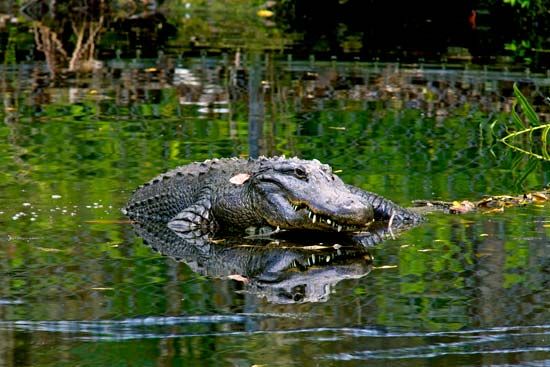
Physically, the American alligator is characterized by a broad, U-shaped snout and an “overbite,” where the upper jaw covers the lower teeth when the mouth is closed. Adults typically reach 3 to 3.4 meters (9.8 to 11.1 feet) in length, though some can grow up to 4.5 meters (15 feet). While juveniles are black with yellow banding, adults are generally brownish or olive-hued black.12
Once threatened by overhunting, the species has made a significant recovery and is currently classified as a species of least concern by the IUCN. They are carnivorous, feeding on a variety of prey including fish, birds, and mammals.21
Where do American alligators live?
American alligators (Alligator mississippiensis) are native to the southeastern United States and northeastern Mexico.3
Their geographic range in the United States extends from the Gulf Coast eastward through Florida, Georgia, South Carolina, and North Carolina, and reaches northwestward into Alabama, Mississippi, Louisiana, Arkansas, and Oklahoma. In Mexico, they are found in the states of Coahuila, Nuevo León, and Tamaulipas.3
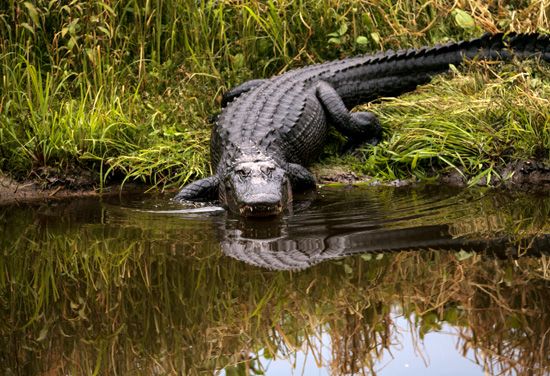
These animals primarily inhabit freshwater environments, including rivers, lakes, swamps, marshes, and other wetlands. While they prefer freshwater, they are occasionally observed in brackish waters and saltier habitats, such as mangrove swamps. They typically live along the edges of permanent bodies of water and often excavate burrows in the soil to rest and escape extreme weather.341
What does an American alligator eat?
The American alligator is an apex predator capable of consuming prey of nearly any size. As opportunistic carnivores, they utilize a quick, snatch-and-grab hunting style, often ambushing prey from beneath the water’s surface or along the shoreline.3
Their diverse diet includes a wide variety of animals, such as:
- Invertebrates and amphibians3
- Fishes, including largemouth bass3
- Reptiles, specifically turtles and snakes3
- Birds3
- Mammals, with a particular preference for nutria3
While their typical diet consists of smaller animals, large adults are powerful enough to take down significantly larger prey, such as deer or cattle. Conversely, younger and smaller alligators are themselves prey for various animals, including raccoons, otters, black bears, bobcats, and larger alligators.13
How do American alligators differ from crocodiles?
Although alligators and crocodiles are both large, powerful crocodilians, they can be distinguished by several key physical and behavioral traits:
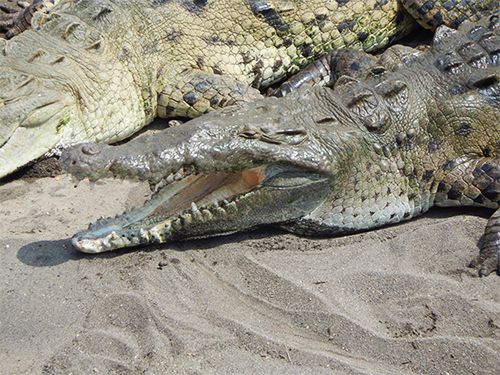
- Snout Shape: Alligators possess a broad, U-shaped snout, whereas crocodiles have a narrower, V-shaped snout.51
- Teeth: When an alligator’s mouth is closed, its lower teeth are typically hidden. In contrast, a crocodile’s lower teeth—especially the large fourth tooth—remain visible outside the upper jaw.51
- Coloration: Alligators generally appear gray or black, while crocodiles tend to be olive or tan.5
- Habitat: Alligators prefer freshwater environments like swamps and lakes. Crocodiles are more commonly found in saltwater or brackish habitats.5
- Temperament: Crocodiles are generally considered more aggressive than alligators, which typically avoid humans.51
Both animals share similar adaptations, such as eyes and nostrils positioned on top of their heads to allow them to remain submerged while observing their surroundings.1
Sources
- alligator — Encyclopædia Britannica
- American alligator — Merriam-Webster
- American alligator — Encyclopædia Britannica
- 7 Crocodilian Species That Are Dangerous to Humans — Encyclopædia Britannica
- What’s the Difference Between Alligators and Crocodiles? — Encyclopædia Britannica
- crocodile - Behavior — Encyclopædia Britannica
Published on · 3 min read