American Crocodile
The American crocodile (Crocodylus acutus) is a moderately large crocodilian that possesses the largest geographic range of any crocodile species in the New…
What is an American crocodile?
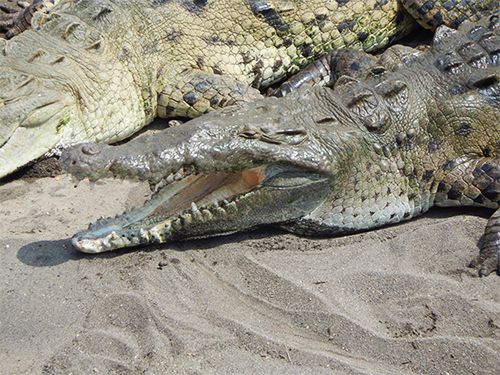
The American crocodile (Crocodylus acutus) is a moderately large crocodilian that possesses the largest geographic range of any crocodile species in the New World. It inhabits freshwater, brackish, and marine environments across a vast region stretching from southern Florida and Mexico through Central America, the Caribbean, and northern South America.1
Physically, the species is sexually dimorphic, with males growing significantly larger than females; some males can reach lengths of 5–6 meters (16.4–19.7 feet). They are distinguished from alligators by their triangular, V-shaped snouts and the fact that several teeth remain visible when their mouths are closed.12
Although they are apex predators that feed on a variety of prey, including fish, birds, and mammals, they are generally less aggressive toward humans than the American alligator. Currently, the species is considered vulnerable by the IUCN and remains listed as endangered under the U.S. Endangered Species Act due to threats from habitat loss, illegal hunting, and hybridization.1
Where do American crocodiles live?
The American crocodile (Crocodylus acutus) possesses the largest geographic range of any crocodile species in the New World. They inhabit a variety of forests, freshwater environments, and brackish or marine intertidal zones across the Americas.1
Their distribution includes:
- North America: Southern Florida in the U.S. and the Pacific coast of Mexico.1
- Central America: Throughout the region, including countries such as Costa Rica, Guatemala, Belize, and Honduras.1
- The Caribbean: Several islands, specifically Cuba, Jamaica, Haiti, and the Dominican Republic.1
- South America: Northern regions, extending from Colombia and Venezuela south to the northernmost parts of Peru.1
What do American crocodiles look like?
The American crocodile (Crocodylus acutus) is a massive reptile with a distinct appearance that helps distinguish it from other crocodilians like the American alligator.
Physical Characteristics
- Snout and Head: The American crocodile has a triangular head with a narrow, V-shaped snout that tapers to a small bulb containing the nostrils.4
- Coloration: Adults are typically grayish green on their tops and sides with lighter undersides. In contrast, juveniles are brownish and feature more pronounced spotting or banding.4
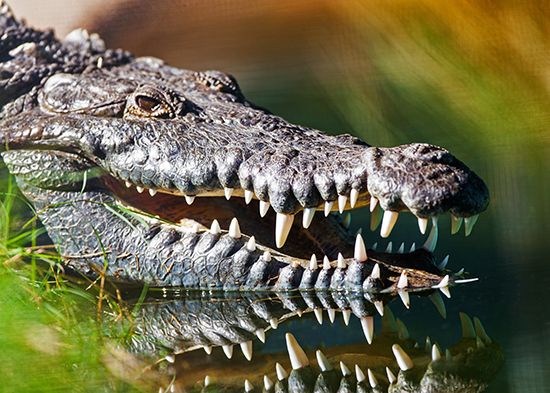
- Teeth: They possess 30–40 teeth in the upper jaw and 28–32 in the lower jaw. A key identifying feature is that when the mouth is closed, several teeth remain visible, most notably the large fourth tooth from the front of the lower jaw.4
- Body and Scales: Their bodies are covered in thick scales with long rows of small bony plates extending down the back and tail, though they are considered less armored than some other crocodilians.4
- Size: The species is sexually dimorphic, with males growing significantly larger than females. Males can reach 5–6 meters (16.4–19.7 feet) in length and weigh between 220 and 450 kg (485–992 pounds), with some large males exceeding 900 kg (1,984 pounds).4
What do American crocodiles eat?
American crocodiles are apex predators that hunt primarily during the evening hours. Their diet changes as they grow and mature:1
- Juveniles: Young crocodiles feed on smaller prey, including small fish and various crustaceans.1
- Adults: Mature crocodiles have a broad, varied diet. They consume insects and small invertebrates, such as crabs, as well as larger prey including fishes, turtles, frogs, birds, and mammals, such as dogs.1
While they generally prefer small vertebrates, they are opportunistic hunters. Although they have been known to attack humans on rare occasions, such incidents are typically provoked.1
Sources
- American crocodile — Encyclopædia Britannica
- American crocodile — Merriam-Webster
- alligator — Encyclopædia Britannica
- crocodile - Size range and diversity of structure — Encyclopædia Britannica
- What’s the Difference Between Alligators and Crocodiles? — Encyclopædia Britannica
- American alligator — Encyclopædia Britannica
Published on · 3 min read