Apatosaurus
Apatosaurus, Diplodocus, and Brachiosaurus are all members of the sauropod group, sharing a body plan of a small head, long neck, massive body, and columnar…
How does Apatosaurus differ from other sauropod dinosaurs like Brachiosaurus or Diplodocus?
Apatosaurus, Diplodocus, and Brachiosaurus are all members of the sauropod group, sharing a body plan of a small head, long neck, massive body, and columnar legs. However, they differ in size, skull shape, and classification:12
- Classification: Apatosaurus and Diplodocus are both diplodocids, whereas Brachiosaurus belongs to the Brachiosauridae family* belongs to the Brachiosauridae family.1
- Skull and Teeth: Apatosaurus and Diplodocus possess slender, elongated skulls with peglike teeth. In contrast, Brachiosaurus has a distinct shoe-shaped skull with large, arched nasal bones and spatulate teeth.32
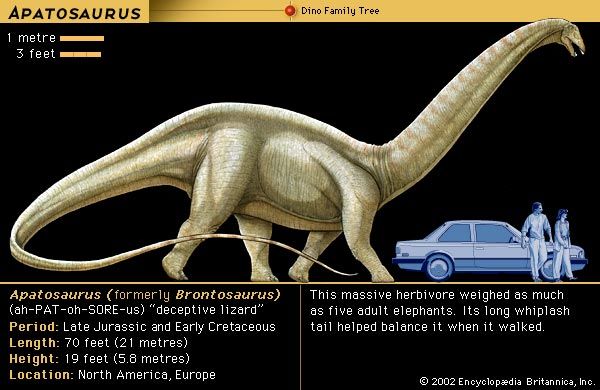
- Size: Brachiosaurus was significantly more massive, reaching weights of 80 metric tons, while Apatosaurus weighed up to 41 tonnes. Apatosaurus typically reached lengths of 21–23 meters, whereas Brachiosaurus could reach 30 meters.13
- Tail: Apatosaurus and Diplodocus are noted for their extremely long, whiplike tails, which may have served as defensive weapons or props for rearing.34
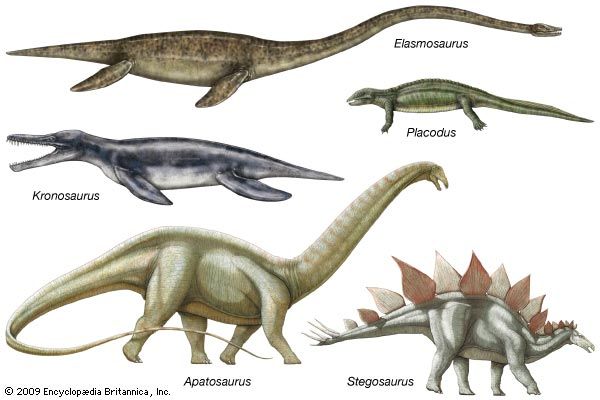
When and where did Apatosaurus live during the prehistoric era?
Apatosaurus lived during the late Jurassic Period, specifically between approximately 156 million and 151 million years ago. Fossil evidence confirms that this giant herbivore inhabited North America during this time.62
Contrary to older theories suggesting that large sauropods were aquatic, scientific consensus now establishes that Apatosaurus was a strictly terrestrial animal. Its skeletal structure, including a heart-shaped ribcage and limbs capable of supporting its massive weight, indicates it was well-adapted for life on land, much like modern elephants.62
What are the key physical characteristics of the Apatosaurus?
The Apatosaurus was a massive, herbivorous sauropod characterized by several distinct physical features adapted for a terrestrial lifestyle:
- Body Size and Stature: It was one of the largest land animals, reaching lengths of up to 23 meters (about 75 feet) and weighing as much as 41 tonnes. It possessed four massive, pillarlike legs that supported its weight on land, with feet featuring horny pads similar to those of modern elephants.62
- Skull and Teeth: Unlike earlier, incorrect models that depicted it with a boxy, snub-nosed skull, the Apatosaurus had a slender, elongated head containing long, peglike teeth, which is characteristic of diplodocids.23
- Neck and Tail: It featured a very long neck and an extremely long, whiplike tail. The tail served as an anchor for powerful hind leg muscles and likely functioned as a defensive weapon.234
- Internal Anatomy: Its ribcage was heart-shaped in cross-section, and its bones were structured to support its great bulk, confirming it was not an aquatic animal.62
What fossil evidence of Apatosaurus has been discovered, and where are some notable specimens housed?
The discovery of Apatosaurus fossils has been marked by both significant scientific breakthroughs and historical confusion. Early descriptions of the genus were complicated by incomplete remains and a misidentification of the skull, which was initially modeled after the boxy, snub-nosed head of a Camarasaurus. This error persisted for over a century until 1978, when scientists rediscovered the correct, slender, and elongated skull of an Apatosaurus in the basement of the Carnegie Museum of Natural History in Pittsburgh, Pennsylvania..com/place/Pennsylvania-state), Pennsylvania.2
Beyond the skull, fossil evidence including skeletal structures and footprints has been vital in proving that Apatosaurus was a terrestrial animal rather than an aquatic one. These findings, which highlight features like elephant-like horny pads on the toes and a heart-shaped ribcage, have allowed paleontologists to accurately reconstruct the animal’s appearance and behavior.2
While many museums worldwide house Apatosaurus specimens, the Carnegie Museum remains a notable site due to its role in correcting the historical record regarding the dinosaur’s anatomy.2
Sources
- sauropod — Encyclopædia Britannica
- Apatosaurus — Encyclopædia Britannica
- dinosaur - Sauropoda — Encyclopædia Britannica
- Diplodocus — Encyclopædia Britannica
- saurischian — Encyclopædia Britannica
- Apatosaurus: Top Questions — Encyclopædia Britannica
- Dinosaur Provincial Park — Encyclopædia Britannica
Published on · 3 min read